
1 September 2025
In this article, I have discussion on five Arthurian Legends cards that deserve more love, a deep dive into some Arthurian lore and how the card mechanics bring this to life, and two fun duel decks that you can build and play.
SPOILER WARNING: There is one mention of a previewed Gothic card in number three on the list, which I have italicised if you want to avoid spoilers.
With Gothic looming on the horizon, I thought I’d take a look through Arthurian Legends and pick out some cards that deserve some more love.
Arthurian Legends is packed with rewarding cards for those who went looking. The set is criticised for having a lower power level than Beta, and while that might be true from a competitive lens, I think the flavour and mechanics of AL are incredible and a step up from Beta. Even though AL has been out for a while, there’s still more to discover and enjoy in this set.
My aim with this article is to encourage players to brew up something cool to take to their next Sorcery meetup and get more mileage out of their cards.
When researching this article, I came across some ancient texts referencing a strange concept. This primitive concept was dubbed ‘fun’. At first, it seemed galling to my indoctrination of pure efficiency and synergy, but I thought maybe we could give it a try in our game. After all, most games of Sorcery are not a tournament finals.
Bonus: All the Kings, Queens, Knights, and Dames.
Before getting to my top five, I just wanted to give an overall shoutout to this category. The complaints and confusion over the Elite-Unique status of the knights and how they appeared in booster packs really dominated the discourse on these cards. I think people were needlessly soured to them before even playing them and they haven’t appeared as widely as they should have.
These cards are all flavour slam dunks and do a great job of representing the characters and lore. I will go on a bit of a tangent here to dive into how the mechanics of the cards do such a great job in representing these tales.
At university, I did a paper on the Arthurian mythos, and I hated it. Having to decipher Middle English, unpick the tangle of different authors, and resist the urge to go to the bar instead of attending lectures, I didn’t get what I wanted or expected to from this paper. I wish they had offered Tolkien instead that year. I would have aced that paper.
In Arthurian Legends, Erik’s Curiosa really did an amazing job bringing these characters to life with stunning art and flavour text – so much so that I dug out my old textbooks and gave them another read. This time, I was able to digest the stories and get so much more out of them due to having these artistic depictions to anchor names to. Reading the stories this time, I realised just how hilarious they are beneath the stuffy prose. Lancelot is seen leaping out of windows, jump-kicking people off their horses, and running mad through the woods because he accidentally slept with someone who was pretending to be Guinevere. I think modern adaptations miss out on the fun and humour, instead being ‘realistic and gritty’. Conversely, the satirical versions take it too far, undermining the humanity, tragedy, and heart of the stories. I don’t expect we’ll get a modern middle ground anytime soon as it seems every Hollywood writer actively dislikes Fantasy and Science Fiction and has a personal vendetta against the authors whose work they’re adapting.
Delving into how the mechanics of the game represent the lore, we can look to the threshold costs of the Sirs and Dames to get a hint into their stories. Each Element gives a starting point:
Earth – The Round Table
Fire – Challengers, traitors, and threats to the Round Table
Water – Avalon, the fey, and folk
Air – Virtues and Chivalry.
Air is the most ambiguous, but the knights with Air threshold seem to be outstanding examples in their field, such as the Earth-Air knights being those who undertook the Grail quest.
Then in two-threshold pairings, there are some clear groupings:
Fire-Earth: Powerful knights of the Round Table from other countries – note that Lancelot is French.
Earth-Air: The Grail quest knights – Bors, Galahad, Perceval.
Fire-Air: More independent knights with more personal quests and events, such as Sir Pellinore and the Questing Beast.
Fire-Water: The traitors Agravaine, Gaheris and Mordred.
Then with the three-threshold knights, we get the most complicated stories, such as Sir Gawain. Gawain is the eldest son of King Lot, Agravaine, Gareth, Gaheris, and Mordred being the other four, but Gawain is the eldest and most loyal to Arthur. So when his brothers plot to bring down Arthur by exposing Guinevere and Lancelot’s affair, Gawain is conflicted and tries to take the middle ground and stay out of the conflict. While rescuing Guinevere from being burnt at the stake, Lancelot kills three of Gawain’s brothers. Gawain demands that Arthur goes to war against Lancelot in France, shattering the Round Table and sealing Arthur’s fate. So Earth-Earth-Fire-Water shows this divided loyalty between his king and family and the tragedy of Gawain ultimately failing both.
Poor Sir Gareth is a real tragedy in the lore. He is one of the most down-to-earth and honourable knights, working to prove himself through his deeds and not rely on his family name. Gareth is ultimately killed by Lancelot in the aforementioned rescue. I guess it’s poetic that the knight who used anonymity to prove himself worthy was killed by the anonymity created by the chaos and brutality of war. I love Gareth’s Sorcery depiction. The life of a knight was more than just martial prowess, and Gareth represents that – honour through hard work, diligence, and self-sacrifice.
As a final lore tidbit, my (slightly tongue-in-cheek) assessment is that Sir Bors the Younger is the real protagonist of the Arthurian mythos. He is there at the start and the end, so his perspective contains all the important events of Arthur’s reign. Bors undertook the Grail Quest with Galahad and Percival, with Bors ultimately being the only survivor. Bors also navigates the diplomatic challenge and love triangle between Lancelot, Arthur, and Guinevere, preventing tragedy for a time and personally putting his own honour and life on the line for his King and Queen. Bors is also a mighty warrior in his own right. It’s unfortunate that modern adaptions malign him so much and turns him into comic relief.
Now, back to the actual cards and mechanics. The general vibe is that these knights are tuned a little bit on the weak side. Maybe that’s the case, but I think that’s preferable to overpowered bombs that displace everything else. But I do think most of these cards are stronger than people give them credit for. Sorcery really excels in creating situations where certain cards can really shine, and it’s up to players to create those situations. I think Captain Baldassare is the perfect example of this. At four-cost three-power, most people dismiss him as he fails the ‘Autumn Unicorn test’ of cost-to-power ratio. But the card advantage he can generate from just a single attack is insane. Seriously, play Captain Baldassare.
In the opening weeks of the set, people busted out Templar with great excitement, and then fed their brave knights into the meat grinder of Earthquake. They didn’t stand a chance. There was also an evil Mage who had access to twice the allocated quakes to add insult to injury. As the meta shifts to being more watery, there might be a bit of room for the knight deck to perform well. Just watch out for a Dragonlord with a penchant for drowning things. It’s worth revisiting ideas and seeing how they stack up when meta conditions have changed.
A universal truth post AL release is that it’s extremely punishing to miss on threshold. Going into Gothic, the Atlas remains at 30 cards, so it will only take a small amount of new sites to potentially make Templar more feasible. But for now, Templar stumbling on its sites means that it misses out on its early game advantage through its cost reduction ability, and then with no consistent card advantage, can’t get back into the game. But maybe the strength of Templar isn’t about just playing three drops on turn two. Maybe there’s more to leverage higher up the curve and in enabling combo plays. Definitely more to experiment with this Avatar.
Now, to the actual top five…
5. Sir Kay

Sir Kay gets a special shoutout separate from the previous category as I think he’s the knight with the most potential and the least amount of actual play.
Sir Kay is Tvinnax Berserker with more self-control, an additional point of power, and two more threshold pips. Not being forced to attack is a big upside, as he can attack something weaker than him and then be ready to defend or take a step back so he can be defended by his allies.
Kay, and the other Fire-Earth knights feel like the Voltron knights, where they really benefit from weapons and armour to boost their martial prowess. Kay can put King Arthur’s weapons to great use. Rhongomyniad and Excalibur turn him into a machine. However, there is no bigger blowout than having your minion killed and their equipment stolen, so I think players are a bit wary to play Voltron strategies.
To help with the Voltron strategy, I’m hoping Gothic gives us a card that can help reclaim stolen equipment – something like a Telekinesis for artifacts that you own, with the casting conditions of Burning Hands. This would make a great little cantrip to mitigate the two-for-one risk in playing equipment.
4. Invasion
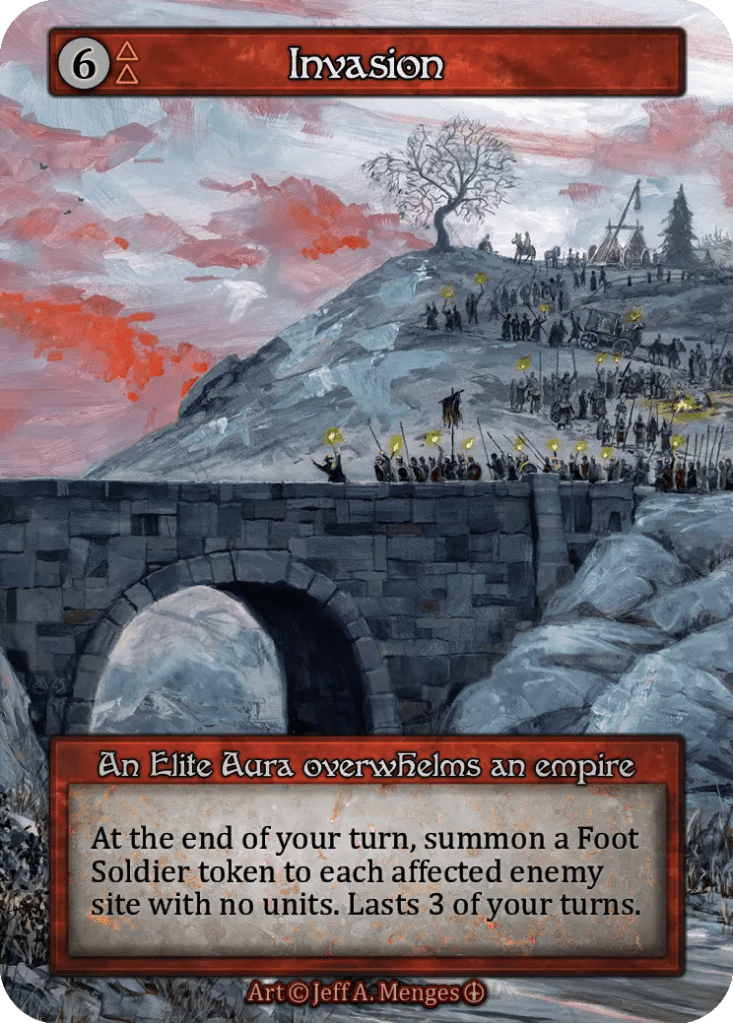
As the card pool grows, we will see more diverse strategies develop within each Element. Currently, Air and Fire are relegated to mostly aggro as the bulk of their pool is just that. There is a smattering of control and ramp cards in these elements, with expensive and powerful cards such as Lord of the Void and Meteor Shower. New cards can help grow these strategies and unlock the playability of these old cards. Occult Ritual is a ramp card we have already in Air, but we’re missing something to really bring it together and make it consistently powerful.
Invasion feels like a control finisher in Fire without enough support. Invasion has also been victim to ‘all or nothing’ thinking. Invasion challenges you to get the maximum 12 Foot Soldiers from it, which is an incredibly generous amount for six mana, so when we only get six or so Soldiers, we feel cheated and that the card has underperformed, even though that’s still a great rate from one card.
Invasion at first glance feels like a card that gives the opponent too much agency. They can prevent you getting Foot Soldiers by playing minions. But in a Fire deck that is daring the opponent to play minions into cost-effective removal, how much agency is that, really?
I have to say I also initially maligned Invasion due to it being slightly antagonistic with Enchantress. If you animate Invasion, then you don’t get any Foot Soldiers that turn as Invasion is now a unit in those sites. However, if you look at the card as a six-power minion with ‘Genesis: Summon four Foot Soldiers. Can’t be attacked until your next turn. Dies at the end of the third turn,’ that still represents four Soldier tokens and 12 damage from a single card. That seems pretty good to me.
Maybe there is potential for a strong Enchantress build in this card pool that plays Invasion, or a Fire control deck that has Invasion as the finisher? There is so much room for creativity and personal expression in Sorcery. I really encourage players to just try different cards and see how they perform. I think Invasion is a powerful card, but it didn’t quite get enough testing. We got 100 different versions of Charge minion Fire Aggro this year and not nearly enough variety with Fire control decks.
3. Pig Trio

Grand Old Boar, Pigs of the Sounder, Squeakers. There was so much excitement for these cards in theory and then not enough players actually sleeved up the deck to play. I think people got put off because someone said one time, ‘They’re worse than Autumn Unicorn, and you should just play Fire minions with Charge.’ I’m here to tell you that these pigs are fun and powerful and are worth giving a go. Here are some upsides you may not have considered:
You can get multiple pigs from one Deathrite. The threat of your opponent getting two Grand Old Boars when you kill their Pigs of the Sounder will have your opponent thinking twice. No such thing as a free attack against these pigs.
Squeakers can be used to protect your other minions from effects like Deserts. Safeguard other weaker minions, like Tawny, by giving them a porcine honour guard.
Squeakers as a late-game top-deck blocker are better than the vast majority of other minions. In the position where an Amazon Warriors is threatening me, Squeakers are better than Autumn Unicorn. Squeakers actually has a chance to high roll into a winning position and turn the tide.
Players will bemoan the randomness of the pigs and then play Headless Haunt. The pigs are like opening a booster pack in the middle of a game.
Amazing flavour. Sometimes when you go hunting and you target the little tasty pigs, you summon the big boar that will gore your king.
SPOILER: Return to Nature is a cantrip in Gothic that puts cards from the cemetery back on to the bottom of the library, so the slot machine can be refilled and repeated.
2. Vanishment

Vanishment is a card that’s been on my radar for a long time, but I never got around to actually testing it properly. I was thinking an Archimago deck with four Fade, four Vanishment could provide a lot of self-sustaining card draw and aggressive pressure. Unfortunately, it was the third Archimago deck I wanted to test, (after Soldier token spam and Riptide spam into Shark) so I didn’t get around to it before Archimago became public enemy number one.
Vanishment runs into the common problem with Magic that interacts with your minions. You have to have a minion on the board first. If you draw the wrong half of the deck, then you’re floundering. I’m really looking forward to the Collection mechanic in Gothic to help alleviate this issue.
To help get these cards played, I’ve devised a pair of duel decks that can be played against each other. The first is a Water-Air list built around Vanishment.
https://curiosa.io/decks/cmevxk850005nii042kxfdho8
I will go into more detail on how these decks play against each other at the bottom of the article after talking about number one on my list, which is…
1. Field Laborers
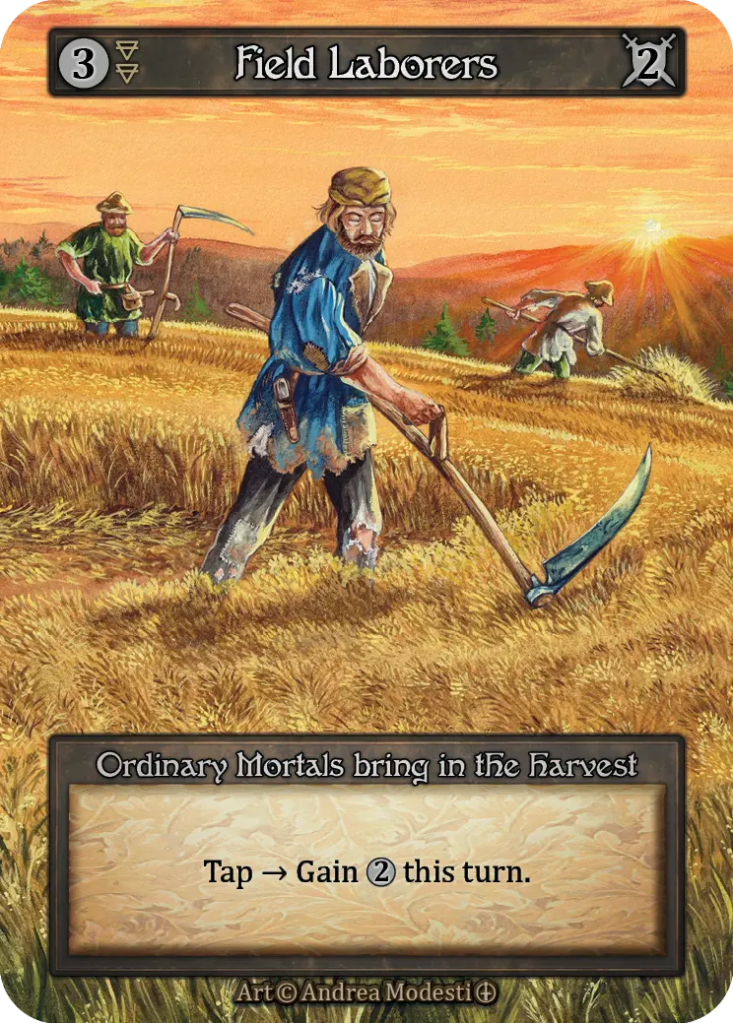
One of the most loved archetypes in many card games is ramp. Being able to play a six drop on turn four is just so much fun. Field Laborers is the most accessible ramp spell we have, as it’s an Ordinary Minion in Earth. This means it can be tutored by Common Sense, giving us access to effectively eight copies in the Spellbook. I really was expecting to see more Sorcerer lists built around wanting to play a turn three Field Laborers and then drawing two spells for the rest of the game.
I think the problem with the card is pretty obvious in this meta. It just doesn’t stack up to a turn two Lugbog Cat off a Pond. Removal is so strong, it’s dangerous to have a whole strategy relying on a single minion. But I think the biggest issue is that Field Laborers takes two Earth threshold, which limits its ability to provide ramp to other Elements that might make better use of the mana boost.
For example, imagine an Air deck leveraging Voidwalk with Field Laborers. It plays three to five sites along the back row, and then challenges the opponent to come to them, whilst your Voidwalk minions attacks the opponent. But the threshold requirements for this concept don’t work, with double-Air, double-Earth, and maybe Water for Ghost Ship. Maybe if Field Laborers was in Air, then it would unlock more deck archetypes than it does currently in Earth? Check out Apprentice Wizard from the early days of Magic – ramp in blue. I would enjoy a similar card in Gothic for Air.
However, back to Field Laborers as an Earth card. The second duel deck leverages Field Laborers:
https://curiosa.io/decks/cmevy5u6j00gjlk04i4heiasu?tab=view
Duel Decks! Vanishment versus Field Laborers
Both Field Laborers and Vanishment feel like archetype-defining cards, so as an added bonus I’ve put together two decks to put these cards to use. These lists are tuned as casual decks to be played against each other. They feature no Uniques and only a small smattering of Elites.
The first deck is an Air-Water Vanishment deck that is trying to stick a minion like Men of Leng and keep up the chain of stealth to dismantle the opponent piece by piece.
Paired against it is an Earth deck with a healthy Common Sense package to help unlock the Pigs package and use the ramp from Field Laborers. It has a nice chunky top end to push through damage.
The challenge when putting these decks together is that stealth can encourage non-interactive play patterns. I don’t want the decks to just turn into a race with no interaction. The Earth deck has one copy of Scent Hounds (that can be fetched with the four Common Sense) and one Hunting Party. The Earth player needs to time when to use these cards to turn the tide against the stealth minions, and the Air-Water player needs to be aware of this to not get blown out, and perhaps save a removal spell for these cards. I didn’t include any Hunter’s Lodge in the Atlas as I want the Earth player to be focused on drawing spells to fully utilise the Field Laborers rather than drawing sites blindly for an answer to stealth minions. I’d advise the Earth deck to save a Cave-In to get rid of a stealth minions sitting on top of a Mountain Pass.
I also added some Elites that people might not have played in a while. Recurring Specter is a nice mana sink that can clean up Soldier tokens, and Thundering Giant is another AL Elite that deserves a bit more love.
There’s also only one copy of Pudge Butcher and Daperyll Vampire in the lists as they’re such iconic cards and deserve a slot, but they are such bombs that they might be too strong for the format.
I think duel decks are a great way to get some mileage out of cards that might otherwise be sitting in bulk boxes. Sorcery has that board game vibe, so having some decks ready at hand is always a good idea. These decks can be used to help guide newer players through some more advanced mechanics and strategies after the precon experience.
Conclusion
I am obviously excited for Gothic. Even when I’m trying to talk about Arthurian Legends, Gothic just pops up into the discussion. There will be fun new archetypes and strategies in Gothic, but I’m excited to see what Gothic can do for the 600-plus cards we already have. A single new card can bring a dormant strategy to life. The Collection mechanic is also a blanket boon to everything. I think it will really unlock a lot of potential in the game and bring life to so many cards and strategies.
But until that time, there is still so much juice left in Arthurian Legends. It’s an amazing set to draft and play sealed with, so I highly recommend people to give these formats a go instead of just ripping packs for Unique foils.
What card do you think deserves more love? There’s still plenty of hidden gems in Beta. It would be great to hear your feedback on this and on the duel decks.
 Bardsword Sorcery Blog
Leave a comment