
11 December 2025
My first article for Bardsword was written six months ago. In it, I speculated about the future and designed five cards that could possibly appear in Gothic. Now the set has released, I can evaluate my speculation and see how close my attempts were. Did I get five out of five correct? To see my reasoning in full, please read the first article: https://bardsword.com/2025/06/16/five-predictions-for-gothic/
1. Everyone Loves (Hates) Frogs
This was my first design:
Lily Pad Pond.
Water threshold.
An Ordinary Site emits a lonely croak.
Genesis – create a submerged Frog token.
And the card that Erik’s Curiosa printed:
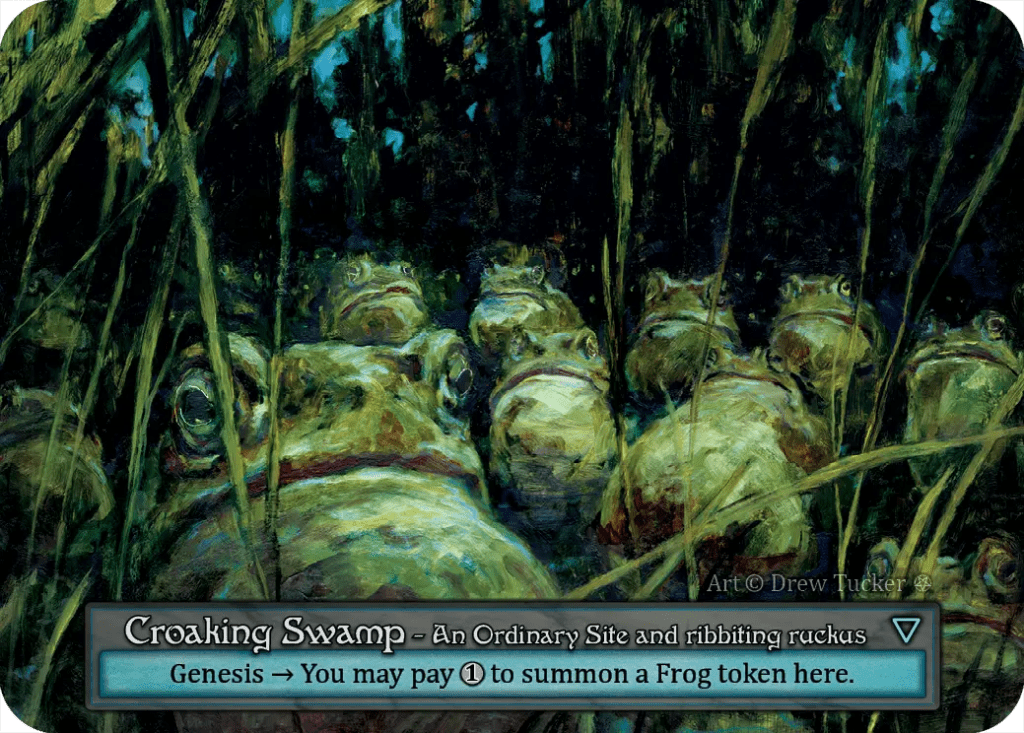
I was pretty close. I debated between paying 1 for a frog compared to getting it for free but submerged. In my design, I like how it’s different to the Ordinary villages. This gives a bit of a flavour and mechanical difference to how the two elements play a similar Site.
A flavour distinction between the two designs is the number of frogs depicted in the art and type line. My site depicted a solitary frog, and Croaking Swamp depicts a slimy horde. This could be one of those situations where the art received from Drew Tucker determined the final outcome.
One of my thoughts behind Lily Pad Pond was that I saw a need for new tokens in Gothic, whether Minions or tools similar to the Lance token. However, the Collection solved that problem wonderfully. Now we don’t need 100 different tokens, ever increasing over the years. Having ordinary cards in the set function as tokens is an elegant solution.
Verdict: One point. I think I was pretty close. Though, I feel like this was an easy one, but you gotta start with a freebie.
2. Coat of Arms
For my second design, it was a two for one, exploring tribal effects. ‘Tribal’ is a concept featured heavily in Magic the Gathering, where creature (minion) type matters, and then you have payoffs and other benefits for building your deck around a singular type. It is a popular mechanic, and one of my favourites to build around. Onslaught block with its Elves, Goblins, and Clerics was my favourite era of Magic. How could Tribal work in Sorcery? I predicted that Gothic with its undead flavour would benefit from a new token minion. Skeleton felt like the logical pick for that. So here was my design for a card that produced Skeletons:
Rank of the Damned.
3 cost. Air, Air Threshold.
An Exceptional Magic that demands service.
Choose a row. Summon a Skeleton token to each site you control in that row.
In Gothic, we received two cards similar to my design:


So again, I was close. Both these cards deploy Skeleton tokens with a placement restriction. Raise Militia is essentially Border Militia for Skeletons. My design differentiates itself from Border Militia in that you have choice in where they are summoned.
In both my first and second design, I struck out by overcomplicating the design to be deliberately different from Earth cards. But is that distinction worth the added complexity? It seems the design team prefers that functionally similar cards play the same way to prevent confusion, and slight flavour or element identity quirks aren’t worth adding complexity to gameplay. I can see merit in that, so I will be keeping that in mind if I design cards in the future.
Undead Ambush at Exceptional gets to be a bit more powerful and a bit more complex, and the flavour and execution of this card is fantastic. The optimal result is receiving four Skeletons for three mana, but there is a subtle restriction to this determined by the amount and placement of sites in play when you cast the Ambush. The power and flexibility of this card grows as the game goes longer as there will be more sites. Also it’s interesting to note that you get more tokens if you use it aggressively to the middle of the board rather than defensively around a minion attacking your back row.
So, while I was correct in guessing at the existence of Skeleton tokens, I had also guessed that there would be Cultist tokens. Cultists would have an ability where they could sacrifice themselves for mana to pay for your big monsters. Whilst we didn’t get Cultist tokens, we received many cards exploring this design space. Gnarled Wendigo, Temple of Moloch, Dormant Monstrosity all conjure images of ravenous cultists bringing forth dark designs, but without having to require a whole new token cluttering up the board. The design team certainly knows how to be elegant and considered. Opting to only have a single new token minion in the set is absolutely the right choice.
My second tribal design was around upgrading your Skeleton tokens:
Scholomance.
Air threshold.
An Elite Site of profane knowledge.
Your Skeleton tokens gain Spellcaster.
Tap four Spellcasters here to draw a card.
After seeing the Necromancer and how easy Skeleton tokens are to produce, this site would have been broken. Also looking at my card now, the wording is incorrect, and it should be Spellcaster ‘here’. Or was my intention to give them Spellcaster everywhere? That would have been silly.
Now that I reflect on Scholomance, I like the flavour, but I dislike the execution. This site is pretty uninspired, and card draw should be harder to come by. We already have Standing Stones if we wish to educate our undead friends to the ways of being a Spellcaster, and we can take them to a Necronomiconcert if we desire card draw from them. I think Necronomiconcert is a great example of how many hoops should be jumped through for a payoff of cards, and my Scholomance offers neither an interesting mechanic or rewarding payoff.
As for tribal payoffs in Gothic, we got quite a lot. First are the power boosters – Death Knight and Fallen Angel. It’s interesting to note the subtle differences between these two cards. Fallen Angel itself isn’t a Demon, which is subtle but incredibly evocative. We also didn’t get a similar design for Monsters, which showcases the differences between the three Evils.
We also got Undead payoffs in the forms of recursive upgrades – Bone Jumble, Barrow Wight, Fowl Bones, and Zombie Bruiser. These are great designs as everything you need is on the card, which reduces the mental load of having to remember multiple things at once as you start to layer different bonuses and buffs. The downside to Tribal in Magic is the constant calculation required to update power and toughness and changing abilities every time a creature enters or dies.
So, all up, I was correct about Skeleton tokens, wrong about Cultist tokens, and off-base with the tribal payoff. Considering I gave myself the easy point for my Lily Pad Pond design, it’s fair that I don’t give myself a point for this category.
3. An Avatar of Sites and Aggression
Gothic gave us a plethora of new Avatars. But the Avatar design that I was so confident the game needed was nowhere near any of the 13 we received. My design was:
Titan – 2 power.
Your Avatar shapes the land through mighty deeds.
When Titan kills a minion, replace an adjacent Rubble with a site from your hand.
The glaring problem with this Avatar design is that it needs other cards to function, namely things that generate Rubble. I designed Titan with Hamlet’s and Castle’s Ablaze in mind, but that restricts Titan to Fire. One of the most successful aspects of the Gothic Avatars is that they aren’t restricted to any one or two elements, so Titan fails in that regard.
A fix to Titan would be to change the ability to: ‘When Titan kills a minion, replace an adjacent Rubble with a site from your hand or an adjacent void with Rubble.’ But more words doesn’t equal more interesting (a note for myself).
I do enjoy the payoff and interaction between attacking and playing sites. One of the limitations of Titan is what happens if the opponent doesn’t play any minions to fuel our ability? At least Battlemage gets to hit for three. The new minion Bitten is a great design space to address this problem, so perhaps in the future we might see this design space explored further.
This one, I will give myself zero points for. This was my first design where I would either be completely right or wrong, so no wriggle room here… though, technically, with the right combination of Avatars out of Imposter, can we cobble together Titan?
4. An Unordinary Tower
I believe that the three Ordinary Towers in Alpha-Beta are problematic for design. They are powerful ramp effects that must be considered in every deck. Often you will see decks that don’t run any Air cards run one of each of these Towers to get that boost of mana to play minions above curve.
I picked that we would get the fourth Ordinary tower in Gothic mainly because it felt obvious. Gothic didn’t seem like a place we’d find a desert. I was definitely wrong there. Mechanically, Deserts are the perfect counter to both Ward and Skeleton tokens, and the beauty of the world of Sorcery is that you can have anything anywhere anytime.
My design for this category was:
Crumbling Castle. No Threshold.
An Exceptional Site that is doomed to disintegrate to dust.
Genesis – gain Three this turn.
At the start of your turn, replace Crumbling Castle with Rubble.
Crumbling Castle would have been great with Titan. And as I said in the previous article, the three mana burst would have been far too strong. So this design was problematic because the numbers didn’t work. Though, we did see cards in Gothic that suggest that the team were working through this tower problem. Ultimately, their solutions were fascinating:
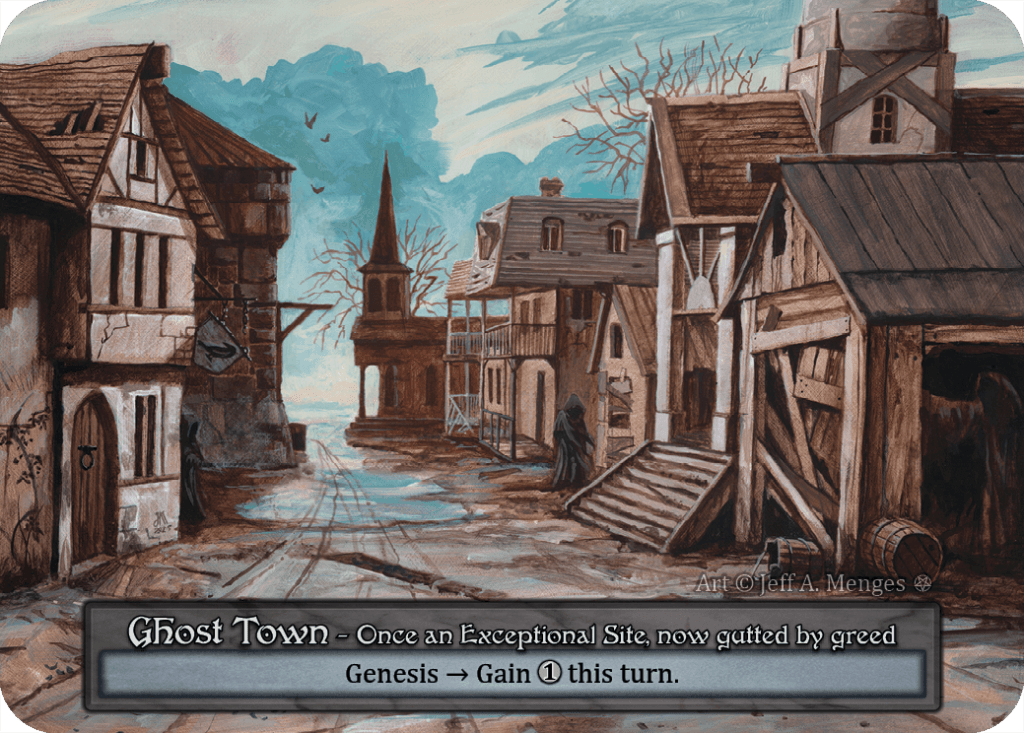
The fix to the Ordinary towers is to… make a stronger card? The benefit of Ghost Town is that it doesn’t have the limitation requiring it to be your only copy in play. There is something incredibly unsatisfying about playing your second copy of Gothic Tower in a game, or worse yet having to Mirror Realm a Lone Tower – ew.
Going forward, Ghost Town will save me thousands of mouse clicks in Curiosa as I can just add three copies of Ghost Town to a deck instead of typing and clicking each individual Tower in ‘quick add’.
However, are the Towers still better? Atlantean Fate is one of the best cards in the game, and the counter is to have Ordinary Sites. So is there any benefit to three Ghost Towns over three Towers? The only one I can think of is to prevent Avatar of Air from puffing all over you.
We also got four Unique sites that can provide a constant two mana a turn with some serious downside. These are City of Plenty, City of Traitors, City of Glass, and City of Souls.

I think these sites will be strong, but they do require a bit of finesse. They can’t be jammed into every deck, which is a sign of good design, but they will greatly benefit those who put in the effort.
My initial thought was how to turn on and off threshold so you can benefit from the Cities on your turn and deny it to your opponent. The Bloom Ordinary sites can do this, and I think there might be a worthwhile deck in that concept.
Returning to my design of Crumbling Castle, I do think sites that turn into Rubble is an interesting design space. I was hoping for more Rubble generation in Gothic, and we got this incredible Ian Miller site:
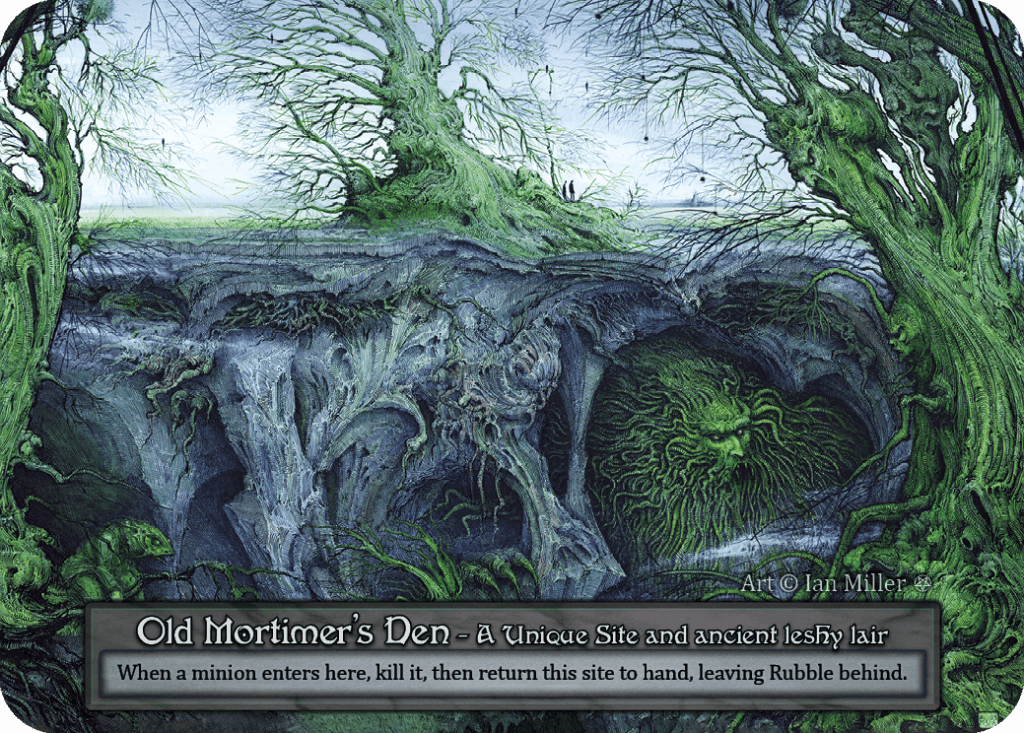
Old Mortimer’s Den might be my favourite site in Gothic. I have been a fan of Mariner’s Curse since Alpha, and using forced movement effects to kill your opponent’s minions is so much fun. I think Mortimer will warp games, where your opponent is incentivized to play more sites than they’d like to prevent you from replaying the Den freely turn after turn.
In regards to all this Rubble talk, I have been experimenting with Geomancer in non-Earth decks, using site destruction and other effects that leave Rubble behind to then get free Sites from the Avatar ability. Mono-Fire Geomancer has been a fun little project, but it might be dead with a 60-card spellbook. Send me a message if you want to learn more about this.
So, do I deserve the point? Probably not. But it did generate some good talking points. Did we get a King Gizzard and the Lizard Wizard reference in Gothic? Not that I’ve noticed. We did get a Ten Ton Slug reference for fans of Doom and Sludge Metal.
5. Jesus Christ
My most controversial pick. Would Gothic give us a depiction of this iconic figure? Looking through the set, we got many Biblical references, named angels and demons, and even real-world historical figures such as Rasputin and Jack the Ripper. We even got Judas named on Kiss of Judas, so this shows the extent that Erik’s Curiosa is willing to use these references and risk potential public outcry. Here is my design for the big man:
Jesus Christ.
A unique Mortal of the divine trinity.
4 Cost – Earth, Water threshold. 0 power.
Other minions nearby can’t be destroyed.
So did Gothic give us Jesus? I say, yes, it did.

The flavour of this Unique minion ticks many boxes that we’d expect to see for Jesus, chiefly the redemption of evil. The art itself certainly suggests a divine and powerful figure.
My mechanic is similar to the Saint of Redemption, both focusing on preventing conflict between Minions. My choice for Jesus to be Earth and Water is confirmed to be on the right path by Garden of Eden in Gothic.
Now, my wild prediction is that there is a Curio version of Saint of Redemption with Jesus Christ as its name with new art. Perhaps it will have similar gilding to Unladen Swallow and the Sir Curios from Arthurian Legends, in the fashion of illuminated manuscripts.
So far in Gothic, we have seen seven curios, which doesn’t feel like enough based on how many we saw in previous sets. But the quantities in which these have been found suggest a certain possibility. Beta was distributed in waves, demarcated by differences in colour saturation. Perhaps if there is to be three waves of Gothic releases, we will see the Curios released across waves, seven in the first, six in the second, and five in the third, for example.
So, until we have all the Curios accounted for, I maintain that I am correct on this point. And give myself the point.
Extra Credit Bonus Round
So, I had an extra bonus prediction regarding the release date for Gothic. I had picked a Halloween release date for flavour reasons, and it did seem like a likely spot based on other events like the Crossroads. It was also Friday, which is the perfect day of the week. Some pundits were picking 2026 dates, so I’m glad that wasn’t the case – apologies to our friends in Europe, Australia, and Brazil who haven’t got product yet.
So, not releasing on Halloween seemed like a missed opportunity, but then I discovered (from watching a year-old MeatCanyon video) that December 5th was also thematically appropriate – Krampusnacht. In many European countries, the night of December 5th is when they celebrate Krampus, so ultimately the fifth was the perfect date for Gothic.
Conclusion
So, how many points would you give me? Six out of five? That’s very generous. Thank you.
I was more incorrect than correct, but I had a lot of fun thinking about these possible designs. I enjoy deliberating and thinking through the ramifications of cards more than designing them from scratch. Design and development should be a collaborative process, and there’s only so much I can do by just throwing out ideas without any testing and conversation.
I think Gothic is a beautifully designed set, and the team really hit high marks in terms of interesting game mechanics and elegance in function. So five out of five for Erik’s Curiosa.
I greatly enjoyed the first week of Gothic. I attended two Sealed events and a draft, and got to play a handful of matches of Constructed on Tabletop Simulator. Over release weekend, I managed to place first at all three Limited events, going 11-0 overall, so I’m happy with my performance. Gothic looks to be another excellent set for Limited play, and I’m looking forward to many more events throughout the year.
 Bardsword Sorcery Blog
Leave a comment