
15 January 2026
A new year, a new set, a new meta, and we’re starting to see shapes form in the primordial soup. In this article, I’m going to point to a couple of things that are worth considering in this nascent meta. It’s far too early to say anything with certainty, but there are some early frontrunners to be prepared for. I’ll highlight a couple of Avatars and an archetype to be wary of during this time of discovery.
Overall, Gothic is a home run, and the amount of exploration required is off the charts. My Curiosa is chockful of decks I’ve brewed up, and I’ve got a couple of pet decks that I’m putting through the paces. So far, my three favourites are Water-Air Imposter, Fire-Earth Persecutor, and Mono-Air Pathfinder. I haven’t had the chance to play any Battlemage yet, but my old favourite is calling out to me.
At the end of the article, I will go over the Imposter list I played in the recent Online League Championship and how the deck has evolved since then.
SCG Atlanta
SCG Con Atlanta fired this past weekend. This was the first SCG event that wasn’t a Crossroads-level event, so perhaps this affected the decks that people played. Reports from community legend Pete state that in the top 17, there were 16 different Avatars, with Interrogator being the duplicate. This is fantastic and reinforces my optimism for Gothic. This shows that curiosity and creativity is high as players are exploring a wide range of decks and Avatars.
Is Interrogator Too Strong?
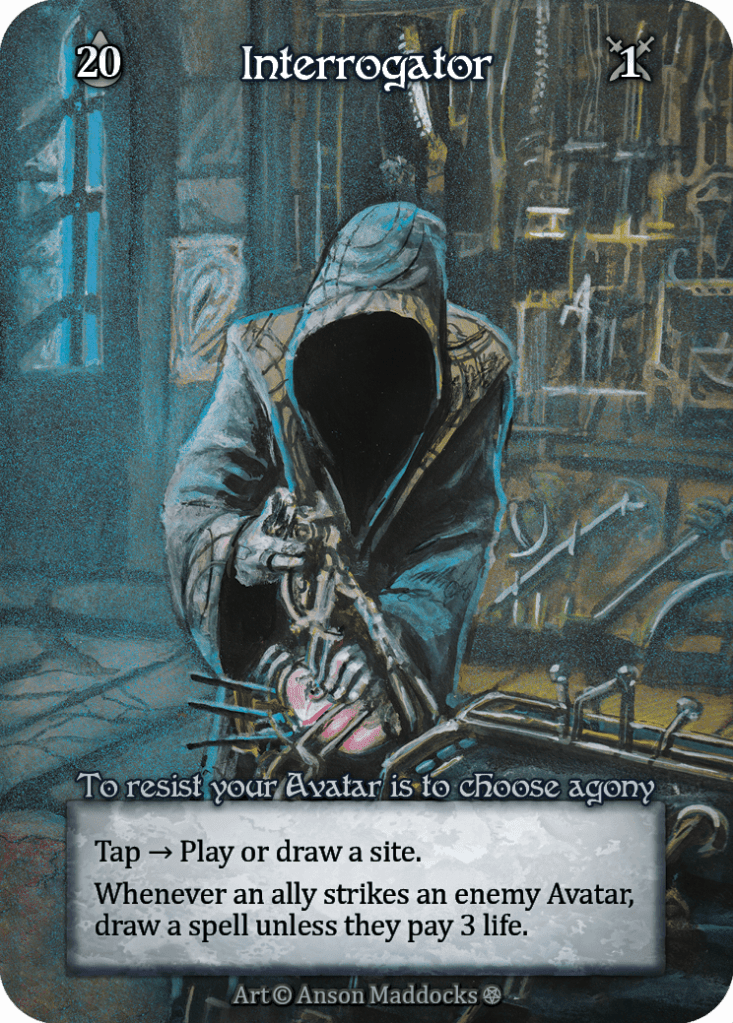
Interrogator was my pick for the Avatar that competitive players would lean towards as it combines aggression and card draw. I was worried that Interrogator might be an early problem, but after playing with and against it, I think its power level is acceptable. It’s strong, but there is sufficient counter-play.
Most Interrogator lists I’ve seen lean towards Air and Fire with cheap minions to put early pressure on the opponent and then keep the foot on the accelerator. My experiments into Interrogator took a more midrange approach, using Pudge Butcher and Meat Hook to bring the opponent to me, and then take bigger chunks out of their life to make it more unappealing to deny the card draw. The new Earth site No Man’s Land is a boon to this strategy, so beware the Pudge.
The weakness of the Interrogator is that the opponent knows what you are up to and gets a choice to thwart your efforts. My advice in brief is to give the Interrogator cards when they have too many cards in hand to play effectively and take the life damage when the Interrogator is running short on cards. If Token Interrogator strategies become popular, Briar Patch and Troll Bridge are good choices. Avatars with high power such as Persecutor and Avatar of Earth force the Interrogator to trade their small minion if they want to trigger their ability.
One of my core mantras with Sorcery is that if you give the opponent a puzzle to solve, they will solve it – and in the way that’s most detrimental to you. Interrogator is such a puzzle, and you have options to mitigate its strength.
But I am grateful that there are viable aggro decks in the format, as it’s essential to have a mix of aggro and control decks for a healthy and balanced meta. I expect that we will continue to see Interrogator throughout the year, so make sure to get some practice in against it.
Water World
Throughout 2025, the meta shifted slowly. Water went from being viewed as the weakest element to becoming a dominant force. Crossroads Melbourne cemented this assertion, and we left Arthurian Legends with a fear of water in our hearts. It’s no surprise that players have continued to explore this space into Gothic, and we are seeing Water emerging as the frontrunner as the dominant element.
So what was it that allowed Water to rise to power in 2025? The first horseman of the water apocalypse was Lugbog Cat. Initial assumptions had it as a Autumn Unicorn with restrictions. Autumn Unicorn had been the benchmark for minions in Beta, but was beginning to fade in popularity. Earthquake was the premium removal spell in the game, so Water sites were a more common countermeasure. This meant that Lugbog Cat’s inherent limitation became a strength. Pond was the second horseman, allowing aggressive plays and cost-effective turns. The only thing worse than a turn-two Lugbog Cat is a turn-five Lugbog Cat into Grapple Shot to take out your valuable minion.
Troll Bridge was the third horseman. A ‘Free City’ with Water threshold meant that Water had a powerful, repeatable, and essentially free source of board control out of the Atlas. A fantastic early defensive play turned into a removal spell in combination with forced movement effects such as Riptide.
Now Water has the benchmark minion of the meta and an Atlas packed with powerful sites, so players start pushing the envelope and going heavier Water to play powerful cards such as Mesmerism and The Green Knight. By the end of 2025, players were thinking mono-Water might be viable, but no one was brave enough to test it at high level tournaments. Then Mirror Realm team took Melbourne Crossroads by storm with their Mono-Water Druid. But even then, Mono-Water relied on clever plays, careful consideration, and perhaps an overpowered Avatar to reach its potential.
Going into Gothic and spellbooks increase to 60 cards. Mono-Water was having a hard time packing enough punch with 50, so would Gothic give us enough for the archetype to function? If anything, Gothic gave Water too much good stuff. Failed Mutation, Sacred Stag and Lacuna Entity give us great four and five drops to curve out following a Lugbog Cat. Ward, Voidwalk, ‘can’t be damaged by Magic’ means these minions can be played around the board to dodge area-of-effect removal spells like Earthquake and Poison Nova. Gnarled Wendigo, Gilman House, and Dormant Monstrosity allow for insane plays in decks with token minions, such as Necromancer. Watch this video from Old Fashioned Nerds for an excellent breakdown of the deck you need to be very, very frightened of: https://www.youtube.com/watch?v=ilZLOYMwzq8
But with so many great Water cards, what is my fourth horseman of the Water apocalypse? Could it be Lord of Lies, the ultimate Pudge Butcher? No, it’s another site – Thin Ice. Thin Ice pairs perfectly with Troll Bridge to give incredible board control, and forced movement effects make it feel incredibly oppressive. Coy Nixie on a Thin Ice is the last thing you want to see if you want to play minions.
So, if you’re brewing and testing decks, you need to have a heavy Water deck in the line-up. This is an archetype you need to be prepared to play against.
So, how do we beat it? It’s a tricky one. Drought off a Silver Bullet I fear doesn’t even achieve anything as Water is no longer reliant on having a continuous body of water for many of its cards.
Iceberg is a cute card to stifle Coy Nixies. But if the answer to Water decks is other Water decks, you’re better off playing your own Thin Ice instead of a marginal corner case card like Iceberg.
Site destruction and nullification is useful. Fields of Phyxis and Smokestacks of Gnaak are strong choices, and don’t sleep on Leadworks. Sometimes a single turn is all you need to break through the opponent’s defenses and win the game. I’m sure we will see Fire-based aggro decks in the new meta, perhaps Sorcerer or Witch Fury Road style decks, or maybe something leveraging Saviour’s ability to benefit from Lances and Lethal minions.
Battlemage, Bladedancer, and Avatar of Earth are Avatars that can win without minions. If you can get under the Water deck’s curve, then you can put them on the back foot. Just be careful of having Lord of Lies played on top of you if you go to the opponent’s side of the board, as that will quickly close out the game – and not in your favour.
As for Earth, Zombie Brute has a lot of potential as a recursive answer to Water’s four-power minions. Earthquake is less effective as a removal spell in a Water-dominant meta, but you can still mess up the opponent’s site placement and open up lanes of attack. If in doubt, there’s always Pudge Butcher.
Old Favourites
Despite the plethora of new Avatars in Gothic, I’ve noticed that players are sticking with their old favourites. This is evidence that despite Gothic giving us plenty of new toys, power creep is a non-issue.
It’s a real strength of Sorcery that going into a new set, players are able to keep playing the Avatars and decks that they have come to love. Someone who has been jamming Avatar of Air for three years most likely wants to keep playing Avatar of Air.
So for tournaments early in 2026, it’s likely that your local meta will be similar to what it was at the end of 2025. If a player loved playing a certain deck, they will probably continue to play it, especially in tournaments where familiarity and practice goes a long way to success. Just be wary of players who have been grinding away on Tabletop Simulator as they will likely have something new up their sleeves and the experience to back it up.
Don’t Let Archimago Get Away With It!
During spoiler season, everyone saw the plethora of cemetery hate and assumed that Avatars relying on cemetery recursion were dead, chiefly Archimago and Deathspeaker. But that’s only the case if people actually play graveyard hate!
Early on, everyone wants to play with the splashy and fun cards and not bother with the boring fundamentals like cemetery hate. Fire decks want to play aggressive sites like Road to Perdition, not Plague Pits.
If there was a big tournament this month with prizes on the line, I’d pick Archimago to win. So, make sure you’ve got answers in your Collection to grab with Toolbox, if nothing else. Erik’s Curiosa has given us answers, so it’s up to us to play them.
My Imposter

At the end of Arthurian Legends, I was playing a Water-Air Faerie Pathfinder that was a lot of fun. Helpful Hob was the VIP in that deck, allowing Pathfinder to ramp from four to six, whilst also being a damage doubler and Blink impersonator.
My first thought upon seeing Imposter is, “I can play Pathfinder with a better Atlas,” so this was the direction I took the deck. Imposter also has a much better late game than Pathfinder as it can turn into a card advantage Avatar, such as Sorcerer.
One of my 2026 resolutions is to get involved with the online Sorcery League. So when the League Championship 2025 was announced, I thought I’d better get a head start and start playing. This was my list:
https://curiosa.io/decks/cmj6o8na92n6m1afq0lvp1pwl
It still shows the signs of the Faerie deck it morphed from, including the full suite of Helpful Hob. Sling Pixies is there because I needed something to save me from early aggression without being a dead draw later in the game.
This deck has a site disruption plan. The Great Drowning of Men has been fantastic every time I see it. Ramping to seven or eight sites with Pathfinder, turning into Realm Eater to knock the opponent back a site or two, and then turning into Geomancer to get more free sites off the rubble has been incredibly powerful and fun for me (less so for my opponents).
This list is missing Omphalos. At the time of making this deck, I wanted to only play cards I had in paper. This was definitely a mistake for an online league. I think the jury is still out on just how powerful and game-defining the Omphalos will be, but the safe assumption is that card draw is always good, so they will be good.
The standout card from this deck is Winter Nymph. It’s an incredible card. It slows down aggressive decks. It shuts down the opponent’s blockers to help you close out the game. It’s a way for Water to deal the finishing blow. Charge minions are the greatest threat to Imposter, chiefly Gyre Hippogriffs and Saracen Raiders, so Winter Nymph is a great solution to these.
The championship league is single elimination. I won my first game, and was knocked out in my second. I’m a bit salty towards the TTS shuffler, as I saw seven Helpful Hobs across the two games, and in the game I lost, I didn’t see any Air threshold across 12 sites whilst having three Air spells stuck in my hand from turn three. But such is randomisation in card games. Both my opponents were super friendly and the games were a lot of fun, so as is always the case with Sorcery, playing is its own reward.
This league has me excited for Season 10 of the Online Sorcery League. I highly recommend everyone to get involved. It’s free to play, and registration is open now:
https://forms.gle/Ne4z5F4mepKjg8Ln6
So, what changes have I made to my list? Mono-Water has proven to be sufficiently powerful, so I have removed Air from the list to prevent from stumbling on threshold. Goodbye to the Sling Pixies, which never really did anything without Tawny around. Grandmaster Wizard is great to refill the hand, but the Omphalos likely do that better. I’ve sadly removed all the Helpful Hob in favour of Failed Mutations and Sacred Stag. I don’t love this homogenisation as the deck begins to look less like Pathfinder Faeries and more like Mono-Water Necromancer. This feels a lot like the end of the AL meta, where I was debating turning my Water-Air Battlemage into Druid.
What Does the Year Hold?
So, we’ve got a lot to look forward to this year, and it’s still a mystery just where Sorcery will go in 2026. If this year is anything like 2025, the meta will swing in a direction no one could predict. Whilst Water might be dominant now, it could be replaced by something else entirely in six months.
We’re still in the learning phase, and there’s plenty to discover. Once tournaments start firing, we will see things clearer and can declare what is meta. But until then, have fun, play your favourites, and enjoy everything that Gothic has to offer.

 Bardsword Sorcery Blog
Leave a comment