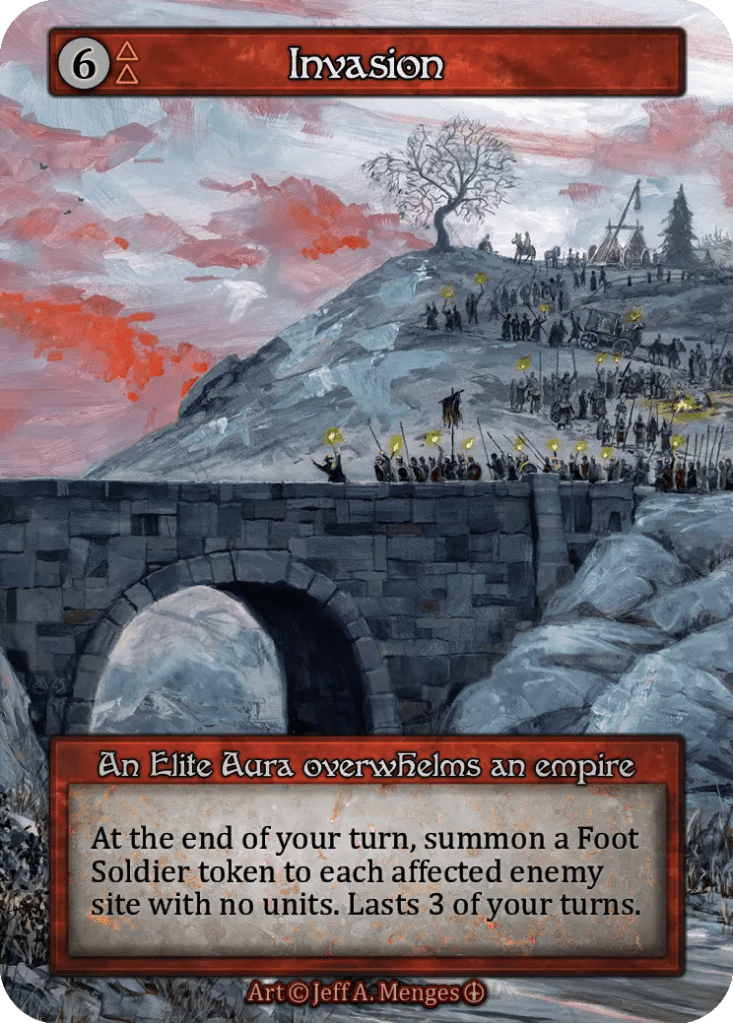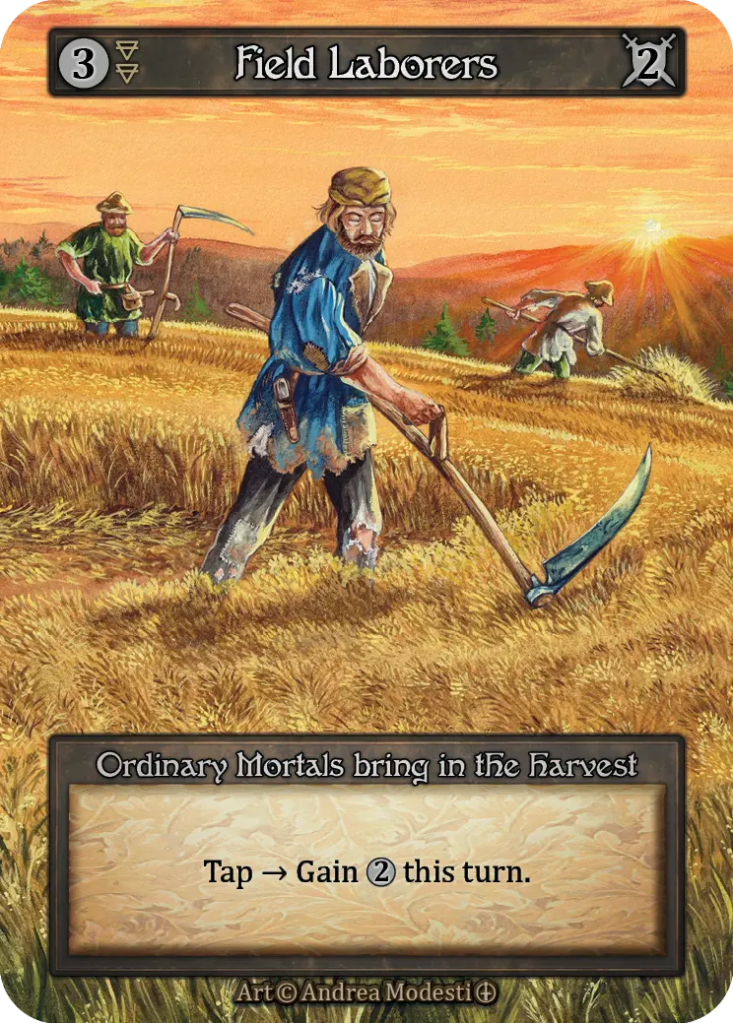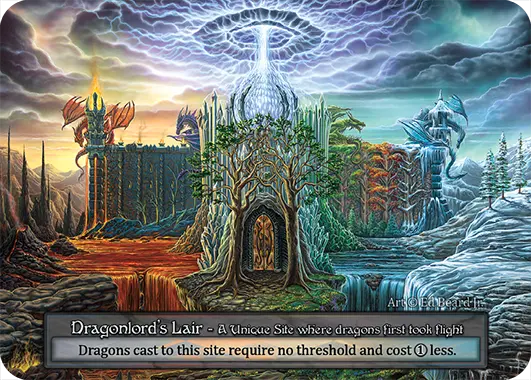
My first article for Bardsword was written six months ago. In it, I speculated about the future and designed five cards that could possibly appear in Gothic. Now the set has released, I can evaluate my speculation and see how close my attempts were. Did I get five out of five correct? To see my reasoning in full, please read the first article: https://bardsword.com/2025/06/16/five-predictions-for-gothic/
1. Everyone Loves (Hates) Frogs
This was my first design:
Lily Pad Pond.
Water threshold.
An Ordinary Site emits a lonely croak.
Genesis – create a submerged Frog token.
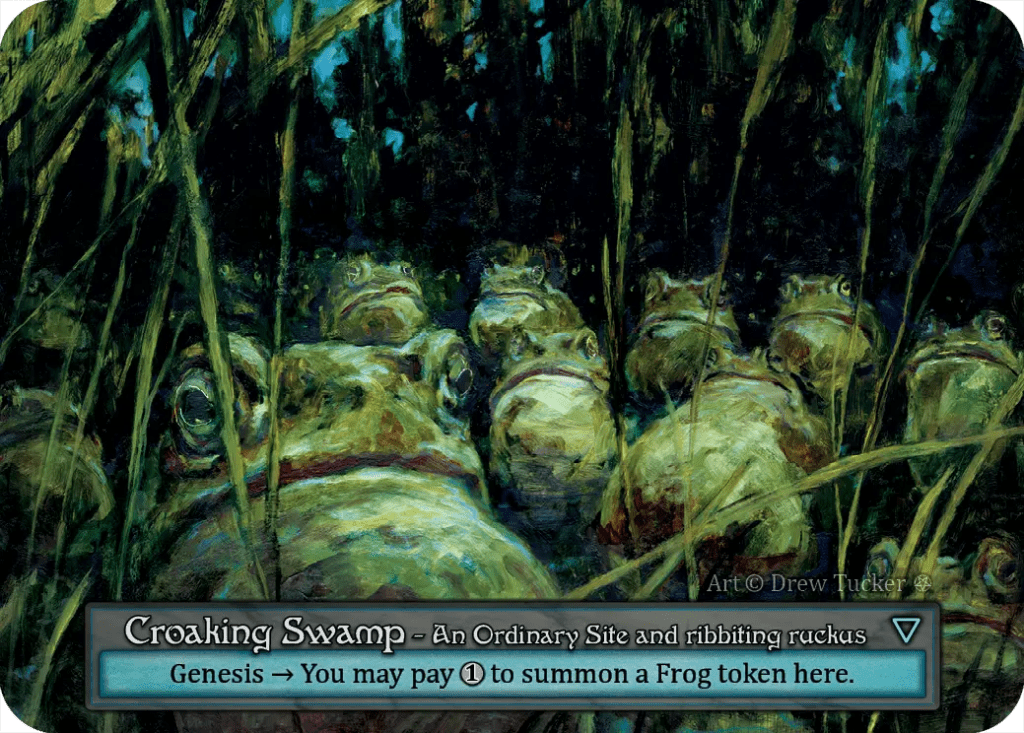
And the card that Erik’s Curiosa printed:
I was pretty close. I debated between paying 1 for a frog compared to getting it for free but submerged. In my design, I like how it’s different to the Ordinary villages. This gives a bit of a flavour and mechanical difference to how the two elements play a similar Site.
A flavour distinction between the two designs is the number of frogs depicted in the art and type line. My site depicted a solitary frog, and Croaking Swamp depicts a slimy horde. This could be one of those situations where the art received from Drew Tucker determined the final outcome.
One of my thoughts behind Lily Pad Pond was that I saw a need for new tokens in Gothic, whether Minions or tools similar to the Lance token. However, the Collection solved that problem wonderfully. Now we don’t need 100 different tokens, ever increasing over the years. Having ordinary cards in the set function as tokens is an elegant solution.
Verdict: One point. I think I was pretty close. Though, I feel like this was an easy one, but you gotta start with a freebie.
2. Coat of Arms
For my second design, it was a two for one, exploring tribal effects. ‘Tribal’ is a concept featured heavily in Magic the Gathering, where creature (minion) type matters, and then you have payoffs and other benefits for building your deck around a singular type. It is a popular mechanic, and one of my favourites to build around. Onslaught block with its Elves, Goblins, and Clerics was my favourite era of Magic. How could Tribal work in Sorcery? I predicted that Gothic with its undead flavour would benefit from a new token minion. Skeleton felt like the logical pick for that. So here was my design for a card that produced Skeletons:
Rank of the Damned.
3 cost. Air, Air Threshold.
An Exceptional Magic that demands service.
Choose a row. Summon a Skeleton token to each site you control in that row.
In Gothic, we received two cards similar to my design:
So again, I was close. Both these cards deploy Skeleton tokens with a placement restriction. Raise Militia is essentially Border Militia for Skeletons. My design differentiates itself from Border Militia in that you have choice in where they are summoned.
In both my first and second design, I struck out by overcomplicating the design to be deliberately different from Earth cards. But is that distinction worth the added complexity? It seems the design team prefers that functionally similar cards play the same way to prevent confusion, and slight flavour or element identity quirks aren’t worth adding complexity to gameplay. I can see merit in that, so I will be keeping that in mind if I design cards in the future.
Undead Ambush at Exceptional gets to be a bit more powerful and a bit more complex, and the flavour and execution of this card is fantastic. The optimal result is receiving four Skeletons for three mana, but there is a subtle restriction to this determined by the amount and placement of sites in play when you cast the Ambush. The power and flexibility of this card grows as the game goes longer as there will be more sites. Also it’s interesting to note that you get more tokens if you use it aggressively to the middle of the board rather than defensively around a minion attacking your back row.
So, while I was correct in guessing at the existence of Skeleton tokens, I had also guessed that there would be Cultist tokens. Cultists would have an ability where they could sacrifice themselves for mana to pay for your big monsters. Whilst we didn’t get Cultist tokens, we received many cards exploring this design space. Gnarled Wendigo, Temple of Moloch, Dormant Monstrosity all conjure images of ravenous cultists bringing forth dark designs, but without having to require a whole new token cluttering up the board. The design team certainly knows how to be elegant and considered. Opting to only have a single new token minion in the set is absolutely the right choice.
My second tribal design was around upgrading your Skeleton tokens:
Scholomance.
Air threshold.
An Elite Site of profane knowledge.
Your Skeleton tokens gain Spellcaster.
Tap four Spellcasters here to draw a card.
After seeing the Necromancer and how easy Skeleton tokens are to produce, this site would have been broken. Also looking at my card now, the wording is incorrect, and it should be Spellcaster ‘here’. Or was my intention to give them Spellcaster everywhere? That would have been silly.
Now that I reflect on Scholomance, I like the flavour, but I dislike the execution. This site is pretty uninspired, and card draw should be harder to come by. We already have Standing Stones if we wish to educate our undead friends to the ways of being a Spellcaster, and we can take them to a Necronomiconcert if we desire card draw from them. I think Necronomiconcert is a great example of how many hoops should be jumped through for a payoff of cards, and my Scholomance offers neither an interesting mechanic or rewarding payoff.
As for tribal payoffs in Gothic, we got quite a lot. First are the power boosters – Death Knight and Fallen Angel. It’s interesting to note the subtle differences between these two cards. Fallen Angel itself isn’t a Demon, which is subtle but incredibly evocative. We also didn’t get a similar design for Monsters, which showcases the differences between the three Evils.
We also got Undead payoffs in the forms of recursive upgrades – Bone Jumble, Barrow Wight, Fowl Bones, and Zombie Bruiser. These are great designs as everything you need is on the card, which reduces the mental load of having to remember multiple things at once as you start to layer different bonuses and buffs. The downside to Tribal in Magic is the constant calculation required to update power and toughness and changing abilities every time a creature enters or dies.
So, all up, I was correct about Skeleton tokens, wrong about Cultist tokens, and off-base with the tribal payoff. Considering I gave myself the easy point for my Lily Pad Pond design, it’s fair that I don’t give myself a point for this category.
3. An Avatar of Sites and Aggression
Gothic gave us a plethora of new Avatars. But the Avatar design that I was so confident the game needed was nowhere near any of the 13 we received. My design was:
Titan – 2 power.
Your Avatar shapes the land through mighty deeds.
When Titan kills a minion, replace an adjacent Rubble with a site from your hand.
The glaring problem with this Avatar design is that it needs other cards to function, namely things that generate Rubble. I designed Titan with Hamlet’s and Castle’s Ablaze in mind, but that restricts Titan to Fire. One of the most successful aspects of the Gothic Avatars is that they aren’t restricted to any one or two elements, so Titan fails in that regard.
A fix to Titan would be to change the ability to: ‘When Titan kills a minion, replace an adjacent Rubble with a site from your hand or an adjacent void with Rubble.’ But more words doesn’t equal more interesting (a note for myself).
I do enjoy the payoff and interaction between attacking and playing sites. One of the limitations of Titan is what happens if the opponent doesn’t play any minions to fuel our ability? At least Battlemage gets to hit for three. The new minion Bitten is a great design space to address this problem, so perhaps in the future we might see this design space explored further.
This one, I will give myself zero points for. This was my first design where I would either be completely right or wrong, so no wriggle room here… though, technically, with the right combination of Avatars out of Imposter, can we cobble together Titan?
4. An Unordinary Tower
I believe that the three Ordinary Towers in Alpha-Beta are problematic for design. They are powerful ramp effects that must be considered in every deck. Often you will see decks that don’t run any Air cards run one of each of these Towers to get that boost of mana to play minions above curve.
I picked that we would get the fourth Ordinary tower in Gothic mainly because it felt obvious. Gothic didn’t seem like a place we’d find a desert. I was definitely wrong there. Mechanically, Deserts are the perfect counter to both Ward and Skeleton tokens, and the beauty of the world of Sorcery is that you can have anything anywhere anytime.
My design for this category was:
Crumbling Castle. No Threshold.
An Exceptional Site that is doomed to disintegrate to dust.
Genesis – gain Three this turn.
At the start of your turn, replace Crumbling Castle with Rubble.
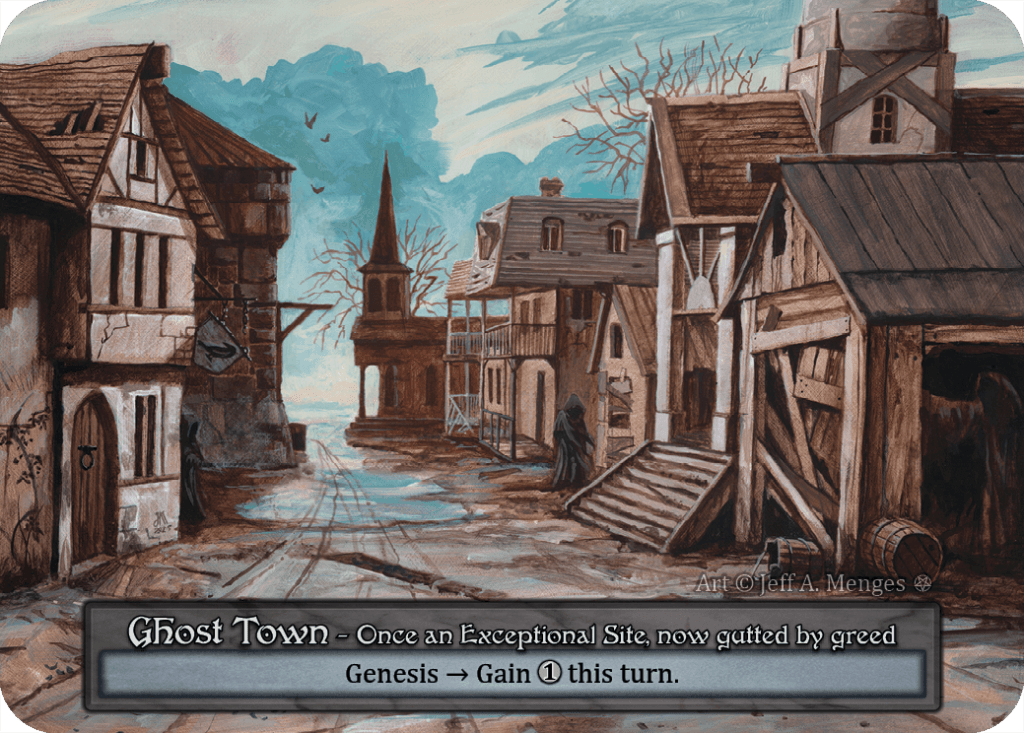
Crumbling Castle would have been great with Titan. And as I said in the previous article, the three mana burst would have been far too strong. So this design was problematic because the numbers didn’t work. Though, we did see cards in Gothic that suggest that the team were working through this tower problem. Ultimately, their solutions were fascinating:
The fix to the Ordinary towers is to… make a stronger card? The benefit of Ghost Town is that it doesn’t have the limitation requiring it to be your only copy in play. There is something incredibly unsatisfying about playing your second copy of Gothic Tower in a game, or worse yet having to Mirror Realm a Lone Tower – ew.
Going forward, Ghost Town will save me thousands of mouse clicks in Curiosa as I can just add three copies of Ghost Town to a deck instead of typing and clicking each individual Tower in ‘quick add’.
However, are the Towers still better? Atlantean Fate is one of the best cards in the game, and the counter is to have Ordinary Sites. So is there any benefit to three Ghost Towns over three Towers? The only one I can think of is to prevent Avatar of Air from puffing all over you.
We also got four Unique sites that can provide a constant two mana a turn with some serious downside. These are City of Plenty, City of Traitors, City of Glass, and City of Souls.
I think these sites will be strong, but they do require a bit of finesse. They can’t be jammed into every deck, which is a sign of good design, but they will greatly benefit those who put in the effort.
My initial thought was how to turn on and off threshold so you can benefit from the Cities on your turn and deny it to your opponent. The Bloom Ordinary sites can do this, and I think there might be a worthwhile deck in that concept.
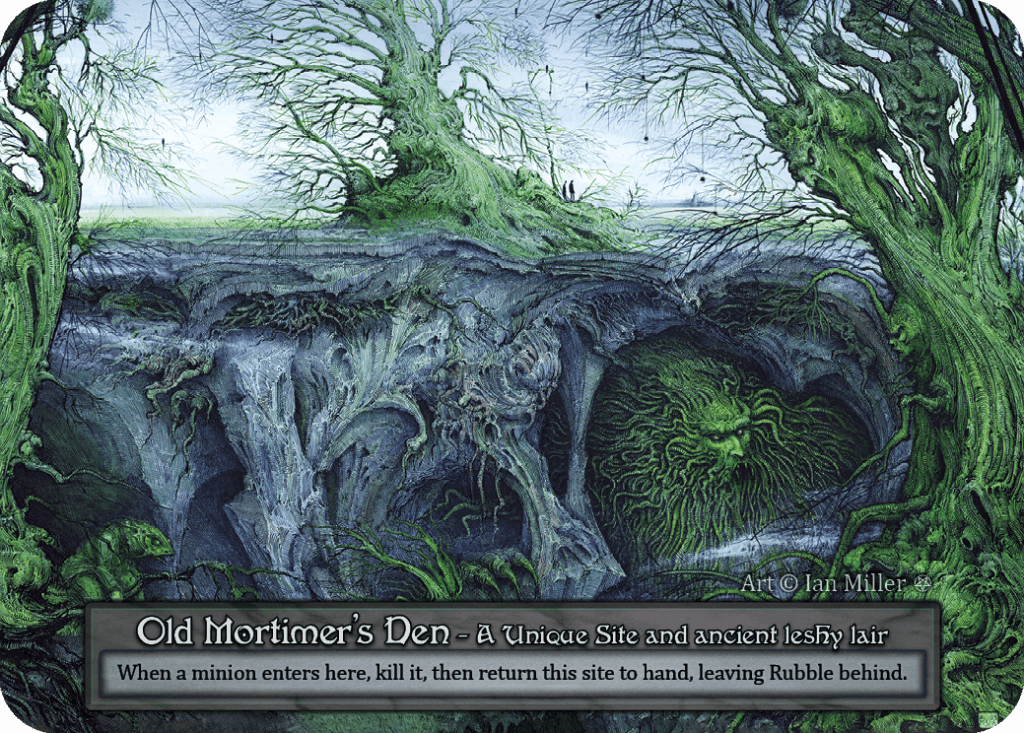
Returning to my design of Crumbling Castle, I do think sites that turn into Rubble is an interesting design space. I was hoping for more Rubble generation in Gothic, and we got this incredible Ian Miller site:
Old Mortimer’s Den might be my favourite site in Gothic. I have been a fan of Mariner’s Curse since Alpha, and using forced movement effects to kill your opponent’s minions is so much fun. I think Mortimer will warp games, where your opponent is incentivized to play more sites than they’d like to prevent you from replaying the Den freely turn after turn.
In regards to all this Rubble talk, I have been experimenting with Geomancer in non-Earth decks, using site destruction and other effects that leave Rubble behind to then get free Sites from the Avatar ability. Mono-Fire Geomancer has been a fun little project, but it might be dead with a 60-card spellbook. Send me a message if you want to learn more about this.
So, do I deserve the point? Probably not. But it did generate some good talking points. Did we get a King Gizzard and the Lizard Wizard reference in Gothic? Not that I’ve noticed. We did get a Ten Ton Slug reference for fans of Doom and Sludge Metal.
5. Jesus Christ
My most controversial pick. Would Gothic give us a depiction of this iconic figure? Looking through the set, we got many Biblical references, named angels and demons, and even real-world historical figures such as Rasputin and Jack the Ripper. We even got Judas named on Kiss of Judas, so this shows the extent that Erik’s Curiosa is willing to use these references and risk potential public outcry. Here is my design for the big man:
Jesus Christ.
A unique Mortal of the divine trinity.
4 Cost – Earth, Water threshold. 0 power.
Other minions nearby can’t be destroyed.
So did Gothic give us Jesus? I say, yes, it did.
The flavour of this Unique minion ticks many boxes that we’d expect to see for Jesus, chiefly the redemption of evil. The art itself certainly suggests a divine and powerful figure.
My mechanic is similar to the Saint of Redemption, both focusing on preventing conflict between Minions. My choice for Jesus to be Earth and Water is confirmed to be on the right path by Garden of Eden in Gothic.
Now, my wild prediction is that there is a Curio version of Saint of Redemption with Jesus Christ as its name with new art. Perhaps it will have similar gilding to Unladen Swallow and the Sir Curios from Arthurian Legends, in the fashion of illuminated manuscripts.
So far in Gothic, we have seen seven curios, which doesn’t feel like enough based on how many we saw in previous sets. But the quantities in which these have been found suggest a certain possibility. Beta was distributed in waves, demarcated by differences in colour saturation. Perhaps if there is to be three waves of Gothic releases, we will see the Curios released across waves, seven in the first, six in the second, and five in the third, for example.
So, until we have all the Curios accounted for, I maintain that I am correct on this point. And give myself the point.
Extra Credit Bonus Round
So, I had an extra bonus prediction regarding the release date for Gothic. I had picked a Halloween release date for flavour reasons, and it did seem like a likely spot based on other events like the Crossroads. It was also Friday, which is the perfect day of the week. Some pundits were picking 2026 dates, so I’m glad that wasn’t the case – apologies to our friends in Europe, Australia, and Brazil who haven’t got product yet.
So, not releasing on Halloween seemed like a missed opportunity, but then I discovered (from watching a year-old MeatCanyon video) that December 5th was also thematically appropriate – Krampusnacht. In many European countries, the night of December 5th is when they celebrate Krampus, so ultimately the fifth was the perfect date for Gothic.
Conclusion
So, how many points would you give me? Six out of five? That’s very generous. Thank you.
I was more incorrect than correct, but I had a lot of fun thinking about these possible designs. I enjoy deliberating and thinking through the ramifications of cards more than designing them from scratch. Design and development should be a collaborative process, and there’s only so much I can do by just throwing out ideas without any testing and conversation.
I think Gothic is a beautifully designed set, and the team really hit high marks in terms of interesting game mechanics and elegance in function. So five out of five for Erik’s Curiosa.
I greatly enjoyed the first week of Gothic. I attended two Sealed events and a draft, and got to play a handful of matches of Constructed on Tabletop Simulator. Over release weekend, I managed to place first at all three Limited events, going 11-0 overall, so I’m happy with my performance. Gothic looks to be another excellent set for Limited play, and I’m looking forward to many more events throughout the year.
It is here! Gothic release day has finally arrived! I hope everyone is enjoying cracking their packs or starting their testing if product hasn’t quite made it to you yet.
During this initial Gothic window, my goal with this blog is to share my experiments with deckbuilding. I want to provide decks for new players to get started with and provide some strategy tips for seasoned players to level up their game with.
During the 2025 Cornerstone Season, I placed fifth at Crossroads Melbourne, placed first in a Constructed Cornerstone with Water-Air Battlemage, first in a Sealed Cornerstone, and finished second a handful of times at other Cornerstone events. So, the purpose in going quickly over my recent tournament credentials is to show that maybe my content is worth the read. I prefer longform written content, so I can share my thoughts in full with a bit of flair and artistry, and to hopefully inspire thinking and testing.
In this article, I’ll go over the 13 new Avatars released in Gothic. I won’t be going into great detail for each as I don’t want to be overly proscriptive. Instead I want to start the brainstorming process and point out cards that might inspire others. This discovery phase of a new set is the absolute highlight of the year for me. There’s so much to find – combos, synergies, maybe some broken interactions that the developers didn’t quite catch. But it’s also the best time for self-expression. Pick your favourite Avatar and elements and just have fun with it. Iterate and reiterate to find the perfect deck for you.
First Impression of Design Direction
Quickly, I’d just like to mention my overall impression of the Avatars as a set of work, of what they represent for the direction and development of the game. Avatars are emblematic of the game and a great starting point to analyse the set.
Overall, the Gothic Avatars feel to be more about creating archetypes, rather than being novel ways of generating card advantage. Sorcerer is iconic and the perfect design to start with. It’s simple, evocative, and sets the standard for every future Avatar. It’s card advantage in the purest sense.
In Beta, Avatars such as Geomancer and Pathfinder looked to generate card advantage by not having to draw sites. This is a more obvious source of advantage as it takes away the opportunity cost of deciding to draw a site or spell for turn. But then it becomes more nebulous as designs become more complex. Now, the term ‘card advantage’ is one of those terms that can elicit as many arguments about what it exactly means as metal fans arguing about genre. Is Seer card advantage? It’s card selection, and in a game like Sorcery where draw is so rare, does that blur the line enough? Either way, it demonstrates the interesting point at which mechanics and card identity blur together to make something interesting. Am I calling the Beta Avatars uninteresting? No, not necessarily, but the Gothic Avatars are definitely much more interesting.
This is because they leap the boundaries out of early set design and become something altogether novel. This shows the maturity and growth of the development team and their ability to play within their own system. The old adage is that you must first master the rules before bending them.
Early Avatar design was largely restrained by tap abilities. The positive of this is that you can have some powerful effects that require timing and sacrificing the ability to perform other actions. The downside is that tapping for an ability means you can’t tap to draw and play sites. Avatar of Fire is an example of this not working well. It needs sites in hand for its tap ability, but then the more you use it, the less fuel you have. So, then strategies get stuck around making the most of fewer sites, but Avatar of Fire really wants to get to eight mana to throw two fireballs in one turn. This makes for an uncomfortable grinding of gears with this design.
Flamecaller and Sparkmage are good examples of tap abilities. Removal in a game where minions are so central will always be powerful. They are also tap abilities that can directly win you the game. Conversely, Waveshaper and Witch didn’t quite make the mark. Temporary effects and hobbling your opponent proved to be insufficient to be worth tapping for. Waveshaper has many fans, but I’ve seen too many games where the Waveshaper’s plan fails to develop because they’re forced to use their ability too early and too often in the game. In the fast AL meta, this meant that Witch never had the opportunity to get off the ground at all.
The downsides of tap abilities are exacerbated by how important moving around the realm is. Early in the game’s life, Avatars seldom moved. They started in their square and sat there for the entire game, playing sites, tapping for sites all game. Now, the game is more dynamic. There’s more nearby and adjacency requirements. There’s also more effects that let you move your opponent’s Avatar. This means that Avatars have to be more flexible with their actions to not be sitting ducks and get themselves out of sticky situations. Don’t let your Avatar get trapped in the Darkest Dungeon.
So, with Gothic avatar design, we’ve moved away from tap abilities as a whole. Instead we see more deckbuilding opportunities, more movement and combat abilities to encourage Avatars to get into the fray, and more abilities that don’t get in the way of drawing and playing sites.
Trust me to get so sidetracked in an article about the new Avatars. I hope I haven’t turned away readers or they’ve at least managed to scroll past successfully. But I think it’s important to reflect on the past to understand the future. So don’t forget to reevaluate older Avatars and cards alongside the new to see what’s been unlocked. So, let’s dive in.
The Precon Four
These four Avatars are the perfect ones to start with. They are emblematic of the set’s mechanics and flavour. They are elegant designs, but there are so many different routes to take them. I think these four will be the most popular Avatars for a long time in the Gothic meta.
Savior
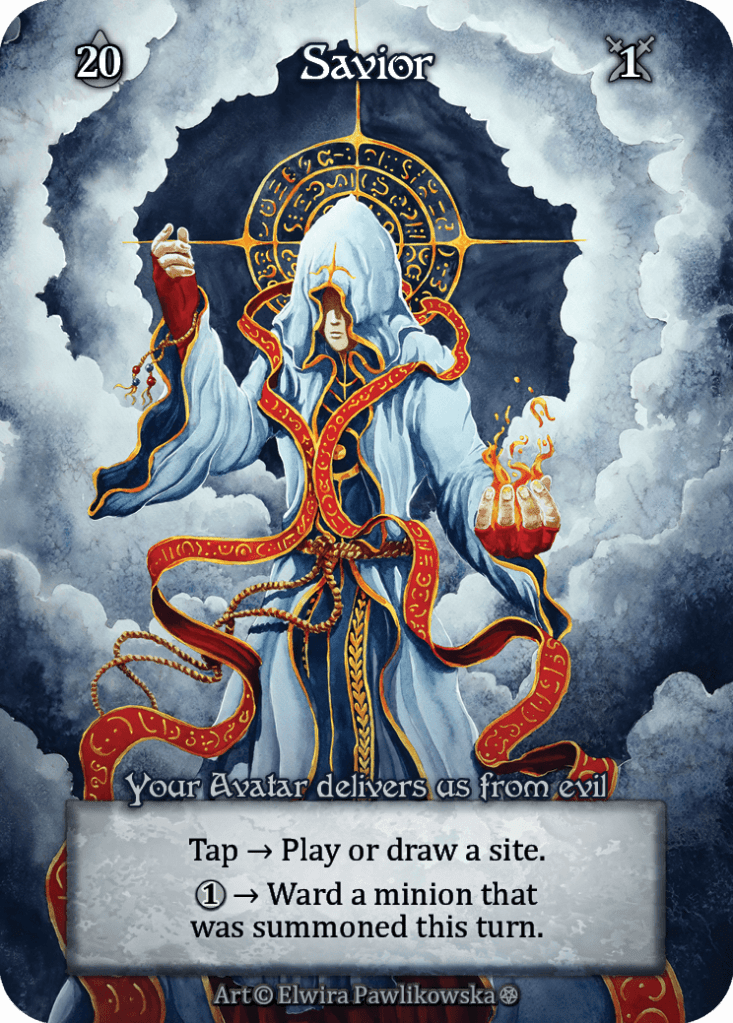
Savior fundamentally shifts the cost curve of minions. Now, every minion essentially costs one more and comes with a Ward. There are plenty of good Ward synergies in the set, and I think the precon demonstrates this strategy well. Timing when to use your Holy Nova and other payoff effects will be interesting when piloting this Avatar.
Savior’s ability scales well across archetypes. We can play cheap minions such as Pit Vipers with ward; we can midrange minions with Charge aggro getting in immediate damage with our Redcap Powries and making them a mission to deal with; or we can drop in expensive bombs that warp the game. When building your Savior deck, I think deciding upfront where you want to exist on this spectrum is an essential first step.
Outside of combat, Ward can help us protect important minions. Lances in AL were useful to protect our valuable minions from combat, but didn’t help against a Lightning Bolt. Ward solves that problem. So this is a boon for cards like Mother Nature and Queen of Midland. I’m very interested to see if these value engines see more play now. Mother Nature was a lot of fun out of Dragonlord-Xeraphine, so I’m crossing my fingers.
Important to note that Savior’s ability works on summon. Casting is what you do to summon a minion from hand. So this is a double benefit for Mother Nature, as you can protect her on cast and then protect what she summons to the realm. This also makes Adept Illusionist a terrible pest. Bodyguard minions like Old Salt Anchorman, who protects your minions from being submerged and burrowed, become incredibly resilient.
Savior is single-handedly going to turn the wheels of the Meta. What will be the sweet spot of power to cost? Will small minions be the threat, or will large resilient threats be our bane? This is my favourite Avatar out of the precon kit, and I think will be a great choice for new players and experienced alike.
Necromancer
Necromancer is our token deck. The precon list gives a great starting point to get the most out of our tokens, whether that’s upgrading them, boosting their power, giving them more bang with Artifacts. Anything that boosts power is a winner here, so consider your Pendragon Banner and House Arn Bannerman.
But for alternative strategies, you can consider your skeletons as sacrifice fodder to power out monsters from the deep. Your skeletons can lower the cost of cards like Gnarled Wendigo. Instead of making a beeline for your opponent, your skeletons can go to the corner void to summon forth the Dormant Monstrosity.
I could also see a version of Necromancer that’s all control spells as you have a win condition printed on your Avatar. Punish your opponent for playing minions, punish them if they don’t by attacking their hand or sites. This could be a fun toolbox deck to explore the Collection mechanic with Toolbox and Silver Bullet.
That’s three completely different archetypes to explore with this one Avatar. But I’m looking forward to seeing what the community comes up with. Necromancer is my pick for the Avatar that will be winning the first round of tournaments.
Persecutor
This is an interesting one. To me this feels a lot like Avatar of Water in that it has built-in movement and then the payoff isn’t immediately obvious. I think Persecutor will have a huge surprise factor where you’re not quite sure what your opponent is up to until it is too late.
Poison Nova and proximity spells are a great starting point. The free movement lets Persecutor position efficiently to time their spells for the most devastation. Movement without a tap is super useful for effects like Love Potion. Will Persecutor finally be the Love Potion menace we all feared ever since that card was spoiled?
This is the only Avatar in Gothic with more than one power, so is a contender for more aggressive strategies. Will it achieve what Templar couldn’t? Two power can be an awkward amount as it’s not enough to threaten burst damage like Avatar of Earth; and as Witch showed, two damage chunks aren’t super threatening.
Town Priest is our most cost-efficient source of bounce so far in the game. Could this pairing be enough for a successful tempo deck? Persecutor makes good use of a large suite of anti-Evil tech in the set. If Evil decks become popular, then Persecutor’s stocks rise as well.
Persecutor can embrace the dark side and consort with demons. It’s the perfect companion for Shackled Demon, which needs a Spellcaster to unchain it with a tap.
Harbinger
Precon Harbinger wants to go big and play big minions early. Harbinger is one of the best flavour Avatars as well, and I think many players will enjoy the storytelling opportunity of being the key and guardian of the gate to the dangers of the cosmos.
I’m a big fan of stacking cost reduction effects. If you can get a Town underneath a summoning portal, you will have a lot of fun. The randomness of the effect does have to be mitigated, so Voidwalk minions are a great choice. Headless Haunt is an obvious choice, but maybe this will give Peregrine Apparition a new lease of life?
Harbinger is going to be a deck where the roll of the dice could make or break it. The worst-case scenario is that you roll entirely on your back row. Will you build your Harbinger to be able to pivot into a more defensive deck if that happens? Or will you lean fully into the all-or-nothing aggressive strategy and just make do without your portals?
Harbinger is the antithesis to Savior, shifting the cost curve in a different direction. Will resilient Warded minions trump big monsters coming down early? This will be a battle fought across local metas.
Let Loose the Avatars of War
In this next section, I’ll go over the three Avatars that point us in a more aggressive direction, where they directly take the battle to the opponent. Persecutor belongs in this category as well, so any tips here can apply to it as well.
I’m a big fan of aggressive combat-orientated Avatars. Battlemage was my champion throughout Cornerstone season. I enjoy having an Avatar that can directly influence the board, deal with the opponent’s minions, and can thwart my opponent’s anti-minion strategies.
Combat Avatars have unique deckbuilding considerations. They need to consider movement effects so they can influence the board efficiently. They need cards to boost their combat prowess. But it’s also important to bring minions of your own that support your Avatar and benefit from your combat spells and Artifacts.
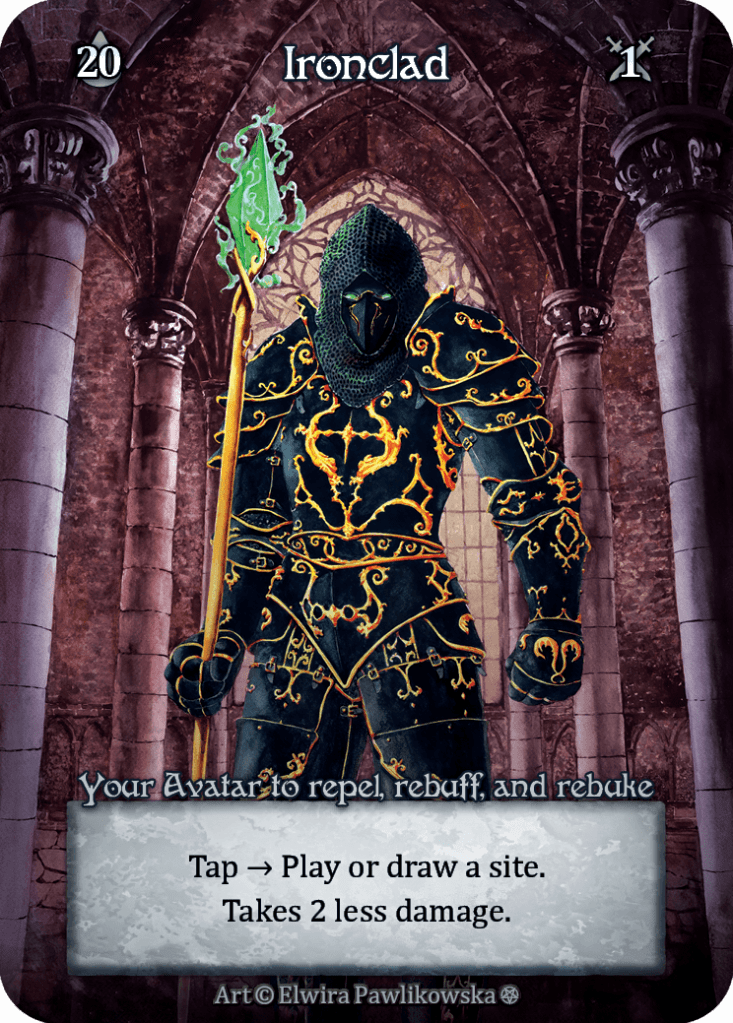
Ironclad
Ironclad and Bladedancer are great Voltron style decks. This is where you load them up with Artifacts, such as Flaming Sword, and go all-in on this strategy. Ironclad is the more resilient and defensive flavour of the two, so I could see the possibility of building a deck and then swapping between the two Avatars depending on your local meta.
Ironclad shines with untap abilities, such as Belfry, Sugarplum Pixies. Maybe this is even the moment where Silver Valkyries gets played. Ironclad makes it harder for your opponent to get in attacks on your sites, whilst also defending the valuable minions you’ve invested in. Ironclad will have your opponent scratching their head trying to find a way to break through your defenses, so you also need to be bold and aggressive so they don’t have the opportunity to solve that puzzle.
Ironclad is also great with self-damaging effects. Note that life lost is not damage, so he doesn’t synergise with many demons like Lesser Blood Demon. However, Searing Truth is damage. Throughout this year, thousands of Ironclad decks will be started in Curiosa and the first thing added is three copies of Searing Truth.
Ironclad’s downside is that it has no built-in mobility, so you will need to answer this. War Horse is a great pick. I love Blink and run it in nearly every air deck. Helpful Hob’s untap can pack a punch once you’re fully decked out in equipment.
Ironclad is also a great meta answer to Necromancer, so if that pesky control Necro that wants to win with tokens gets too bothersome, then Ironclad might be the solution.
Bladedancer
This is going to be a fun avatar once it’s fully suited and booted. Too bad it doesn’t have Battlemage’s card draw ability, but I guess we can’t have everything on one Avatar. Bladedancer’s strength is that it gets to push through damage on the opponent and thin out the opponent’s minions. Battlemage has to choose which axis to focus on and commit to it, but Bladedancer can split the difference.
Bladedancer does suffer from the problem of what do you do if the opponent doesn’t have any minions? There are a handful of cards that give your opponent minions, like Bitten, but is that even worthwhile? Battlemage gets to kill that token and draw a card from it, so Bitten is an efficient threat that replaces itself eventually for Battlemage.
I think I prefer Ironclad out of these two, but I think I’m missing something. Let me know what you plan to do with Bladedancer. I’m sure I’ll get my butt kicked by her soon enough.
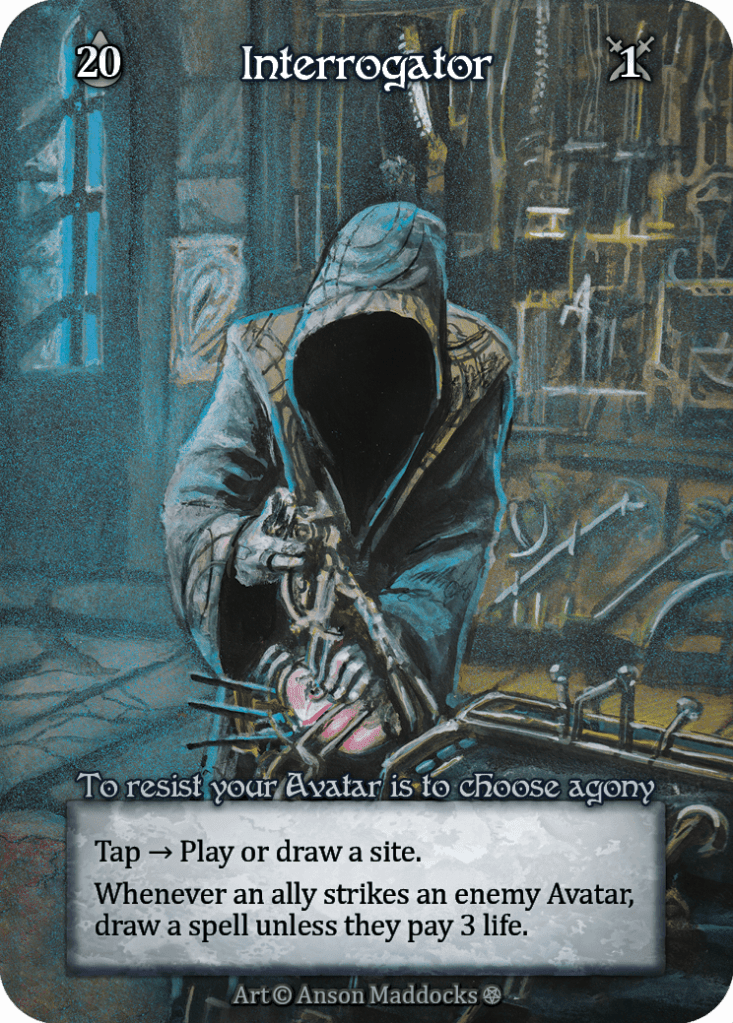
Interrogator
This is my pick for the most popular initial Avatar out of the gates. Players love drawing cards, and unlike Battlemage, you can send your minions in to do your dirty work. The fact that this isn’t once a turn is scary. ‘Ally’ also includes your Avatar, so I’ve included Interrogator in the combat section as it can do the Battlemage plan of getting in your opponent’s face.
Token minions are a good strategy here. Zero damage still counts as a strike, so Frog tokens are viable. But since they have to attack the Avatar directly, this means tokens are likely single-use as they will get struck back, but single use for a card draw is very powerful. You can leverage that with Shield Maidens.
Denying the opponent life gain is strong in this build, so River of Blood is a strong contender here.
Yeah, I’m scared of this Avatar. It’s like starting with a Boudicca in play as your opponent will likely pay the three life whilst they have life to spend. Your opponent will have to play extra defensive to deny the draw. Going all in on small minions could be a strategy, but just be careful of Poison Nova and Holy Nova wiping out your forces.
This Avatar appeals to me a lot, and this might be the one that I take to my first tournament. I think there will be a large brain trust of competitive players working on this deck and perfecting it into a meta dominating force.
Leverage Other Angles
In the game of Sorcery, there are several things that can lose you the game. Losing to burn spells and minions attacking is the first and most obvious axis. You can also lose a game of Sorcery because you didn’t draw the threshold you require or because your opponent messed up your sites. The third axis of losing is being denied board access. Perhaps this is due to your opponent flooding sites to deny your Burrowing minions access. Maybe this is done with a Bailey or Mountain Pass.
Site placement and moving sites is one of the most underrated axes of the game but might be the most powerful. If you can destroy an opponent’s site and replace it with your own, you’ve now given yourself access into the opponent’s line and given yourself immense opportunities. Just make sure you don’t give your opponent an easy site for their minions to chew through your life. In Gothic, we’ve been given the strongest Avatar yet that can exploit this axis. Say hello to the Real-Meater.
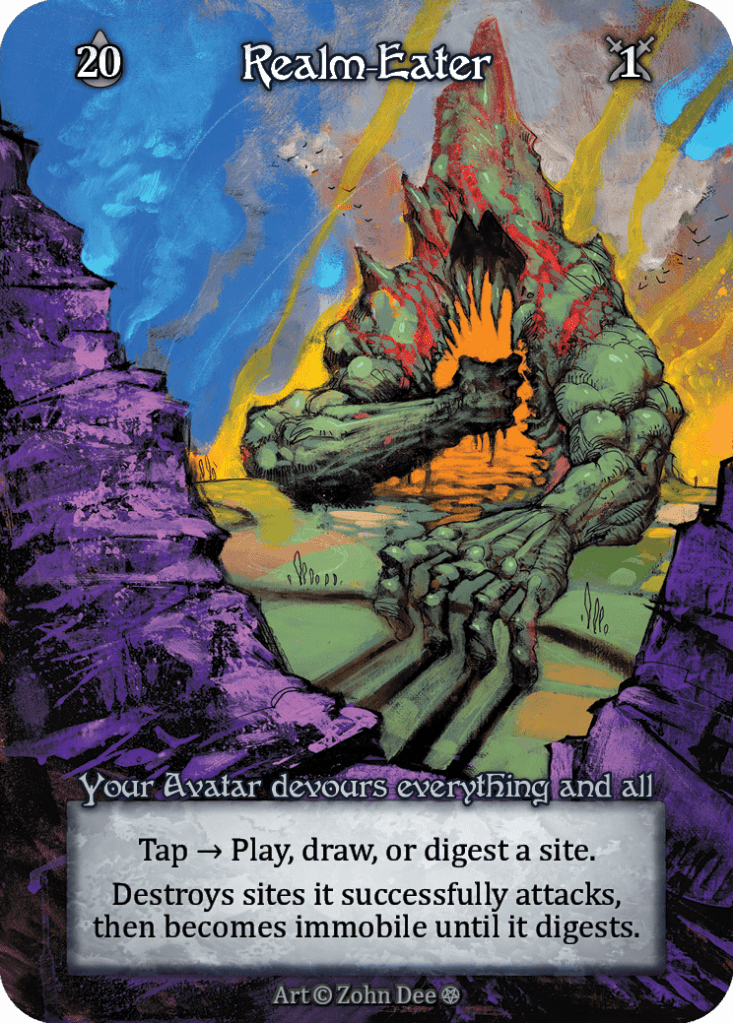
Realm-Eater
When using Realm-Eater’s ability, this is the hierarchy of power:
Denying threshold.
Denying opportunities to defend.
Denying your opponent mana.
Denying threshold can prevent your opponent from playing threats for many turns, putting them at the mercy of drawing from the site deck. Whilst they’re trying to fix their threshold, they aren’t drawing threats or playing them. This is the attack that will have the greatest impact on your opponent.
Denying your opponent board control is also very strong. Taking out defensive sites like Gnome Hollows so your attackers can get in is a big tempo swing. Breaking their line so your Airborne minions can easily attack their backrow is also very strong. Realm-Eater will require an untap to be able to destroy a site and play a site on the same turn, so this might be a bit more difficult to achieve with just the Avatar ability.
The least impactful is taking your opponent off one mana. Sometimes this denies them a turn; most often they just play a different card. Similar effects like Witch and Tax Collector never really had much success. A common mistake with Realm-Eater will be taking the opponent off an inconsequential site instead of developing your own board. Since Realm-Eater has to digest before it can use the Move ability again, your opponent will look to play their important sites during your off turns when your belly is full. Such moments will be where Realm-Eater players lose the game without realising it, so be considerate with your timing. Often the threat is more dangerous than the action.
It will be interesting to see how these decks shape out. I think initially we will see cards like Teleport played with the intention of being able to snipe any site early to try and take the opponent out of the game ASAP. If you spend your turn three playing Teleport and attacking a key site like Tintagel, you might throw your opponent off their entire strategy. But this costs you a turn, a card, and your own development. But my gut feeling is that Realm-Eater will work better with a longer and more deliberate game in mind.
Like the combat-focused Avatars above, Realm-Eater needs movement effects to fully leverage its ability, and it also needs ways of taking out defenders. You have to successfully strike the site itself to feast on it. Immobile doesn’t prevent you from Attacking the site you are on, so effects like Blink are super powerful here to dance around defenders and strike deep into the enemy’s territory.
The mere existence of Realm-Eater is an existential threat to greedy atlases and greedy players. The mere possibility that you might sit down to face this Avatar in a tournament is enough that every deck has to be prepared for it. My guess is that this Avatar will have a low play rate in tournaments (I think it will be quite popular in more casual settings), but will be an impactful and important deck with a high win rate. The players who take this to tournaments will be dangerous.
There is a risk that this is the negative-play-experience Avatar of the set. There’s a chance that Realm-Eater becomes the new Archimago, where the chance to play the game gets taken out of your hands and you are forced to sit back and watch the slow inevitable conclusion play out. I hope not.
I know there’s players in my meta that will pick this as their first deck to pilot, and I’m scared. I’d better start thinking of a game plan to beat this deck.
A New Way to Play
This category of Avatars introduce new angles to the game and feel like the wildcards of the set. When you sit down to play against these decks, you will have a hard time guessing what their game plan is.
Animist
Animist is a spellcaster that can play to the board. Animist can compete on the board with minions whilst benefiting from having more options in hand. This feels like the toolbox Avatar of the set. Mortality is never a dead card for Animist.
The problem with cards like Mortality for Animist isn’t that they’re narrow, it’s that they make for weak minions. A two-cost two-power minion that has no ability is pretty weak. A three for three is where it starts feeling all right. For this reason, I think we need to look at silver bullets that cost three, four, and five mana, so they can be reasonable minions. Extinguish and Boil are the most immediate picks from the older card pool.
However, then my brain goes to, ‘What’s the point of playing an Avatar whose strength is having a weak back-up plan in case its A plan fails?’ Maybe this is fine for the deck that’s just a pile of removal spells and then the removal can be a threat. Maybe this is fine for a deck with such a strong combo that if you get it, you definitely win, but you just need a backup plan to not get overrun or just lose the game otherwise.
The biggest issue against Animist is the lack of built-in card advantage. Is Sorcerer or Archimago just the stronger combo Avatar? I’m not sure. It will be interesting to see what players come up with.
My only corner-case tip to offer is that it might be useful to run effects like Fey Changeling so you can bounce your spell-minions back to hand if they become relevant in the match. Yeah, that’s a nice utility, but will it ever be relevant? Probably not.
Animist is a great Limited Avatar as it ensures you can pack more powerful utility spells in your list whilst being able to play minions on curve. In a draft, if you get Animist early, you will then be able to take and utilise cards that no one else can. And in draft, where removal is king, having your removal spells turn into minions is super helpful.
Imposter
This will be an incredibly fun Avatar and is my pick for what I want to brew with first up. I think the best Imposter decks will have a plan to change Avatars through the early, mid, and late game, with a toolbox to draw upon to adapt and counter threats. We also get to combo and synergise Avatar abilities in a way that’s never been possible before. We can be a Realm-Eater and make a bunch of Rubble, then switch to Geomancer for efficient site ramp.
The ‘getting damaged’ clause makes combat Avatars like Battlemage and Bladedancer more difficult but not impossible to use. This is a deck that definitely wants Amulet of Niniane and maybe even Blasted Oak to protect your Avatar from errant Lightning Bolts. I think it’s incredibly compelling that Imposter creates a fourth axis in addition to what I talked about before in regards to Realm-Eater, in that you force your opponent to directly interact with your Avatar lest you run away with advantage.
Here is how I’m planning on building my Imposter. It’s an Earth deck with a Fire splash ramping and disrupting the opponent. In my Collection, I have 10 Avatars to have access to maximum utility. Pathfinder, Realm-Eater, Geomancer, Avatar of Earth, Sorcerer, Witch, Flamecaller, Avatar of Fire, Ironclad, Necromancer.
Early: Pathfinder. On turn three turning into a Pathfinder, tapping for a site, is incredible. The slower the format, the more powerful this is going to be. If you can get away with three or more turns masquerading as Pathfinder, then that’s incredible value. Even just getting one turn as Pathfinder, you’ve essentially started the game with a free ramp spell in hand.
Then going into the mid game and late game, there are several routes to take depending on what the opponent is doing. Having Realm-Eater means you can disrupt the opponent who is minion light and wants a long game. Geomancer helps get even more free Sites down. Avatar of Earth can start dishing out massive damage once you have a cluster of sites. If my opponent has too many minions, I can retreat back and shift into Sorcerer to start drawing cards and benefit from my ramp. If I’m ahead on the board and don’t want to overextend, I can shift into Witch and curse my opponent.
I also have utility picks such as Ironclad to thwart token strategies if I’m on Death’s Door. I have Necromancer as well if I need tokens to gum up the board or have a constant flow of threats.
Being able to shift into an Avatar with an ‘I win’ button is incredible, so that’s Avatar of Fire or Flamecaller. Depending on whether you’re more likely to have a Fire site in hand or a Fire minion in the bin will determine which is better here.
You could easily cut out the three least likely Avatars you’ll need, arguably Witch, Ironclad, Necromancer, so you have a bit of room left in the Collection for other toys, but why not lean fully into the Imposter?
My Work is Done in Deckbuilding…
This next category of Avatars are those with abilities that impact Deckbuilding more than gameplay. These will be a lot of fun to tinker with in deck builders, but once they’re on the table, will have more linear games executing their strategy.
Corruptor
This is the most wide open Avatar of the 13. It cracks open the card pool and makes us peer through the kaleidoscope of choices.
An important rules note is that this effect applies everywhere, so unfortunately cannot use Call to War (one of my all-time favourites) in Corrupter.
I think the best way to approach this is by working backwards. Start by looking for strong payoffs for Evil, Monster, Undead, and Demon and then seeing if they’re strong enough that including more minions is worthwhile.
Here are a few possibilities for each archetype:
Evil: Willing Tribute, Witching Hour.
Monster: Abyssal Assault lets our efficient beasts like Lugbog Cat turn into monstrous bombs on curve.
Undead: Carrionette. This lets us recur our expensive utility mortals such as Grandmaster Wizards, Death Dealer.
Not being mortal means we’re safe from All Mortals Gone and play it ourselves.
Kiss of Death: unlocks this powerful kill spell.
Necronomiconcert: This lets our utility mortals like Land Surveyor join in the card advantage party.
Angels and Demons? I just love the flavour of building an Angels and Demons list, so hopefully there’s something spicy to justify this. Let me know if you see a spoiled card that Corrupter could use.
…and What the Hell is That?!
Now, these last two are pure insanity that not only change how we approach deckbuilding but also how we perceive the game. These next two Avatars are going to be contentious, and I predict there will be a furor and uproar from the community over what they represent.
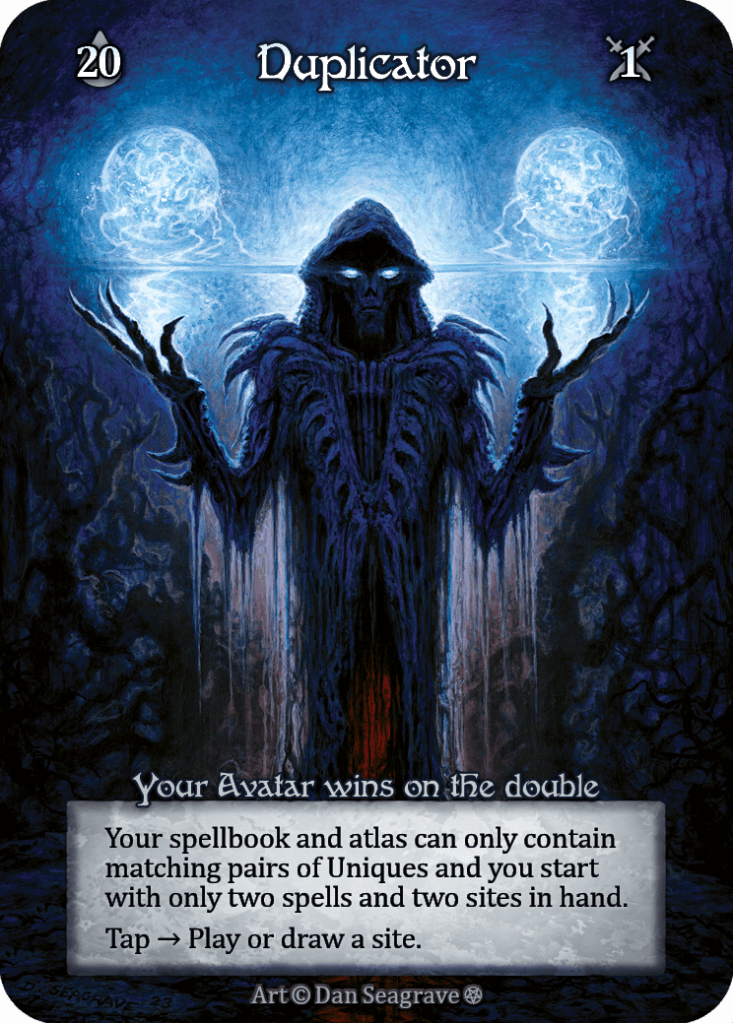
Duplicator
I am torn on this card. On one hand, this destroys the implied contract of what Unique means to us as players and collectors. One of the selling points of Sorcery was that we only needed a single copy of each Unique card. This affected prices for Uniques as players only needed to get a single copy. Duplicator will affect the entire marketplace.
On a sour note, this also means that individuals who saw this card leaked before release date had a window of time to gain an unfair advantage by buying cards before the general public was aware of what was happening and could react accordingly. Worst is in the case of Dragonlord. Due to scarcity, many players missed out, and those who got one copy were relieved that it represented all they needed for gameplay. Now that’s no longer the case.
As for playing with Duplicator, the first hurdle is overcoming the inherent card disadvantage. Tithe and Round Table are the two standout for this. I think there are two obvious routes to building this list. One is the Knights of Arthurian Legends. The other is Immortal Throne. Maybe you could do both of these in the same deck. I have tried Immortal Throne Knights Templar back in the day to middling success, but having two copies of the Round Table is super useful. But it remains to be seen if having a second copy of a critical lynchpin Unique outweighs losing out on the initial card advantage and utility contained in Elites, Exceptionals and Ordinaries.
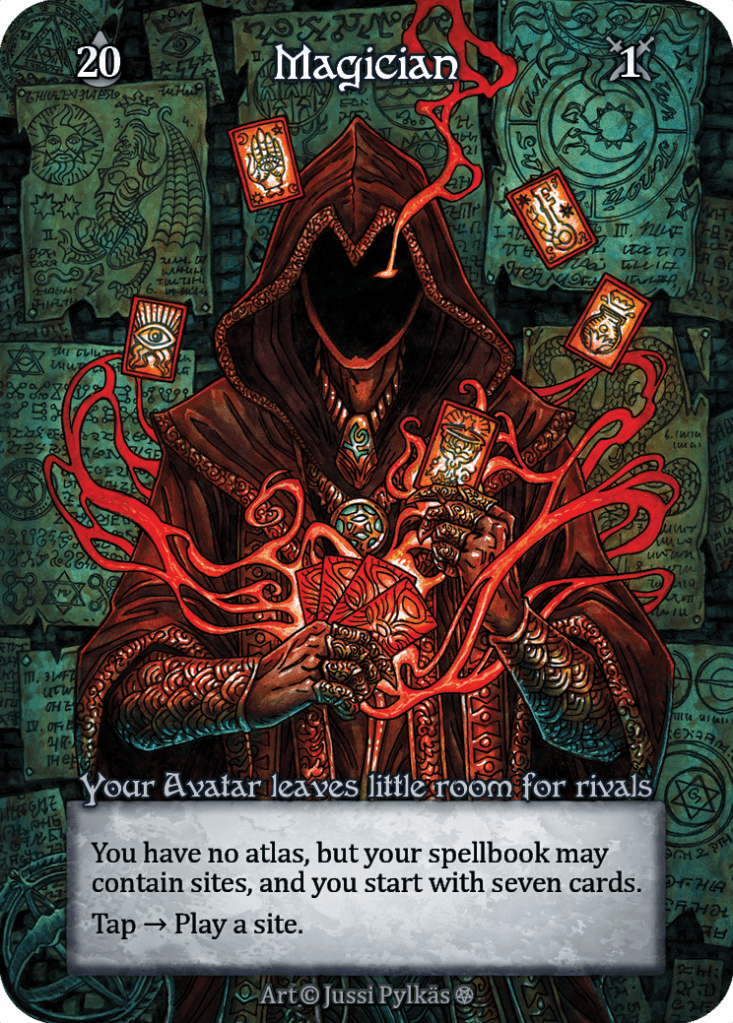
Magician
Now, this is a card that will create positive controversy. I think everyone will have the same reaction of, ‘Oh, no, they didn’t,’ when seeing this for the first time. It’s just a perfect joke and emblematic of the flair and fun out of Erik’s Curiosa.
On first pass, this just feels like a worse Spellslinger. You get one extra card over Spellslinger without the certainty of drawing an optimal mix of sites and spells.
But then the next pass is the realization that you get to control the ratio of sites to spells with full control at deckbuilding. This means you can build a deck that wants to draw six spells and one site in the opener – or conversely, a six site and one spell hand. With Sorcery’s mulligan system, it’s easy to push this to the limit since you have a lot of control in choosing what to keep and what to put back.
For fans of the 40-20 format, this kinda allows you to do essentially that. The cost is that generally it’s cheaper and easier to draw sites than spells, so you’re losing out on the most efficient card advantage sources, such as Tithe and Kettletop Leprechauns, with Magician.
Magician still has access to the 10-card Collection, so make sure you make the most of that advantage.
So, what does Magician do that other decks can’t? You’re exchanging one form of consistency to adjust the dials elsewhere. Is that sufficiently powerful? We saw Spellslinger achieve Rainbow foil status, so it’s not impossible that Magician will see tournament play if just for the memes. There is something appealing about only having to shuffle a single deck…
The worst-case scenario is that Magician’s deckbuilding advantage enables negative-play-experience combos that have been dormant since the increases in deck size. Players were glad to see the back of frustrating combos such as Roots of Yggdrassil, and Candlemas Monks with Crave Golem, so I hope they remain dormant. I’m sure there will be a new negative play experience found in Gothic for those desiring the chance to frustrate their opponents. If such strategies do become a thing, just save them for your friends and tournaments. Don’t make new players suffer through Candlemas Monk nonsense, please.
Bonus Round: Aspiring Avatar Demon Lord Mephistopheles!
Mephistopheles wants in on the fun as well! This card is my favourite Unique in the set, and I hope to crack a copy (maybe even a foil) early on so I can play with it. This design space of being able to ascend your Avatar is something I enjoy a lot in card games, and I’m super happy to see it here in Sorcery. Hearthstone fans will know Jaraxxus, but there was a similar mechanic in the older World of Warcraft TCG, where you could turn into a master hero such as Jaina or the Lich King. I find this mechanic extraordinarily fun as it feels like a quest and accomplishment within the game and has great storytelling potential. I’m glad that we only got one card in Gothic, though, so it’s special and unique overall, but I hope to see this design space revisited in the future.
Mephistopheles is great for Avatars that have an early-game benefit and then need a bit of a push to win the game. This is perfect for Seer, who can find Mephistopheles easier and needs some help in the late game. Pathfinder is another perfect choice. Interrogator is a fun one where once you’ve accumulated lots of cards in hand, Mephistopheles lets you spew them out.
Conclusion
Wow, that was a big article. My biggest one yet. I hope it wasn’t too wordy and was densely packed with useful information. I don’t expect anyone will read it entirely, but hopefully people can jump around to their favourite couple of Avatars and leave with something useful to start their brewing.
Overall, I’m super excited. There’s hundreds of possibilities to explore here. Each Gothic Avatar has at least three obvious paths to go down, with multitudes of less obvious ones to discover. As no Avatar is restricted to a single element, like in Alpha and Beta, each element and combination requires examination.
We also have to go back and see what Gothic does for our existing 21 Avatars. I am looking forward to seeing what the community comes up with. This time of exploration is going to be immensely fun and rewarding.
In this article, outside of a few spoilers, I haven’t even talked about how the actual card pool impacts all of this. How will the big archetypes influence things? We have Evil and Ward turning the wheel of the meta. What will come out on top?
The Beta-Arthurian Legend meta was generally quite fast, especially early on. What will be the tempo of this new meta? Will this be a meta where fast decks, such as Interrogator and Harbinger aggro is MVP, or will it be slow enough where Imposter can shift through six different guises and come out on top?
So, let’s get on Curiosa, sleeve up some decks, fire up TTS, and have fun with Gothic.
Waking up the following day to find all three non-foil sets and foil Fields of Phyxis sold out was a massive disappointment. Many people opted to not get these due to the high shipping costs and were hoping for a solution to this access issue. To see ‘sold out’ 24 hours after they dropped just puts everyone into FOMO mode. I expect all six items will be sold out soon enough.
Yesterday, I made the decision to hold off on getting these sites because the shipping cost to my country was prohibitive. I would have loved to get the cards, but I figured I’d get them later, maybe when I had the dust to get one or two other items in the shipment. Now, do I pay the incredibly high shipping to just obtain two of the three foil sets that are still available, scrambling to get something rather than nothing? No, that’s even worse. The cost remains too high, and I won’t even get the site I was most excited to play with.
My only hope is that these will return in a future store update and that this allocation was a super small ‘early access’ (maybe even with a dust cost premium). But for those attending SCGCon Las Vegas and need to factor the cards into their tournament, this is devastating, and I fully empathise with anyone feeling frustrated and angry about this situation.
Ultimately, what I said about the cards in the article, what the promos represent for the game, and the excitement they generate is still all relevant (with an asterisk). I even wrote about the benefit they have on the game even if individuals can’t get them in hand, but that’s now a bittersweet silver lining that most people won’t see any merit in.
Any sort of FOMO, intentional or not, is disastrous. This will have a negative impact for any dust store updates in the future, creating a precedent that urgency is required. People will feel pressured to act with immediacy and be unable to fully consider the pros and cons of their purchase. Ultimately, in a FOMO environment, everyone loses. Those who do get the cards in hand are undermined by the negativity of those who missed out, and the legacy of the art gets overshadowed, becoming representative of a feel bad moment. If we go into the Gothic Dust Store refresh with FOMO being the expectation, then there will be more tears.
I left yesterday’s article with a sentiment that this early access drop will encourage play, on a note of hope that these promos will entice attendance throughout the window before Gothic releases. This ‘sold out’ dashes that hope on the rocks. If anyone had acted yesterday and roused their friends to play on the weekend with the promise of earning some cool early access promos, then I have to imagine they’ve cancelled those plans now.
15 October 2025
Just when I thought I might get a reprieve from the Sorcery roller coaster that I’ve been on for the past week, Erik gives us an unexpected surprise. Three Exceptional sites from Gothic have been released on to the Dust Store and are available now. Read the official article here:
In this article, I will go over my thoughts on these cards, the impact they might have on the meta, and whether they’re worth spending your dust on.
I wrote an article earlier in the year about the ways in which the Dust Store adds value to the game and allows for creative opportunities for the design team. I also went over my favourite cards that were added in the Arthurian Legends store update, so if you’ve got a difficult decision on how to spend your dust, this might be of some use.
River of Blood – this card is a powerful hoser against life gain. It’s important to note that since the effect rounds down life gained, it’s especially effective against cards that gain odd amounts of life, reducing one to zero and three to one. The cards most impacted in the meta are Ring of Morrigan, Angel’s Egg, Holy Ground, Divine Healing, and Pillar of Zeiros.
Fire-based aggro decks were already incredibly powerful, and this pushes their power even higher. I think Fire decks won’t struggle to find space for three of these sites, especially those that don’t need to run multitudes of Ordinary Deserts.
Fields of Phyxis – where were you at Melbourne Crossroads? This card would have answered so many problems for me. It’s certainly finding a slot in my Water-Air Battlemage deck. I got wrecked by Troll Bridge at this event, so having some tech against that is more than welcome.
Fields of Phyxis also helps with threshold needs by turning off the negative clauses that many multi-threshold sites have. Fields boosts the power of the Unique castles, such as Tintagel, and might even put some life into Avalon and Wedding Hall. Perhaps this is the time to try out some Knight builds. Could this one site save Templar?
Haystack – this card is hilarious from a flavour perspective, but scary in application. It hits format staples like Common Sense and Highland Princess hard. It serves as a safety valve if search effects become too strong in Gothic, so I’m happy that we’re getting this card.
I enjoy that it offers protection against Feast for Crows, and in a super niche way is great for beast tribal decks to thwart Kingswood Poachers from stealing all your pigs.
The most powerful aspect of Haystack is that it’s not symmetrical. This means you can benefit from all the searching that you want whilst your opponent misses out. This is an interesting design choice as often effects like this would be symmetrical, as is the case with River of Blood.
For the Collection
‘Collection’ I mean in two ways. Firstly, these sites are great for collectors looking to add some more bling to their binders. But more importantly, these sites are incredible additions for your Collection once Gothic releases. If you haven’t seen the news on this mechanic, read about it here:
Ersatz Platz is going to be an important site in the game once Gothic releases. It’s an incredibly flexible card, offering threshold fixing and utility in one card. These three sites today are all excellent grabs for the Platz.
But how do these Dust Store promos in particular facilitate the Collection? If you don’t normally play foils in your deck, you could form your collection with foil and promo versions of cards? This will help you differentiate cards that belong in your deck and in your collection and allow you to get extra mileage from your promos and foils. My suspicion is that Dispel was chosen as the Crossroads promo for just this reason. Now plenty of players have access to a special version that will be a frequent inclusion in Collections.
As these sites come in three packs, it might be a fun idea to team up with two friends to each buy one pack of these sites and then divvy it up so everyone gets one copy. It’s quite possible that one will be sufficient for Collection purposes.
Meta Impact
So, these three sites turn off searching, life gain, and defensive sites. Hmm, which powerful meta deck ran all three of these things? Archimago. Is this an attempt to nerf Archie without any bans or errata?
Even if people in your local meta don’t get these cards in hand before Gothic, the fact that they exist will affect beliefs and expectations and will have an impact on how people value certain cards and strategies.
Maybe players will shift right off control strategies, and cards like Angel’s Egg will be seen as too much of a liability. Between River of Blood and Swap, is Ring of Morrigan sufficiently nerfed?
I look forward to seeing how this plays out in upcoming tournaments. It’s possible that even in events where these cards aren’t legal, we will begin to see this shifts as people adapt to future changes. Or maybe we will see a surge of Archimago in the short term as people try and get their wins in with this Avatar before it becomes more difficult to do so. Maybe this will see a spike in people playing Archimago at the next two Crossroads event in an attempt to earn a Rainbow foil version before it becomes more difficult to do so?
Design Considerations
Nerfs and errata are a common tool for managing balance in games. It’s interesting that despite some vocal calls to ban cards such as Ring of Morrigan and the Archimago Avatar, Erik’s Curiosa have stuck to their guns and let these cards run their course. Is releasing these three sites an attempt to nerf these cards in an unique way? Will we see this method employed again in the future?
I enjoy the possibilities that this creates. There is now a precedent that cards could be added to the Dust Store at any time. This means that going into a tournament, changes could be made without warning or with only a short time to adapt. We’ve already seen how impactful Swap has been on the meta for Crossroads Melbourne. Personally, I find this incredibly exciting, but I appreciate how this could be stressful for other players.
Imagine if they released a Unique Minion in this way, some big swingy creature that adds spice to a certain archetype in an unexpected way. This also helps with the ‘one set per year’ design pace, as cards that might be deemed risky during the design and testing process can be pulled from a set and then released as a Dust Store surprise later on. I can just imagine something like the spoiled Asmodeus card literally exploding on to the scene halfway through Gothic’s lifespan, adding a powerful and format-warping Unique to the mix.
The Art!
These three cards have different art to their Gothic versions, so are a special treat for art lovers. It’s actually absurd how spoiled we are with art in this game.
The regular versions of River of Blood and Fields of Phyxis have been spoiled already. There was some art spoiled in the Gothic trailer that could possibly belong to Haystack. And I’m torn between which version I like more!
River of Blood by AronjaArt is beautiful, but after meeting Brian Smith in Melbourne, he’s skyrocketed up my leaderboard of personal favourite artists. So which version will I end up using in my decks? Maybe I’ll use one for the Collection and one for the main deck.
The Cost…
Dust is feeling more and more valuable as time goes on. There are more great things to get from the store, the price of booster boxes is trending upwards, and dust feels scarcer to find on the secondary market.
200 dust for the non-foil set feels generous and priced appropriately, but 1200 for the foil set seems like a premium price, especially compared to the dust store Briar Patch set at 500. I think we will see that these sites are format staples and the higher price reflects this expectation.
The reality of dust is that tough choices have to be made. When everything was limit one, it was much more feasible to get everything. Now, I think a very small percentage of players will be able to afford everything they’d like to get. This does make for interesting decisions. I was so close to getting three War Horses recently, but today I’m glad I resisted the urge as I’d prefer these sites to the War Horses. But then that just makes me think maybe something I’d prefer more than these sites might pop up in the store. So, the downside is that players might be incentivised to sit on their dust, waiting for the perfect offering that might never come.
The other issue is shipping costs. Currently, the price to get cards shipped to me is prohibitively high. Many people, myself included, waited and did a single big order to pick up cards from the recent Arthurian Legends update and aren’t in a position to afford another shipment. The early access benefit is hampered if you can’t get these cards in hand during the early access window before Gothic releases. With shipping time factored in, that window becomes even smaller. I’m sure I will likely get these cards in time, but the impetus to do so today is lessened by these factors. So whilst I’m positive about what these cards represent and how incredible they are, the reality is a bit less exciting.
Better Start Saving! Better Start Playing!
But this does serve as a poignant reminder that if you want dust store promos, then you need dust. And with seven and a half weeks until Gothic releases, there’s plenty of opportunities to play and earn dust.
Before Gothic releases, by just playing in regular events, that’s up to 200 Dust for participation (100 capped per month). Every time you win an eight-person event, that’s another 200, and 100 for second place. If you can get a regular eight-person group to play once a week, over eight weeks, that’s 4000 Dust earned for the group between participation, first, and second-place prizing. It does add up pretty quick.
In Conclusion
Overall, these are fun cards that could make a splash in the lead up to Gothic. Anyone playing SCGCon Las Vegas needs to work these into their plans and build their decks and strategy accordingly.
I have to imagine that these three sites will be format staples going forward, and even if you can’t get them during the early access window, will likely be solid picks throughout 2026.
They serve as an exciting reminder of the impact the Collection will have on the game and how the game will evolve with Gothic.
My advice is to play as much as you can. Earning dust is secondary to the enjoyment of playing this incredible game, but it is an incentive to get players to attend. Remind your community of how these points can stack up over time. If you’re playing regularly and having fun, the dust will accumulate, and those promos will eventually wind their way to your mailbox to end up in your favourite deck.
Melbourne Crossroads and PAX Australia are now in the history books. In this article, I will report my tournament results and experience. This article is a personal journal and won’t capture the overall data such as the meta and breakdown of decks played. I want to focus on what it’s like to attend a big tournament and what you can expect. The Crossroads was the culmination of competitive Sorcery for the Beta-Arthurian Legends era for me and a chance to put all my theory to the test.
Whilst a main focus of these events is competitive play, I want to highlight the social aspects. Sorcery fans are incredible, and the comradery I’ve experienced at these events is second to none. I’m quite shy and introverted, and Sorcery has been an incredible opportunity to push myself out of my comfort zone.
Cornerstone Season for me was a bit rocky. I had challenged myself to play Battlemage and then never had an opportunity to do so. Both of the Cornerstones I attended were Sealed, so I felt underprepared for a Constructed event. This year had also been financially challenging, so I was unsure if I’d be able to make the numbers work. The expense of international travel is always high and the rising cost of living is affecting us all. Fortunately, with the support of my wonderful partner, we were able to make it work for me to head over to Melbourne.
I’ve also never been to a large convention like PAX before. New Zealand has the Armageddon Expo, but like most things in New Zealand, it just can’t compete on size with international offerings. But I’d heard many good things about PAX Australia, so I figured I should go – and perhaps the presence of a certain Ed Beard Junior project got that decision over the line. I had travelled to Melbourne twice last year for Sorcery tournaments, so I knew what I was getting myself in for. I knew the Crossroads would be highly competitive. I had made the top eight at my first tournament in Melbourne, so I was looking forward to proving myself once again.
If you’ve read my Cornerstone Series, you will know about my goals and my decision to champion Battlemage. Soon, I will reveal what version of the deck I decided to take with me and pin all my hopes on. The opportunity to win a Rainbow Foil was an important part of the Crossroads journey. So, did I achieve my goal of winning a Rainbow Foil Battlemage? Read on to find out.
Predicting the Meta
But first I want to go over my predictions of the meta. I knew there would be plenty of Druids and a handful of Archimagos. I felt that Battlemage had a decent chance against Archimago, but Druid was the clear best deck, backed by recent tournament results.
Beyond that, though, it was anyone’s guess. The Australian meta is interesting. There are many local scenes across the country, each brewing their own micro-metas that then converge at these big tournaments. So perhaps by embracing the chaos and championing Battlemage, I had avoided a series of impossible to answer questions in attempting to predict the meta.
The path through a tournament is always chaotic. There’s a real chance with random pairings that you might have a day where you play no meta decks, dodging the match-ups that you have tuned your deck to beat. For example, at this Crossroads I faced no opponents playing Earth in the Constructed, so my tech against Earthquake was useless. Worst still, I was weak to all the Water-based decks that I was paired against.
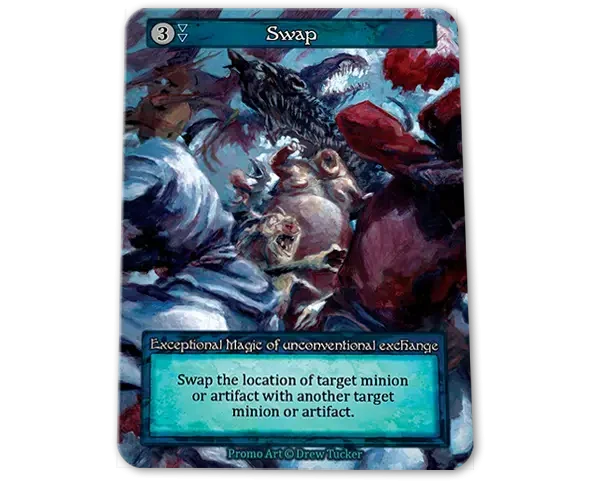
Swap!
Swap was also a massive consideration going into this tournament. Historically, Water threshold has been the least popular element in competitive Sorcery, so it was hard to guess how many people would swap to Water-based decks for this one card. Despite Swap’s power, there was an obstacle in obtaining sufficient copies for the tournament. Everyone in attendance could rely on getting one on the day, but getting two or three was a challenge, either requiring purchasing or borrowing copies, or attending multiple Cornerstone events and being rewarded a copy intended for community champions.
How did Swap affect my deck building? Swap is less effective in Battlemage than in Druid, where both Tawny and Torshammer Trinket make it very abusable. I played one copy as a finisher and instead of a copy of Disenchant. It’s nice having an answer to Artifacts and Auras, but I find Disenchant can be a dead card in many games. I did make some card choices to not get destroyed by Swap, such as using Mix Aer over Cores and Philosopher’s Stone. Mix Aer is a powerful accelerant, allowing for turn two Hounds of Ondaros and explosive plays with Whirling Blades. I also enjoy the high risk, high return of Mix Aer, so I was excited for this build.
It’s a Water-Air Battlemage focusing on Airborne minions, boosted by the power of Updraft Ridge. Water-Air Battlemages are currently quite popular and putting up good results, but I feel like this variation has a unique spin on it.
Airborne minions are incredibly resilient and aggressive. If your opponent isn’t playing their own Airborne minions, then they need a removal spell to kill them. Updraft Ridge gives you incredible board coverage and defensive opportunities. I have played against a lot of Avatar of Air, so this minion-forward strategy has been etched into my brain as both powerful and frustrating to play against – a perfect combination for a tournament.
In Battlemage, I like diversifying my threats, so I play more minions than many other Battlemage lists. This means I have multiple axes of attack and am less reliant on the Avatar itself if I gets locked out by defensive sites or put to Death’s Door.
Gnomes Hollows is a Site that I’m terrified to come up against with Battlemage. The Palliburrie Bats are an answer to that, along with the Magic Missiles as a finisher. It’s hard fitting in answers to everything into a list, so there were some tough cuts. I really wanted to play three copies of Shrink, a second Polar Explorers, and a third Blink, but there’s just not the room for everything.
Tension Rising
Arriving at Plenty of Games on Wednesday morning, I was relatively calm. I knew I wanted to go in and focus on fun, so I needed to push aside any nerves and expectations to perform. This was helped by seeing so many familiar faces from my last two trips and being able to immediately dive into conversations. I just love how passionate Sorcery players are, and getting to hear stories of exciting games, recent acquisitions of prized cards, and reports from all the recent Cornerstone events melted away my nerves.
There was also a great contingent of players from all across Australia, a handful from Singapore, and a great group of New Zealand players. There were 57 players in total, and many familiar players that I had lost to in the past, so I was getting nervous in the lead up to round one pairings. There was also a group of eight New Zealand players in the field, so I wanted to avoid getting paired with them so we didn’t knock each other out of contention.
Round One versus Water-Air Druid
My first opponent was armed with an aggressive Water-Air Druid. I thought I was unique for bringing Updraft Ridge, but my opponent was on a similar plan, so essentially a mirror match out of the gate. My Battlemage was able to get an early lead, and my deck was able to counter my opponent’s aggressive airborne minions that other lists might have struggled with. Ring of Morrigan did its work and I was able to stabilise and be aggressive with my Avatar. This was the perfect first round for me, as my opponent and I were able to have a fun lighthearted game, sharing jokes and discussing strategy. This really helped set the tone for the rest of the day and shed my nerves.
Round Two versus Air-Fire Battlemage
My second opponent was a fellow Battlemage. This was unfortunate because even if I couldn’t personally make top four, I wanted another Battlemage player to be able to do so, so getting paired up against a fellow Battlemage reduced the chances of that. I also really dislike mirror matches in any game, so it was a little tilting to be paired up against two decks that were so similar to my own.
My opponent was playing an Air-Fire list that looked similar to one that I had tested earlier in the year. I wish I had seen their entire list to compare notes, but an early Sacred Scarabs off a Highland Falconer was a great meta pick with so many Lugbog Cats running around. I had teched against Infiltrate with two Hounds of Ondaros and two Watchtowers in my list, but I didn’t draw either of these, and their Infiltrate stalled my aggression. Updraft Ridge allowed me to maneuver my minions effectively and attack their life and get them to Death’s Door first. An explosive rebuttal also knocked me to Death’s Door, reminding me of the power of Battlemage and to not get complacent. Fortunately, I had plenty of answers in hand to close out the game, including a Swap to steal their Flaming Sword if they attempted to play blockers on the same site as their Avatar.
Drafting
I was 2-0 going into the draft portion of the event. I was placed ninth at this point, putting me into the second pod. Having draft rounds in the middle of the Constructed allows a bit of chaos into the mix, shaking up the event and requiring players to showcase a diversity of skills. I feel pretty confident with drafting, and would say I’m a stronger Limited player than a Constructed one, so this event format worked for me. But with the randomness inherent in booster packs, there’s always room for disaster. The draft was Beta-AL-AL.
My Beta picks were pretty mediocre. Pack one, pick one I took Firebolts, and then second picked a Cloud Spirit, so no bombs for me. With two packs of AL in the mix, I was favouring Fire because of the absurd power level of the Fire Exceptionals in Arthurian Legends. Cloud Spirits is a card I probably pick higher than most because it’s a great aggressive minion and finisher due to its maneuverability. My remaining picks weren’t anything super exciting, with some okay Ordinaries such as Highland Clansman and Sand Worm. I grabbed a Standing Stones on the off chance I got a couple of Magic Missiles in the next two packs and could use it as a surprise finisher, but unfortunately didn’t end up playing it. It would have made for a fun play.
My first AL pack presented me with one of my favourite cards, Goswhit Helmet. I can’t remember what I took it over, but it was a difficult choice against a decent Exceptional minion that most players would have taken. I was rewarded with a pick three Sir Lamorak, having cut Fire and Air in the first pack, but from there the remaining picks were pretty weak.
Second pack of AL, and pack three, pick one I got a Firebreathing, which is incredibly strong and one of the cards I went into Fire for, and then a couple picks later received a Shatter Strike, so felt like I had a decent number of useful spells, but my minion quality was overall on the weaker side.
We then registered another player’s deck before deck building. The deck that I registered was essentially a far better version of my own. They had better cheap minions such as a Vile Imp, oodles more Charge minions to actually be an effective aggressive deck, and more removal. So I wasn’t feeling great about my deck’s ability to perform in the next two rounds.
Overall, I had an aggressive pile, but it was lacking power to back it up. This is how my list ended up. Note that my recollection of the list might be different to what I submitted. I think I went Beast of Burden over Snow Leopard for the maneuverability over the cheaper minion, but I can’t remember 100%. Here’s my list:
My game plan was to just be aggressive and push damage. I had plenty of cards that could close out the game if I got my opponent to Death’s Door first, so I just poured all my resources into that goal. Turn two, a Spectral Stalker started the clock, and from there I just kept deploying minions. In the back of my mind, I had the looming spectre of Lava Flow. In my two Cornerstone Sealed events, I lost both of my finals to this card, so I knew its devastating power. But I also had to play into it to push enough damage. Luckily, there was no Lava Flow this game, and I was able to succeed in my mission. So a win for my first game of the draft rounds.
Round Four – Draft Round Two
There is an outlier in my deck list. Highland Clansman is the only card that costs more than four – and seven at that. It’s a powerful card, but not really conducive to my game plan. The longer the game drags on, the more difficulty I would have winning, so I considered replacing it with another cheap minion. But Charge wins games, so I decided to keep it in as a powerful outlier.
In this game, my Atlas betrayed me. I need two Air threshold before I need two Fire. In this game, I saw all five of my Air sites before I saw my second Fire site, complete with a hand of double-Air cards. So, the game dragged longer and longer, and I missed my early game window to be aggressive. I was able to get ahead in the race, but then disaster. Lava Flow. It got me. It always gets me. This turned the tide back and put me on the back foot. But fortunately, I had a friend come to my rescue. Goswhit Helmet. Most people just play the Helmet defensively, and then get blown out by a removal spell and have the helm stolen. The true power of Goswhit Helmet is playing it aggressively, almost like a Torshammar Trinket.
I managed to get a three-power minion to stick on the board, and with six mana a turn, I could use my Avatar and my minion to take out four-power minions without losing life or board presence. I was able to stabilise the game and start chipping away again. Eventually, the card advantage generated by Gowshit Helmet was insurmountable, and I won my second game of the draft portion.
Round Five versus Mono-Water Druid
I was now 4-0 in the tournament, and reaching the pointy end of the day. Crunching the numbers, it would be plausible to reach top eight with a 4-2 record, but 5-1 was the goal to feel confident.
I was paired up against a player who I knew was a formidable opponent. Sitting down against a Druid deck, I was already nervous, but this was new tech, and I struggled to think of how to play against it. I often say that if your opponent can’t work out your plan in the first few turns, then you’re at a massive advantage to win, and I certainly felt that was the case here. Big Water minions overwhelmed my resources, and positioning effects such as Riptide took away my maneuverability.
One of the strengths of my deck is that it can operate well with few sites. It also doesn’t have to push up as aggressively as other Battlemage decks. This is important against many Druid decks, especially those running Fire, as it buys me some time to stabilise. But a Sinkhole on 13 took me off mana, threshold, and tempo. My list is reasonably ‘ungreedy’ with threshold, but I just couldn’t draw back into my second Water threshold. My one remaining Water site also betrayed me, allowing their Pirate Ships and Mester Stoor Worms easy access to attack my life. A Maelstrom on Site 13 also provided massive board control, and Troll Bridges were chipping away at my life. Tufted Turtles are also difficult for Battlemage to deal with, and playing a Ring of Morrigan to pop their shield (if I had one) only opens me up to Swap. By the end of the game, I was so far on the back foot and they still had plenty of tools in hand, so the game was well and truly over. My first loss of the day.
Round Six versus Mono-Water Waveshaper
Sitting down to face another Water deck, I had the fear of Swap in me. My opening hand had a Ring of Morrigan in it, and I strongly considered mulliganing it. I think that would have been the correct choice as I went the whole game without playing it for fear of it being stolen. Chances are high that my opponent had zero to one copies of Swap in their deck and didn’t draw into it, but the damage was done and I just couldn’t bear to play it. At least it would be a tool to finish the game on Death’s Door if it came to it.
Troll Bridges and Lugbog Cats have been the bane of my day. Free damage from sites and four-power minions are definitely pain points for Battlemage. Updraft Ridge allowed me to maneuver around their Mester Stoor Worm, and whilst their Avatar’s ability could lock down my minions, it didn’t prevent my Avatar from getting in damage. My deck’s ability to attack on multiple axes got me the win here. My final record was 5-1.
End of Day One
As the dust of day one settled, I was buzzing. Overall, I ended up in second place, which put me in good stead for the first round of top eight, as I would be on the play as I had the higher seed. There were two New Zealanders in the top eight, which was a fantastic result for Team Kiwi. Unfortunately, I was paired up against my compatriot, Nick, who was on Enchantress. The silver lining was that at least one of us would make top four, taking our unique Avatars picks to Rainbow Foil glory. So, whilst I was nervous about the next day, I was able to enjoy myself and celebrate my achievement. I had a fantastic evening, socialising with a large group of Sorcery players at the incredible Fortress, an amazing all-in-one bar, restaurant, arcade, and board game cafe.
Top 8 versus Enchantress
The next day dawned, and top-eight match was here. I had played against my opponent, Nick, earlier in the year at the Tūmatarau whakataetae o Aotearoa. Enchantress is a deck that I struggle to play against in general. It’s full of complicated rules and corner cases; it has amazing resilience and the ability to be both controlling or aggressive when required. Someone said Battlemage was the favourite in the match-up, but I certainly didn’t feel that was the case.
My opening hand had a Cloud City, which allowed me amazing board control to prevent Nick from forming the requisite clump of sites to allow their massive Auras to attack. This also meant I could maneuver myself around the board. I was glad to see this in my opening hand, and felt confident that it would be a large component of a winning strategy.
But then the rest of the game just didn’t fall my way. After my mulligan, I drew two copies of Pollimorph, which is normally an incredibly useful card, but one that isn’t super effective against Enchantress’ animated auras as they will get an attack in before I can respond to them. My draw was also minion light and slow, preventing me from getting in early damage. My Lugbog Cat ate a Poison Nova, and my Daperyl Vampire got sent to oblivion by an Atlantean Fate. My hand had a Grim Guisarme and Grapple Shot, so I had a potential route to victory, but I needed the mana to deploy it. I was scared to play the Grim preemptively with the looming Atlantean Fate, so I thought myself fortunate to draw an Aquamarine Core to give me the sixth mana without requiring taking the time to draw and play a sixth site. Unfortunately, my opponent’s Shatter Strike with the Atlantean Fate took me off both mana and life, sending me into a scramble of trying to get to a place of safety, knowing I was in a bad spot. Riptide was an incredible card for my opponent throughout this game. With three copies played in total, pulling me into Troll Bridges and through Wall of Fires; I was just torn to shreds.
So an unfortunate ending to my run, and getting so close to top four definitely stung, but I felt I had played my game well without any glaring mistakes, making the best of the tools available to me. Nick played well, with admirable grace and calm, and their Enchantress deck was unique and powerful. Congratulations to Nick, and I am stoked for your success, and just so happy to see a non-Druid, non-Archimago Avatar achieve Rainbow status.
The Rest of Day Two
Unfortunately, I missed the start of the Sealed side event, so I had a bit of time on my hands to think about the tournament. The prizes for reaching top eight were incredibly generous, so armed with my emotional-support Beta booster box, I took the time to reflect and take in the experience. I didn’t have the chance to watch any of the other top eight games, so I am looking forward to watching the three games that were recorded and to observe the full power of the Mono-Water Druid.
Crossroads Melbourne gave me a fantastic opportunity to trade and talk to people. This was my third trip to Melbourne in 18 months, so I have made some incredible friends, and it’s always fantastic to see everyone again and hear about their achievements. So having the rest of day two free to socialise was a silver lining. Overall, I think Sorcery is doing incredibly well in Australia. There are some incredible people working hard to build and support their local communities. I am sure these groups will continue to flourish.
Battlemage Deck Performance Review
Overall, I was pleased with my deck’s performance. It would have been nice to get in some more rounds of Constructed to actually put it to the test, as effectively it went 3-2 in this event (minus the two draft rounds). I think I played well and didn’t get overly lucky, so my result isn’t an outlier. Water-Air Battlemage seems to be doing all right at getting to top eight around the world, but has yet to crack the top four.
I am continued to be frustrated by threshold in Beta-Arthurian Legends. I would say that this deck is ‘ungreedy’, but I stalled on threshold too often for my liking. I nearly went mono-Air on this event, so perhaps I will test out that version. The reason I didn’t is that Shrink and Pollimorph feel so integral to the Battlemage playstyle and strategy. Also, if I went mono-Air, then I figure at that point I should just play Avatar of Air.
The one point I’d like to assert into the Battlemage brainstorm is that in my opinion Plumed Pegasus is stronger than Phase Assassin. Only requiring one Air threshold is a huge advantage, and the Pegasus is more flexible and resilient having Airborne. Phase Assassin requires movement spells, such as Tactical Move, to maximise its potential, and is weak to a defensive Lugbog Cat and the like. So, maybe try the Plumed Pegasus in that slot and give it a go.
For anyone thinking of playing Battlemage in this meta, I think it’s a reasonable choice. Being explosive and aggressive in a tournament means that you can high roll and put your opponents on the back foot. Just be very cautious of Swap. I play way fewer Artifacts than most Battlemage decks, so my lists are already more resilient to Swap than most, but it’s such a powerful spell and it will become more and more common as more events are held. Competitive players will obtain copies if they want to play it.
Mirror Realm
Jarrod and Nick of the Mirror Realm Youtube channel are incredible players. I played Nick in round five, and was just in awe of his skill. Jarrod went on to place first in the Crossroads and Nick third, proving their prowess and the effectiveness of their Mono-Water Druid deck. I would argue that they’re the best in the game. They work hard and put in the hours. Their innovation in deck building is indisputable, their passion for the game is incredible, and their game knowledge is impressive. It was great to meet them in person and spend time with them over the week. For anyone looking to level up their game, they are incredibly generous in sharing their time and knowledge, and there is a wealth of content available on their Youtube channel:
Watching their Arthurian Legends limited video series definitely helped me out this Cornerstone Season, so if you have an event coming up, take the time to study up.
However, the excitement wasn’t over yet. The Crossroad event was just the first part of an incredible week in Melbourne. PAX Australia was next, and whilst I was going solely for Sorcery, I was looking forward to seeing what else was on offer.
The PAX secret ingredient for me, and for most of my fellow Sorcery players, was the availability of Dragonlord. Everyone was fiending for it, and the taste they had received from attending the Cornerstone had not satiated appetites. We arrived early, waited in line, and then power-walked (no running allowed) across the hall to the Sorcery booth. Dragonlord was sold out 20 minutes later.
PAX was the biggest event I had been to since COVID, so it was strange to be amongst so many people. Overall, it was enjoyable and interesting, but with sore feet and lagging energy levels, there was only so much I could take in. It was great to see Null Signal Games with their continuation of Netrunner, so I picked up a couple of expansion sets from them. I also grabbed some Dragon Shield sleeves and a jigsaw puzzle that looked intriguing.
The Sorcery booth was consistently buzzing. There was a constant stream of people learning how to play the game. The Erik’s Curiosa team and volunteers were doing an amazing job, and considering how exhausted I was, I have to respect their drive and energy. The two guest artists, Brian Smith and Lindsey Crummett, were consistently busy with their fans. After getting an Immolation in a trade, I went to have a chat with Brian. I always get a bit tongue-tied talking to artists and people that I admire, but eventually I was able to convey my request. Brian did an amazing job of putting the Returned King, an upcoming card from Gothic, on my Immolation. This is definitely my favourite treasure that I took home with me from Melbourne.
Day two of PAX was similar, and we arrived even earlier and walked even faster to the Sorcery booth. Dragonlord sold out even quicker. With the flight home looming later that afternoon, it was a much more subdued day.
The Avatar of the Realm event was on everyone’s mind – a great sign that despite the exhaustion of four hectic days in a row, people still wanted more Sorcery – and we speculated where it might be held. Of course, there’s only one logical answer, Auckland, New Zealand, so I’ll see everyone in Auckland next year. I joke, of course. Most likely it will be in the States, so I’d better start saving up.
Many Thanks
On that note, I just want to thank everyone who attended the Crossroads and PAX. I know how expensive it is to travel and how difficult it is to take the time away from work and family. I highly recommend that Sorcery fans save up and make plans to attend big events when they pop up. There’s just so much positive energy and enthusiasm, and the fanbase is incredible. It’s clear that Sorcery is a project that touches the hearts and minds of many.
A final massive thank you to the Erik’s Curiosa team, Plenty of Games, and all the volunteers. There’s so much work that goes on behind the scenes to organise these events, and I have incredible appreciation for everyone and their hard work.
And the excitement is nowhere near done! Cornerstone Season is still here, and I look forward to playing in more events. I want to give Battlemage another run, but I have a Dragonlord deck in the works that I think is a real contender.
And Gothic is on the horizon, and hype is building. December 5th 2025. Mark it on your calendar! I have no doubts that this next set is going to be the biggest and best yet. So I’m looking forward to more cards, more events, and being able to write more articles about it all.
Baldassare’s Quest is an solo adventure for Sorcery: Contested Realm. It uses the rules and mechanics of Sorcery with a few twists. Can Captain Baldassare and his pirates conquer the Isle of Avalon and claim its treasures for themselves? This adventure can be played solo using the provided AI rules or against a human opponent piloting the Avalon deck.
The scenario has a unique setup, special mechanics for playing and obtaining cards, and an AI rule set. I have tried to be as nuanced as possible with the rules, so the initial read might be daunting. I recommend setting up the game and playing along as you learn. With the core rules and objective in mind, the flavour and intent of the scenario should unfurl naturally.
Note – this scenario is a work in progress and I would greatly appreciate any feedback to clarify and improve these rules. Sorcery is a complex game, and to get the AI functioning sensibly is quite the challenge.
Disclaimer – this scenario is a fan project, using the rules and mechanics of Sorcery: Contested Realm, a game by Erik’s Curiosa. Thank you to the design team and all the artists whose hard work and creativity make this such an incredible game.
This scenario can be played on Tabletop Simulator, which is available on Steam, but I highly encourage players to buy and play with the physical cards. I’ve prioritised cards from the recent set, Arthurian Legends, and given love to some underplayed cards from Beta. One of the goals in creating this scenario was seeing how I could showcase underplayed cards. It’s a testament to the creativity that underpins Sorcery that there were so many flavourful cards to use. Escyllion Cyclops is a great example of this. Because of its inherent drawback, it doesn’t get used too often, but it’s a powerful card in Limited formats and perfect for this scenario.
Baldassare’s Quest Lore
The infamous pirate captain Baldassare has heard rumours about the mythical Isle of Avalon and the treasures it holds. He’s already gained a foothold in Tintagel, capturing the castle and its surrounding holdings. However, the next part of his mission will not be so easy. He’s roused the ire of the champions of Avalon, who are preparing themselves to repel this invading force and drive them back into the sea from whence they came. Will Baldassare be able to triumph against these mighty figures of legend, such as Merlin and King Arthur?
The very land itself rises up in defiance, and the Druids of Avalon work tirelessly to summon forth its ancient magic. Warriors and monsters have been drawn together in the defense of their homeland. Ever ready for a fight, the Knights of the Round Table have taken up arms to fulfil their oaths and claim glory and honour.
As the old saying goes, the enemy of my enemy is my friend. Blunderbore, the ferocious giant has finished pillaging the Dome of Osiris, and armed with a treasure of great power, is spoiling for another fight. Will he help or hinder the cause of Avalon?
However, weakness has settled in the heart of Camelot. Distracted by the quarreling between the Pagans and Christians, King Arthur has failed to defend his shores. Will the pleas of Avalon fall on deaf ears? Will the King remember his oath to the sacred isle and rally in time?
But those are not your problems; you are the pirate captain Baldassare. You’re here to pillage and plunder these lands and claim its treasures and magic for yourself. Rally your Sea Raiders and prepare your weapons of war. It’s time for battle.
How to Play
The core rules and goal of this solo scenario is the same as a normal game of Sorcery with a few important rules twists and a different initial setup. You have to reduce the opponent to zero life from 20, and then deal a finishing blow while they’re at Death’s Door. You must achieve this without dying yourself. If the player is reduced to zero life and is dealt damage at Death’s Door, they lose the game.
Assume normal rules for the game with the scenario rules taking priority. The Captain plays mostly the same as a regular game of Sorcery, but Avalon has a very different turn structure to create challenge and random outcomes against an AI opponent.
Important Rule Changes:
The Pirate Rule – after the Captain player casts any spells from the Avalon deck through the effect of either Captain Baldassare or Sea Raider, place the cast cards into the Captain’s cemetery instead of Avalon’s cemetery. Any remaining card(s) that the Captain does not cast from these effects go into Avalon’s cemetery. This is how the Captain player gains access to new cards and powerful spells.
Refresh Rule – if either the Captain’s Spellbook or the Avalon Spellbook is empty and you need to draw a card, take the corresponding Cemetery, shuffle it facedown to reform the Spellbook. Neither the Captain or Avalon loses if their Spellbook is empty. If you’ve played a deckbuilding game like Dominion or Ascension, you will be familiar with this mechanic. The second time the Avalon Spellbook is emptied and reshuffled in this manner, Escalation occurs and all Avalon minions gain Movement +1.
The Captain Rule – Captain Baldassare is not an Avatar or Minion in this scenario. Captain Baldassare is not an Avatar, so cannot tap to draw or play Sites. Captain Baldassare has three power, as printed. Captain Baldassare cannot be destroyed by card effects or damage. This rule is important for how the AI operates and evaluates the board. Captain Baldassare cannot be submerged, burrowed, or enter the void.
Importantly, as the Captain is not an Avatar, he does not have Spellcaster. At setup, the Captain player has no Avatar and thus cannot cast cards without special casting conditions, such as stated on Grievous Insult. This is the first puzzle the player must overcome.
The deck list is structured in a way to facilitate being loaded into TTS and for ease of setup. There is a 59-card Avalon Spellbook, a 11-card Avalon Atlas, and a Pathfinder Avatar for Avalon to use. The ‘Sideboard’ comprises of both the 10-card Pirate starting deck and 19 setup cards. The scenario contains 100 total cards. Do not duplicate the cards in the Maybeboard. These 10 cards in the Maybeboard is the Captain’s starting deck to be taken from the Sideboard during setup.
Tabletop Simulator Setup
This scenario can be played using either physical cards or using the Sorcery module for Tabletop Simulator. I recommend building these decks and playing in real life, but for ease of testing, TTS is a useful tool.
Making sure Thresholds are correct is critical for playing the scenario. Keep in mind the effects of Avalon and Bailey’s impact on Pristine Paradise.
Tips for using TTS:
Drag cards belonging to the Avalon AI into the hand of the second player at the top of the screen. This will switch control of the card. This allows you to use the threshold tracking and ‘start turn’ functions of the mod.
Setting up the game in TTS:
To create the game in TTS, go Create, Single Player, load Sorcery module in Workshop, Load. Then in the Sorcery module, Constructed.
Move the 11-card Atlas and 59-card Spellbook to the opponent’s side of the board.
Setup
Take the cards from the Sideboard and place them on the board in the following positions under the control of the appropriate player.
Avalon Player – 13 cards and the Pathfinder Avatar. All these cards come into play under the control of the Avalon player except for Ruby Core, which begins on the site and thus isn’t controlled by either player at the start of the game.
Site 1 – Four cards: Camelot, King Arthur, Fine Courser, Four Waters of Paradise. King Arthur is carrying the Four Waters of Paradise. Fine Courser is carrying King Arthur.
Site 3 – Two cards: Island Leviathan, Belfry.
Site 5 – Three cards: Dome of Osiros, Blunderbore, Ruby Core. (Note Blunderbore does not start the game carrying the Ruby Core, and thus doesn’t provide mana and threshold for Avalon in the first turn of the game)
Site 8 – Two cards: Avalon, Pathfinder. (Note you can use any Avatar card to represent the Avalon Avatar, but Pathfinder is the most appropriate to use as a rules reminder for how sites will be placed)
Site 13 – Three cards: Merlin’s Tower, Merlin, Merlin’s Staff. Merlin is carrying Merlin’s Staff.
Captain Player – 6 cards.
Site 17 – One card: Autumn River. (This can be any of the ordinary River sites. Change the tone of the game by changing the season.)
Site 18 – Two cards: Tintagal, Captain Baldassare.
Site 19 – Two cards: Pristine Paradise, Bailey (note because of the Bailey, the Pristine Paradise won’t provide mana or threshold for the Captain player)
Site 20 – One card: Hamlet.
After setup, shuffle each of the three decks, Avalon Spellbook, Avalon Atlas, and Captain’s Spellbook.
The Captain player draws three cards (from the Captain’s 10-card deck) to form their opening hand. The Captain player can mulligan up to three cards as per normal mulligan rules. The Avalon player does not draw cards from their Atlas during setup or at the start of their turn, so don’t draw a starting hand for the Avalon player. There should be zero sites in the Captain player’s Atlas. Captain Baldassare is not an Avatar, so cannot tap to draw or play Sites. The Captain player is always the first player and takes the first turn of the game.
For the rest of the game, follow the normal turn order and structure as outlined in the Sorcery rulebook noting the exceptions below. There are special rules for how Avalon will draw and play cards from its Spellbook, and then AI rules on where it will place minions, how it will use the ‘Move and Attack’ action, and how it will use its minions to defend.
Keep the Avalon Spellbook and Cemetery distinct from the Captain player’s Spellbook and Cemetery. When using the effect of Captain Baldassare or Sea Raider, make sure to refer to the Pirate Rule and place cards in the appropriate cemetery. The Captain wants to retain his loot.
Captain Player’s Turn
In the solo mode, the player will take control of the Captain deck, led by captain Baldassare.
The Captain’s turn is identical to a normal turn of Sorcery. Follow the turn order outlined in the Sorcery rulebook. Once the player has access to a Spellcaster, they can play cards from their hand following normal mana and threshold rules. The Captain’s Atlas is empty at the start of the game. As the Captain is not an Avatar, he does not have the ability to tap to Draw or Play a Site.
AI Turn, Glossary, and Notes
Direction Rule. When AI minions need to Move and there is a choice of sites, if Avalon is on Death’s Door, go to the lower numbered site, otherwise go to the higher numbered site.
Threshold. Tracking threshold is important. The game is designed to have roadblocks and randomisation created through both players’ access to threshold. Also once the Avalon AI has eight Water threshold, Island Leviathan will activate, so make sure to keep track of this carefully.
Threatened Site. The Threatened Site is the singular Avalon site that contains the Captain’s minion(s) with the highest total power (including modifiers from abilities and artifacts). In a tie, the higher numbered site is considered the Threatened Site. The Dome of Osiros cannot be considered Threatened.
Site Number. For example ‘Site 8’ refers to the site that’s in the grid space numbered 8 on an official Sorcery playmat. Sites go from one to 20. If there are conflicts between numbering orientation across various mats, refer to the Valley of Delight playmat.
Forces Pile. A temporary zone used during the ‘Forces Gather’ step of the Avalon Main Phase.
Captain / Pirate Deck / Invaders / Player – are all synonymous terms for ‘player one’, which will always be a human player. Consider these terms interchangeable to represent this faction. These terms might be used at different points in the document to mean the same thing for flavour reasons.
Avalon / AI – are synonymous terms for the opponent in the solo mode, designed to be governed by the AI rules. These can be used interchangeably at times. The disparate setup of ‘Avalon’, ‘Camelot’, ‘Blunderbore’, AI, etc, as all components of the opponent.
Avalon Turn
In this section, the rules will be written from the perspective that the game is being played solo with the full set of AI rules in force. If there is a human player piloting the deck, then you can substitute choices such as Minion placement and activation with human agency. The turn structure and how Avalon plays cards from the Spellbook remains the same even with a human playing Avalon.
The AI player takes their turn, following the turn sequence as outlined in the Sorcery Rule Book page 16, with Start, Main, and End Phases. The Start and End Phase function mostly the same, but the Avalon Main Phase has extensive changes to allow the AI and the scenario to function.
Avalon Start Phase:
Steps One, Two, Three as per normal. Skip Step Four of the Start Phase. The Avalon player never draws a card at the beginning of their turn.
Avalon Main Phase:
Step One. Place a Site. Activate and tap the Avalon Avatar. The AI draws and places sites similar to how the Pathfinder Avatar functions with a few minor exceptions. The Avalon Avatar can replace Rubble sites. Tap the Avatar and reveal the top Site from the Atlas. Place this site inan adjacent empty (or Rubble) grid spot following these considerations –
Ignore Site 16. (Avalon does not want to move next to the Captain’s stronghold)
Move horizontally before vertically.
If there is a tie between sites it can move to, prioritise the higher numbered site.
If the Avatar cannot place a site following these rules as they are on Site 14, they teleport to Site 13 and attempt this once again.
Essentially, the Grid is formed through the Avalon Avatar moving clockwise through the Realm. This creates opportunities for both players to attack and engage with each other. Avalon will play a site each turn until it runs out of Sites.
On its first turn, Avalon’s Avatar will tap, reveal the top Site from its Atlas and play it to spot nine. This is because of the rules prioritising moving horizontally over vertically, and then since there is a tie between sites 7 and 9 on either side of it, it will go to the higher number, which is 9.
If the Grid is full of Sites, excluding Site 16, or the Avalon Atlas is empty, the Avalon Avatar will move in the most direct route to a site where they have the most number of untapped minions nearby to it without being adjacent to the Captain’s minions. If there is a tie, it will move to be adjacent to their strongest untapped minion. This is where the Cruel Rule is important, if the AI has a choice, it won’t move to a location where it will be dead on board.
Step Two. Forces Gather. This step is the most different to a normal game of Sorcery. In this step, the Avalon AI attempts to muster forces to protect itself from the invaders. The Forces Pile is a special zone to facilitate cards moving from the Spellbook to in play. Cards discarded from the Forces pile always go to the Avalon Cemetery.
Draw five cards from the top of the Avalon Spellbook to the Forces Pile. If there are any cards in the AI Player’s hand, place all such cards into the Forces Pile.
Reveal the Forces Pile. If there are no Minions in this pile, discard all the cards and return to Step 1.
Calculate the threshold and mana the AI player has access to. (During the first turn of the game, the AI player does not generate mana or threshold from the Ruby Core as it’s not controlled by them at this stage as it’s not carried by their minion.)
Discard all Minions in the Forces Pile that the AI player cannot play due to Mana and Threshold requirements exceeding the available Mana and/or threshold available to Avalon. Make an exception for any Minion that can be played to a Site with special rules such as Tournament Grounds.
If there are no Minions in the Forces Pile at this point, stop, discard the Forces Pile and start again at Step 1.
Discard all Magic and Aura spells. For each card discarded this way in this step, deal one damage to the Player’s minion with the lowest power. This can only affect one minion at maximum. Captain Baldassare is not considered a Minion.
Choose the minion with the highest Mana Cost in the Forces Pile (if there is a tie, randomly select one) and play it to the Grid Square following the Minion Placement Rules below. Discard all other Minions and Automatons.
Calculate the remaining mana available to the AI player. Discard all remaining cards in the Forces Pile that exceed this amount.
Play an Artifact from the Forces Pile into the hands of the Avalon Minion with the highest power (even if it wasn’t played this turn).
If there is still an Artifact in the Forces Pile, return to Step 8.
Surge! Mill cards from the top of the Avalon Spellbook until a Minion is revealed and place this in the Forces Pile. If the Avalon AI can play this Minion with their remaining Mana and available Threshold, play this minion following the Minion Placement Rules, otherwise discard it. The Avalon player will only Surge a maximum of once per turn.
Proceed to the Step Three of the Main Phase, placing any remaining cards from the Forces Pile into the Avalon Cemetery.
Minion Placement Rules
These rules determine the priority of where the Avalon AI will summon minions to. The AI will never summon a minion to the subsurface (Burrowed or Submerged) or to the Void. Consider in order when casting a minion…
If Avalon is on Death’s Door and there are no Minions in the same square as the Avatar, summon it to the Avatar’s Site.
If Tournament Grounds is in play, any revealed Sirs, Knights, Dames are summoned here.
If the Minion has the printed Submerge ability, play it to the surface of Site 3, which is the Island Leviathan at the start of the game. (If this Site is Rubble, the Minion cannot be summoned here)
If there is an Avalon Site considered ‘Threatened’, and there are no other Avalon Minions there, summon it to that space. The Threatened Site is the Avalon site that contains the Captain’s minion with the highest power (including modifiers from abilities and artifacts).
Site 8.
Step Three. Avalon Minions Activate.
Start with the Avalon minion with the lowest printed cost. If there is a tie, start with the minion on the highest numbered Grid square. Repeat until all the Avalon minions have activated.
The Minion will pick up any Artifact in their Grid square. For example, on the first turn, Blunderbore picks up the Ruby Core. (Optional Advanced Rule, if a Minion could Drop an artifact it is carrying that would result in a better outcome for Avalon, applying the Cruel Rule, then it does so)
If the Minion has Summoning Sickness, end their activation and go to the next Avalon minion.
Move and Attack, following the Minion Aggression Rules below. If a minion has no possible moves, go to the next Avalon Minion.
Once all Avalon minions have activated, go to the End Phase.
Note, in the early turns, Blunderbore and King Arthur are unable to do anything because they are disconnected from the rest of the realm. This is intentional.
Escalation Rule:
The second time the Avalon Spellbook is emptied and reshuffled, all Avalon minions gain Movement +1. This serves as a timer on the game and to prevent unintentional stalling tactics. Take this added movement into account when considering possible moves for the AI. At this point in the game, it should most likely result in ending the game for the player.
Minion Aggression Rules.
The forces of Avalon are trying to repel the invaders and ultimately defeat them. As such, they will prioritise killing nearby minions before moving to attack Sites. This is an area where the AI can be exploited the most and the player can prevail against the advantages that the AI player has. Follow the Cruel Rule here and skip any activation that is completely detrimental for the AI player. Note that Captain Baldassare isn’t considered a Minion for these calculations.
Direction Rule – when minions Move and there is a choice of sites, if Avalon is on Death’s Door, go to the lower numbered site, otherwise the higher numbered site.
When the Captain is on greater than zero life, follow these rules:
If it’s possible that two Avalon minions could Move and Attack this turn to destroy a minion with greater power than both of the Avalon minions without interference, then Move and Attack that minion.
If there is an adjacent enemy minion with lower power, Move and Attack that minion. If there is a tie, choose the Minion with higher casting cost.
If there is an adjacent enemy minion with equal power, Move and Attack that minion. If there is a tie, choose the Minion with higher casting cost.
If Avalon is on Death’s Door, Move to be able to Defend a Strike made against the Avatar. Calculate Belfry into this consideration.
If an Avalon site is ‘Threatened’ and the minion has equal or greater attack than that minion, Move towards that minion. The Threatened Site is the Avalon site that contains the Captain’s minion with the highest power (including modifiers from abilities and artifacts).
Move and Attack an adjacent Site controlled by the Captain, ignoring any site with Bailey. If there is a tie, consider the Direction Rule.
Move towards the nearest site controlled by the Captain, ignoring any site with Bailey. If there is a tie, consider the Direction Rule.
If the Captain is on Death’s Door, follow these rules. Apply the Cruel Rule where possible considering the Captain’s potential to block, but if it’s possible to exhaust defenders with a suicidal move for the AI to ultimately win, then its minions will make the attack.
If adjacent to the Captain, Move and Attack Captain Baldassare.
If the Captain is on Death’s Door, Avalon Minions gain: Tap, Destroy an adjacent Bailey.
If it’s possible that two Avalon minions could Move and Attack this turn to destroy a minion with greater power than both of the Avalon minions, then Move and Attack that minion.
If there is an adjacent enemy minion with lower power, Move and Attack that minion. If there is a tie, choose the Minion with higher casting cost.
If there is an adjacent enemy minion with equal power, Move and Attack that minion. If there is a tie, choose the Minion with higher casting cost.
If Avalon is on Death’s Door, Move to be able to Defend a Strike made against the Avatar. Calculate Belfry into this consideration.
If an Avalon site is ‘Threatened’ and the minion has equal or greater attack than that minion, Move towards that minion. The Threatened Site is the Avalon site that contains the Captain’s minion with the highest power (including modifiers from abilities and artifacts).
If the Minion can make an effective block on the following turn, they remain where they are.
If the Minion could make an effective block on the following turn by moving nearby the Belfry, they take a step.
If Avalon has more minions than the Captain, they Move towards Captain Baldassare if they are not adjacent to the Avatar.
If Avalon has equal or less minions than the Captain, they Move towards the Avatar if not adjacent.
Apply the Cruel Rule. The AI won’t move their minions needlessly or into harm’s way. If there are no logical moves, then it remains where it is.
Minion Defensive Rules
If the Captain attempts to attack an Avalon minion or Avatar and they have adjacent minions that can block, follow these rules. If there are multiple minions available to block, if it’s possible that they can kill the attacker, they will do so with fewest and least valuable combination of minions. If there is a tie of possibilities, use the minions with the lowest casting costs as a priority, and if there is still a tie, randomise it, ensuring the Avalon loses the least amount of resources.
If the attacking Captain minion would reduce the Avalon life total to zero life or if Avalon is at Death’s Door, then the lowest casting cost nearby minion will block, even if it’s a chump block (it doesn’t kill the attacking minion).
If the attacking Captain minion would kill an adjacent Avalon minion with a higher casting cost, then the lowest casting cost nearby minion will chump block the attack.
End Phase:
This follows the normal rules of the game. Make sure to activate Belfry at this point to ready nearby Avalon Minions. The intention of the Belfry is to allow mobility and defensive power of the Avalon forces.
Play then returns to the Captain player, who has their turn, and so on. The game ends when one player is dealt damage whilst on Death’s Door.
Two-Player Version
This scenario was designed with AI rules baked into it, but could easily be played with either a human player controlling the AI to facilitate play for the Captain player, or with full human agency behind Avalon. The Avalon player will have quite an advantage in this case, so be prepared for this if you choose to play in this way. The Forces Gather step of the game is intended to provide some randomisation to mitigate this power imbalance and removing this step will likely break the scenario.
Difficulty Modes
These rules can be added to increase the difficulty of the scenario. As many can be applied as desired to increase the challenge of the game.
Quick Giant Hands – Blunderbore begins the game carrying the Ruby Core.
Poor King Arthur – Do not include Four Waters of Paradise during setup.
Multiple Surges – add one or more additional Surge steps.
Dangerous Isles – during setup, the Island Leviathan site begins the game in Site 16. Place a Rubble in Site 3.
These difficulty modes were my favourite part of designing this scenario, and I would love to hear what you’ve come up with to spice up the design. There’s so much room for expansion here.
Conclusion
If you’re someone who enjoys reading rulebooks, thank you for making it this far. If you don’t like rulebooks, then you won’t likely read this sentence. Without the AI rules, this document would be a third of the size. I admit that this concept probably got away from me in the end, but I wanted to present this idea to start a conversation and hopefully inspire others to give it a go.
The challenge of creating a solo mode for Sorcery is the complexity of the game. Adding a unique setup and a different turn structure was perhaps excessive, but it was my greatest opportunity for creativity in the scenario and the part I enjoyed designing the most. This is why I’m referring to this rule set as a scenario rather than a complete and all-encompassing ‘solo mode’. Some people may be disappointed that I didn’t just create a single-player version of the normal game. You could try to apply my AI rule set to a normal Sorcery setup, but I think that would just reveal more holes in my AI instead of creating a fun and rewarding game experience. For example, the Forces Gather step was an effort to reduce the number of AI decision trees and create some fun randomisation. One of my favourite moments in solo board games is when the AI gets their worst possible outcome and you get a free turn to exploit their bad luck.
I will keep an eye on feedback over the weeks and continue to tweak the rules and improve the system, but I did rush slightly to get this article out as I need to move on to other things. There is an important Crossroads event on the horizon, and fingers crossed an entirely new set. I have enjoyed this ‘lull’ at the tail end of Arthurian Legends to explore and play around with some more esoteric concepts, but I’m super excited and looking forward to the discovery phase of Gothic.
Ultimately, at the end of all this, I think Sorcery might not really function well as a solo game. Whenever I attempt to goldfish decks in testing, I find it wholly lacking. The joy of Sorcery is seeing what the opponent can do and in the back and forth that comes from that. Still, I encourage and look forward to seeing what other people come up with in regards to Solo and Single Player modes, and I’d greatly appreciate any feedback on my attempt.
I’m also interested in what the Sorcery design team think about a solo mode, as it’s something the community has asked for quite often. There’s a board game that I’ve had my eye on for the longest time that’s proven to be difficult to get in my part of the world – Xia: Legends of a Drift System. The follow up game to that, Arydia: The Paths We Dare Tread, has a name attached to it that Sorcery players should recognise. Ira Fay is a genius when it comes to game design and solo mechanics, and with his involvement with Sorcery, I hope that we will see an official solo mode in time.
My next article will be a design diary based on my thoughts and experience with designing this scenario. Ultimately, it was an exercise that I found challenging and rewarding. I found the cards and mechanics of Sorcery excellent for this purpose and gave me an appreciate for the little things that go into designing a game.
In part one of this series, I declared loyalty to the Battlemage Avatar and set myself some goals to spice up Cornerstone Season for myself. This kicked off in New Zealand with three events in the South Island of New Zealand, in Dunedin, Invercargill, and Christchurch. Unfortunately, I was unable to attend these events, but from what I’ve heard, all three were a lot of fun. This past weekend was my first opportunity to attend a Cornerstone, so I will go over my event and my thoughts on a couple of things in the world of Sorcery.
So, a quick recap of my five goals and how I’m progressing with them.
The first goal was to attend three events. I have one in the books and one planned for the 20th of September. The third is still up in the air. There are three more possibilities, but one’s in the South Island, and details for the other two Auckland events aren’t set in stone, so it would be pretty funny if I failed the easiest of the five goals.
My second goal was to attend an event in the South Island. There is one more opportunity, but with the expense of air travel these days, it’s unlikely I’ll be able to. However, I have decided to attend Crossroads Melbourne in the West Island of New Zealand, so perhaps that counts.
The third goal is to make the top cut / top eight of an event. Technically, I achieved this, but I’m going to roll this one forward to try and achieve it in a constructed event as well.
My fourth goal is to win a Cornerstone event. Have I ticked this one off? Read on to find out.
And finally, number five, the bonus goal, is to see a Rainbow Battlemage Avatar awarded. This is an interesting one. When I set this goal, I felt like Battlemage was a strong contender in the meta. However, with the recent rule change, I feel like Battlemage’s chances have dropped dramatically.
In the next section, I will quickly go over how I feel the rules and meta shift has impacted Battlemage and how it affects my Cornerstone Season.
A Grim Shift in the Meta
All it took was one little rules change to change everything. Grim Guisarme, Mask of Mayhem, and Daperyll Vampire being able to benefit from striking sites has dramatically altered the meta. Now, it’s more dangerous than ever to leave minions on the board. If the opponent starts their turn with a five-power minion on the board, that can easily be doubled to 10 and doubled again to 20 with something like Grapple Shot for six. This insane burst potential means games can end quickly and from out of nowhere. This also means that four- and five-power minions are more significant.
This is terrible news for Battlemage. Now Battlemage has to pack even more answers to big minions, whilst having their most precious resource, their life total, being even more critical. Even being at 16 opens the door to a sudden burst to zero.
Earlier in the year, before the rules change, I was playing Grim Guisarme in Battlemage as an answer to Archimago’s life gain, but now that everyone is playing this tech, everyone is expecting it, and the element of surprise is gone. Battlemage’s unique burst damage is now available to everyone.
So bigger minions, more burst damage, swingier games. It’s a tough field for Battlemage. What does this mean for my goals and decision to take Battlemage to Cornerstone and Crossroad events? Is Battlemage now just a terrible choice in this meta? Is it poor form to renege on my self-imposed challenge and switch to another Avatar?
Dragonlord is Powerful and Fun
With the release of Dragonlord, I’ve been distracted away from testing Battlemage and instead have been experimenting with various Dragonlord decks. Overall, these have been fun and powerful and offer some interesting builds.
Dragonlord-Xeraphine has been my pet deck for the last few weeks, and it’s been a lot of fun. More concerning for my challenge is that it feels like a strong choice into the current meta. Being able to recur impactful minions like Morgana and the Green Knight means this deck can win the long back-and-forth minion-versus-removal match, whilst having game against fast decks that have lots of smaller minions.
Overall, I will decide on whether to stick to Battlemage after the upcoming constructed Cornerstone event later in the month.
Sealed Cornerstone Deck Build
My first Cornerstone event was a sealed event, three packs of Beta and three of Arthurian Legends. Sealed is my favourite format, over draft and constructed, as the added randomness adds some spice to the mix. It also means I don’t have to endlessly test decks in preparation for the event. But this did unfortunately mean no chance to put Battlemage to the test at my first event of Cornerstone Season.
Cracking packs to kick off an event is a great way to inject excitement into the room. And true to form, a foil Philosopher’s Stone was opened, sparking everyone’s excitement levels to 10.
My sealed pool was an interesting one. I had great removal, a bloat of good minions in the three-drop slot, two bombs that pulled me in two completely different directions. Unfortunately, my piles were just a little bit light to go solidly into only two Elements, so my choice was to either go three colours or play some filler.
Here is my pool and the deck I played with on the day. I would be interested to hear what other people would do with this pile. Ultimately, without big minions and powerful finishers, I would have to rely on speed. Two Sly Fox and a Pendragon Banner formed the core of my game plan.
This second list was what I initially built before I got nervous about missing thresholds and removing the Air splash. It increased my chances of hitting my three drops on curve, but took out some power.
This build is a totally different path that I only considered the day after the event. On the day, I dismissed Earth as it appeared shallow. I think I got a bit blindsided by Water due to the double Sly Fox and Lugbog Cat, but in a field with Ordinary Deserts and fewer Water sites, this might have been a mistake. Overall, I think the Ninth Legion is too difficult to cast to consider and my Air isn’t strong enough to justify it. Maybe the correct answer is Fire-Earth with just a light Air splash? But this is the fun of Sealed, and with a time limit, it can be hard to identify the best course in the moment. Much like in constructed, I do let myself get carried away by personal preference, and the Sly Fox duo was too much to ignore.
Sealed Game Results
There were four rounds on the day, and overall I felt confident with my deck. It was a decent pile with a plan.
My first game was against Louis. Louis is a skilled player who I’ve faced in many final rounds of tournaments over the years. Getting this pairing in round one was an interesting way to start the day. At least I had all my brain power intact to throw at this game.
This was a fun game with lots of back and forth plays. His Belmotte Longbowmen on turn three was countered by a Submerged Coral-Reef Kelpie to the site in front of it. This is the kind of three-dimensional play that I love about Sorcery.
There were many interesting decisions, but my Firebreathing and Lava Flow got solid two-for-ones, swinging the game to my favour.
My second game was against Grant. A while back in a draft event where first prize was an Alpha Binder, he beat me in the finals, so another formidable opponent. Unfortunately, Grant stumbled on threshold, and I was able to execute my Sly Fox Pendragon Banner plan successfully. Grant had fielded Sparkmage, an Avatar with an inbuilt counter to Sly Fox, so I got lucky to win this game.
Third game was against Peter, a player who you might know from his YouTube channel: https://www.youtube.com/@feriomadrox Peter is a cunning opponent, who enjoys disruptive strategies and tricky plays with Avatar of Air in constructed.
My brain power was flagging by this point. Sorcery events really take a toll. I had brought a chocolate bar for just this moment, but the sugar dumped fuel into my nervous system rather than into my brain. Adrenaline began to take over. Peter was playing a disruptive deck with cards like Bailey and Hamlet’s Ablaze, which could have really blown me out if I had played the three-element build.
I managed to take the win through consistent minion pressure, meaning I was into the finals.
The final round was against Andre, a newcomer to the Auckland scene. Andre was playing a superb Fire-Air deck with a solid curve and good top-end threats. The game devolved into minion-removal-minion-removal, dragging us into the late game, where my deck would eventually flounder. We both cast Firebreathing and Lava Flow to great effect, highlighting the power of these splashy Fire cards in this format.
Eventually, the game got to double Death’s Door. I had a Sly Fox under his Spellslinger’s feet to threaten a finishing blow the next turn, but a Major Explosion got me first. So good game, and well done to Andre for taking the win.
Cornerstone Results
So, 3-1 made for second place. It’s always frustrating to get so close to the win, but such is the nature of games.
I want to thank FTW Events for their successful Cornerstone Event. Their events are always a highlight for me and something I can mark on the calendar and look forward to. I was honoured to receive a Swap promo for my contributions to the Play It Forward programme – and for writing an article or two. If you are a new player in New Zealand interested in Sorcery, there are sets of Ordinaries available to kickstart your collection just for the price of postage. Send me a message and I can link you the Discord.
Battlemage Update
Following the Sealed event, there was Constructed. I begrudgingly took out Battlemage over Dragonlord. It’s time to start getting a bit more serious with my testing. I immediately sleeved up my Swap to take the new toy for a spin.
My three games were against Enchantress, Avatar of Air, and Dragonlord-Ignis Rex. I got the 3-0, proving that Battlemage is an effective Avatar to play when you’re braindead from playing all day. I think this is the biggest reason for taking Battlemage to tournaments.
A Legacy
With each of my opponents on the day, you may have noticed a pattern. There is a rich history of competition between us. As time goes on in Sorcery, the memories and experiences weave into a rich tapestry. The ‘meta’ is so much more than just the decks people play; it’s the legacy and history formed over time.
It’s also great seeing new players achieve success as it means they are more likely to come to future events, creating an environment where we can push each to greater heights and learn from each other, whilst forming friendships and in-game rivalries.
Watch out, Australia
Getting to Crossroads Melbourne was a bit of an ask this year, but after a lot of consideration, I decided that I will attend. It’s just too much fun.
I had such a great time in Melbourne last year, attending two tournaments at Plenty of Games, so I am looking forward to returning. With PAX as well, it will be an incredible week – even if I go 0-2-drop with Battlemage.
There is a massive group of New Zealanders heading over for the Crossroads in Melbourne, so it will be fun to see if we can get more Kiwis into the top eight than Aussies. It’s good that the All Blacks aren’t playing Australia the same weekend or this might spill over into an international incident.
Gothic Release…?
There are whispers in the darkness, a new shadow over the realm. Gothic is going to change everything. Is it possible that Crossroads Melbourne will be the final big event of Beta-Arthurian Legends? I have thoroughly enjoyed my time in the realm of Arthurian Legends, but I am so ready for Gothic.
My pick for Gothic release date is still Halloween, October 31st, with an announcement six weeks before on the 19th of September (the most important day of the year).
You can read some of my predictions about Gothic here:
My first event of Cornerstone Season is in the books. Event two is close, where I can finally put Battlemage to the test. Melbourne will be the highlight of my year, and then Gothic on the horizon. I’m having a lot of fun with Sorcery. I hear some talk about a lull? I don’t know what that is.
In this article, I have discussion on five Arthurian Legends cards that deserve more love, a deep dive into some Arthurian lore and how the card mechanics bring this to life, and two fun duel decks that you can build and play.
SPOILER WARNING: There is one mention of a previewed Gothic card in number three on the list, which I have italicised if you want to avoid spoilers.
With Gothic looming on the horizon, I thought I’d take a look through Arthurian Legends and pick out some cards that deserve some more love.
Arthurian Legends is packed with rewarding cards for those who went looking. The set is criticised for having a lower power level than Beta, and while that might be true from a competitive lens, I think the flavour and mechanics of AL are incredible and a step up from Beta. Even though AL has been out for a while, there’s still more to discover and enjoy in this set.
My aim with this article is to encourage players to brew up something cool to take to their next Sorcery meetup and get more mileage out of their cards.
When researching this article, I came across some ancient texts referencing a strange concept. This primitive concept was dubbed ‘fun’. At first, it seemed galling to my indoctrination of pure efficiency and synergy, but I thought maybe we could give it a try in our game. After all, most games of Sorcery are not a tournament finals.
Bonus: All the Kings, Queens, Knights, and Dames.
Before getting to my top five, I just wanted to give an overall shoutout to this category. The complaints and confusion over the Elite-Unique status of the knights and how they appeared in booster packs really dominated the discourse on these cards. I think people were needlessly soured to them before even playing them and they haven’t appeared as widely as they should have.
These cards are all flavour slam dunks and do a great job of representing the characters and lore. I will go on a bit of a tangent here to dive into how the mechanics of the cards do such a great job in representing these tales.
At university, I did a paper on the Arthurian mythos, and I hated it. Having to decipher Middle English, unpick the tangle of different authors, and resist the urge to go to the bar instead of attending lectures, I didn’t get what I wanted or expected to from this paper. I wish they had offered Tolkien instead that year. I would have aced that paper.
In Arthurian Legends, Erik’s Curiosa really did an amazing job bringing these characters to life with stunning art and flavour text – so much so that I dug out my old textbooks and gave them another read. This time, I was able to digest the stories and get so much more out of them due to having these artistic depictions to anchor names to. Reading the stories this time, I realised just how hilarious they are beneath the stuffy prose. Lancelot is seen leaping out of windows, jump-kicking people off their horses, and running mad through the woods because he accidentally slept with someone who was pretending to be Guinevere. I think modern adaptations miss out on the fun and humour, instead being ‘realistic and gritty’. Conversely, the satirical versions take it too far, undermining the humanity, tragedy, and heart of the stories. I don’t expect we’ll get a modern middle ground anytime soon as it seems every Hollywood writer actively dislikes Fantasy and Science Fiction and has a personal vendetta against the authors whose work they’re adapting.
Delving into how the mechanics of the game represent the lore, we can look to the threshold costs of the Sirs and Dames to get a hint into their stories. Each Element gives a starting point:
Earth – The Round Table Fire – Challengers, traitors, and threats to the Round Table Water – Avalon, the fey, and folk Air – Virtues and Chivalry.
Air is the most ambiguous, but the knights with Air threshold seem to be outstanding examples in their field, such as the Earth-Air knights being those who undertook the Grail quest.
Then in two-threshold pairings, there are some clear groupings: Fire-Earth: Powerful knights of the Round Table from other countries – note that Lancelot is French. Earth-Air: The Grail quest knights – Bors, Galahad, Perceval. Fire-Air: More independent knights with more personal quests and events, such as Sir Pellinore and the Questing Beast. Fire-Water: The traitors Agravaine, Gaheris and Mordred.
Then with the three-threshold knights, we get the most complicated stories, such as Sir Gawain. Gawain is the eldest son of King Lot, Agravaine, Gareth, Gaheris, and Mordred being the other four, but Gawain is the eldest and most loyal to Arthur. So when his brothers plot to bring down Arthur by exposing Guinevere and Lancelot’s affair, Gawain is conflicted and tries to take the middle ground and stay out of the conflict. While rescuing Guinevere from being burnt at the stake, Lancelot kills three of Gawain’s brothers. Gawain demands that Arthur goes to war against Lancelot in France, shattering the Round Table and sealing Arthur’s fate. So Earth-Earth-Fire-Water shows this divided loyalty between his king and family and the tragedy of Gawain ultimately failing both.
Poor Sir Gareth is a real tragedy in the lore. He is one of the most down-to-earth and honourable knights, working to prove himself through his deeds and not rely on his family name. Gareth is ultimately killed by Lancelot in the aforementioned rescue. I guess it’s poetic that the knight who used anonymity to prove himself worthy was killed by the anonymity created by the chaos and brutality of war. I love Gareth’s Sorcery depiction. The life of a knight was more than just martial prowess, and Gareth represents that – honour through hard work, diligence, and self-sacrifice.
As a final lore tidbit, my (slightly tongue-in-cheek) assessment is that Sir Bors the Younger is the real protagonist of the Arthurian mythos. He is there at the start and the end, so his perspective contains all the important events of Arthur’s reign. Bors undertook the Grail Quest with Galahad and Percival, with Bors ultimately being the only survivor. Bors also navigates the diplomatic challenge and love triangle between Lancelot, Arthur, and Guinevere, preventing tragedy for a time and personally putting his own honour and life on the line for his King and Queen. Bors is also a mighty warrior in his own right. It’s unfortunate that modern adaptions malign him so much and turns him into comic relief.
Now, back to the actual cards and mechanics. The general vibe is that these knights are tuned a little bit on the weak side. Maybe that’s the case, but I think that’s preferable to overpowered bombs that displace everything else. But I do think most of these cards are stronger than people give them credit for. Sorcery really excels in creating situations where certain cards can really shine, and it’s up to players to create those situations. I think Captain Baldassare is the perfect example of this. At four-cost three-power, most people dismiss him as he fails the ‘Autumn Unicorn test’ of cost-to-power ratio. But the card advantage he can generate from just a single attack is insane. Seriously, play Captain Baldassare.
In the opening weeks of the set, people busted out Templar with great excitement, and then fed their brave knights into the meat grinder of Earthquake. They didn’t stand a chance. There was also an evil Mage who had access to twice the allocated quakes to add insult to injury. As the meta shifts to being more watery, there might be a bit of room for the knight deck to perform well. Just watch out for a Dragonlord with a penchant for drowning things. It’s worth revisiting ideas and seeing how they stack up when meta conditions have changed.
A universal truth post AL release is that it’s extremely punishing to miss on threshold. Going into Gothic, the Atlas remains at 30 cards, so it will only take a small amount of new sites to potentially make Templar more feasible. But for now, Templar stumbling on its sites means that it misses out on its early game advantage through its cost reduction ability, and then with no consistent card advantage, can’t get back into the game. But maybe the strength of Templar isn’t about just playing three drops on turn two. Maybe there’s more to leverage higher up the curve and in enabling combo plays. Definitely more to experiment with this Avatar.
Now, to the actual top five…
5. Sir Kay
Sir Kay gets a special shoutout separate from the previous category as I think he’s the knight with the most potential and the least amount of actual play.
Sir Kay is Tvinnax Berserker with more self-control, an additional point of power, and two more threshold pips. Not being forced to attack is a big upside, as he can attack something weaker than him and then be ready to defend or take a step back so he can be defended by his allies.
Kay, and the other Fire-Earth knights feel like the Voltron knights, where they really benefit from weapons and armour to boost their martial prowess. Kay can put King Arthur’s weapons to great use. Rhongomyniad and Excalibur turn him into a machine. However, there is no bigger blowout than having your minion killed and their equipment stolen, so I think players are a bit wary to play Voltron strategies.
To help with the Voltron strategy, I’m hoping Gothic gives us a card that can help reclaim stolen equipment – something like a Telekinesis for artifacts that you own, with the casting conditions of Burning Hands. This would make a great little cantrip to mitigate the two-for-one risk in playing equipment.
4. Invasion
As the card pool grows, we will see more diverse strategies develop within each Element. Currently, Air and Fire are relegated to mostly aggro as the bulk of their pool is just that. There is a smattering of control and ramp cards in these elements, with expensive and powerful cards such as Lord of the Void and Meteor Shower. New cards can help grow these strategies and unlock the playability of these old cards. Occult Ritual is a ramp card we have already in Air, but we’re missing something to really bring it together and make it consistently powerful.
Invasion feels like a control finisher in Fire without enough support. Invasion has also been victim to ‘all or nothing’ thinking. Invasion challenges you to get the maximum 12 Foot Soldiers from it, which is an incredibly generous amount for six mana, so when we only get six or so Soldiers, we feel cheated and that the card has underperformed, even though that’s still a great rate from one card.
Invasion at first glance feels like a card that gives the opponent too much agency. They can prevent you getting Foot Soldiers by playing minions. But in a Fire deck that is daring the opponent to play minions into cost-effective removal, how much agency is that, really?
I have to say I also initially maligned Invasion due to it being slightly antagonistic with Enchantress. If you animate Invasion, then you don’t get any Foot Soldiers that turn as Invasion is now a unit in those sites. However, if you look at the card as a six-power minion with ‘Genesis: Summon four Foot Soldiers. Can’t be attacked until your next turn. Dies at the end of the third turn,’ that still represents four Soldier tokens and 12 damage from a single card. That seems pretty good to me.
Maybe there is potential for a strong Enchantress build in this card pool that plays Invasion, or a Fire control deck that has Invasion as the finisher? There is so much room for creativity and personal expression in Sorcery. I really encourage players to just try different cards and see how they perform. I think Invasion is a powerful card, but it didn’t quite get enough testing. We got 100 different versions of Charge minion Fire Aggro this year and not nearly enough variety with Fire control decks.
3. Pig Trio
Grand Old Boar, Pigs of the Sounder, Squeakers. There was so much excitement for these cards in theory and then not enough players actually sleeved up the deck to play. I think people got put off because someone said one time, ‘They’re worse than Autumn Unicorn, and you should just play Fire minions with Charge.’ I’m here to tell you that these pigs are fun and powerful and are worth giving a go. Here are some upsides you may not have considered:
You can get multiple pigs from one Deathrite. The threat of your opponent getting two Grand Old Boars when you kill their Pigs of the Sounder will have your opponent thinking twice. No such thing as a free attack against these pigs.
Squeakers can be used to protect your other minions from effects like Deserts. Safeguard other weaker minions, like Tawny, by giving them a porcine honour guard.
Squeakers as a late-game top-deck blocker are better than the vast majority of other minions. In the position where an Amazon Warriors is threatening me, Squeakers are better than Autumn Unicorn. Squeakers actually has a chance to high roll into a winning position and turn the tide.
Players will bemoan the randomness of the pigs and then play Headless Haunt. The pigs are like opening a booster pack in the middle of a game.
Amazing flavour. Sometimes when you go hunting and you target the little tasty pigs, you summon the big boar that will gore your king.
SPOILER: Return to Nature is a cantrip in Gothic that puts cards from the cemetery back on to the bottom of the library, so the slot machine can be refilled and repeated.
2. Vanishment
Vanishment is a card that’s been on my radar for a long time, but I never got around to actually testing it properly. I was thinking an Archimago deck with four Fade, four Vanishment could provide a lot of self-sustaining card draw and aggressive pressure. Unfortunately, it was the third Archimago deck I wanted to test, (after Soldier token spam and Riptide spam into Shark) so I didn’t get around to it before Archimago became public enemy number one.
Vanishment runs into the common problem with Magic that interacts with your minions. You have to have a minion on the board first. If you draw the wrong half of the deck, then you’re floundering. I’m really looking forward to the Collection mechanic in Gothic to help alleviate this issue.
To help get these cards played, I’ve devised a pair of duel decks that can be played against each other. The first is a Water-Air list built around Vanishment.
I will go into more detail on how these decks play against each other at the bottom of the article after talking about number one on my list, which is…
1. Field Laborers
One of the most loved archetypes in many card games is ramp. Being able to play a six drop on turn four is just so much fun. Field Laborers is the most accessible ramp spell we have, as it’s an Ordinary Minion in Earth. This means it can be tutored by Common Sense, giving us access to effectively eight copies in the Spellbook. I really was expecting to see more Sorcerer lists built around wanting to play a turn three Field Laborers and then drawing two spells for the rest of the game.
I think the problem with the card is pretty obvious in this meta. It just doesn’t stack up to a turn two Lugbog Cat off a Pond. Removal is so strong, it’s dangerous to have a whole strategy relying on a single minion. But I think the biggest issue is that Field Laborers takes two Earth threshold, which limits its ability to provide ramp to other Elements that might make better use of the mana boost.
For example, imagine an Air deck leveraging Voidwalk with Field Laborers. It plays three to five sites along the back row, and then challenges the opponent to come to them, whilst your Voidwalk minions attacks the opponent. But the threshold requirements for this concept don’t work, with double-Air, double-Earth, and maybe Water for Ghost Ship. Maybe if Field Laborers was in Air, then it would unlock more deck archetypes than it does currently in Earth? Check out Apprentice Wizard from the early days of Magic – ramp in blue. I would enjoy a similar card in Gothic for Air.
However, back to Field Laborers as an Earth card. The second duel deck leverages Field Laborers:
Both Field Laborers and Vanishment feel like archetype-defining cards, so as an added bonus I’ve put together two decks to put these cards to use. These lists are tuned as casual decks to be played against each other. They feature no Uniques and only a small smattering of Elites.
The first deck is an Air-Water Vanishment deck that is trying to stick a minion like Men of Leng and keep up the chain of stealth to dismantle the opponent piece by piece.
Paired against it is an Earth deck with a healthy Common Sense package to help unlock the Pigs package and use the ramp from Field Laborers. It has a nice chunky top end to push through damage.
The challenge when putting these decks together is that stealth can encourage non-interactive play patterns. I don’t want the decks to just turn into a race with no interaction. The Earth deck has one copy of Scent Hounds (that can be fetched with the four Common Sense) and one Hunting Party. The Earth player needs to time when to use these cards to turn the tide against the stealth minions, and the Air-Water player needs to be aware of this to not get blown out, and perhaps save a removal spell for these cards. I didn’t include any Hunter’s Lodge in the Atlas as I want the Earth player to be focused on drawing spells to fully utilise the Field Laborers rather than drawing sites blindly for an answer to stealth minions. I’d advise the Earth deck to save a Cave-In to get rid of a stealth minions sitting on top of a Mountain Pass.
I also added some Elites that people might not have played in a while. Recurring Specter is a nice mana sink that can clean up Soldier tokens, and Thundering Giant is another AL Elite that deserves a bit more love.
There’s also only one copy of Pudge Butcher and Daperyll Vampire in the lists as they’re such iconic cards and deserve a slot, but they are such bombs that they might be too strong for the format.
I think duel decks are a great way to get some mileage out of cards that might otherwise be sitting in bulk boxes. Sorcery has that board game vibe, so having some decks ready at hand is always a good idea. These decks can be used to help guide newer players through some more advanced mechanics and strategies after the precon experience.
Conclusion
I am obviously excited for Gothic. Even when I’m trying to talk about Arthurian Legends, Gothic just pops up into the discussion. There will be fun new archetypes and strategies in Gothic, but I’m excited to see what Gothic can do for the 600-plus cards we already have. A single new card can bring a dormant strategy to life. The Collection mechanic is also a blanket boon to everything. I think it will really unlock a lot of potential in the game and bring life to so many cards and strategies.
But until that time, there is still so much juice left in Arthurian Legends. It’s an amazing set to draft and play sealed with, so I highly recommend people to give these formats a go instead of just ripping packs for Unique foils.
What card do you think deserves more love? There’s still plenty of hidden gems in Beta. It would be great to hear your feedback on this and on the duel decks.
The long-awaited Dragonlord set is here. 13 incredible new cards, featuring the amazing art and lore of Ed Beard Junior, and the designs and mechanics of Sorcery Contested Realm. I want to give a massive congratulations to Ed Beard Junior and the team at Erik’s Curiosa for what they’ve achieved with this project.
I’ve had a weekend to think about the cards, test some out, and design a couple of decks. Overall, I’m incredibly positive on this set. The cards give new life to existing decks, there are new strategies and archetypes to explore, and I’m reassessing Gothic spoilers through a new lens.
Two for One
My favourite part of the design of Dragonlord is that this isn’t a 13-card set; it’s actually 20 cards. The Dragonlord Avatar is actually eight different cards in one. Each Unique dragon minion in this set pulls double duty as a strong minion and as a mode for the Dragonlord. Note that Kairos the Archivist doesn’t work with the Avatar as you cannot pay for its genesis ability during setup.
1 of 13 Foils Collected
I am a fan of foils. They are a great thing to collect or to bling out decks with. I think it will be incredibly difficult to complete this set in foil for one major reason. People will open their Dragonlord box, see the foil and have a reaction along the lines of, “Oh, that’s cool… Wait, what’s that? Whoa, that’s amazing!”
Then they turn it over to the full-art back, “I didn’t see that before! Dragons are awesome. I love this card.”
Then it gets put in the front page of their binder as a reminder of the time and place where they opened their Dragonlord set.
So good luck to anyone going for 13/13.
My First Weekend – Water-Earth Pathfinder
Before release weekend, I had been playing my Water-Earth Pathfinder deck. I needed a bit of a break from Battlemage after spending a month playing it exclusively and writing over 10,000 words on it. Please read my three articles about Battlemage and the upcoming Cornerstone events. What I’ve typed will be a window into my madness.
This Pathfinder brew wanted to achieve two things. First it was to be a deck where I could use my awesome new soldier tokens from the Dust Store. Secondly, it was to see if I could break Helpful Hob. Now, these two missions might seem antagonistic: Hob wants big minions, soldier tokens aren’t big minions. But there’s two things that tie the room together. First is that Hob lets Pathfinder ramp, allowing you to cast your bigger minions sooner. Then with more sites in play, Border Militia and Guards! become stronger, so your soldiers scale with the game. Then the soldier tokens can be Shapeshifted and be the big minions.
I was having so much fun with this deck, that I decided to add some Dragonlord spice to it on release day and keep rolling with it. I added Shrine of the Dragonlord, Talamh Dreig, and Vatn Draconis. Each of these cards were incredibly fun, and made for some incredible moments. My favourite play was Shapeshifting into Talamh Dreig on turn four, equipping Grim Guisarme turn five and hitting for 20.
Is Helpful Hob broken? Maybe not, but he is very, very useful in Pathfinder. He can be ramp, a power-doubler with a big minion, a movement spell, and then a blocker to boot. He won me games as a top deck, and four copies in this deck didn’t feel egregious. In Water-Earth, you don’t have too many similar effects, so give him a go!
Here is the decklist as it stands now. It’s a lot of fun. I also wanted to play Sir Yvain as he’s one of my favourite knights from Arthurian Legends, so there is a beast package as well, but that’s on the chopping block if I wanted to make this deck more refined. So here is my Soldiers, Beasts, and Dragon Pathfinder brew:
I’ll go through the cards now, giving my impressions and ideas for potential strategies and decks. I think there is a lot to discover, and I expect some creative brews to pop up over the coming weeks.
Dragonlord Avatar
There are currently eight modes that the Dragonlord can be. As I go through the eight minions, I will also talk about the Avatar mode at the same time. As I mentioned above, this is fantastic design and allows us to get a lot of mileage from this set.
Caelestis
There’s a couple things to keep in mind with Caelestis. You still need to meet the threshold requirements of the dragon you’re casting for zero. Considering the wide variety of threshold requirements across dragons, it might take a bit of work to squeeze them all in to one deck. You also need to meet normal summoning requirements, so you’ll need a Summoning Sphere to cast dragons on your opponent’s sites.
So Caelestis does require a bit of work as a minion. I think it will be more fun as the Dragonlord.
Dragonlord-Caelestis allows for an interesting strategy. Spend your first three turns deploying sites, hopefully hitting the demanding threshold requirements. Wedding Hall is interesting as it delays you a turn, but it might be more consistent than other combinations.
Then from turn four, tap to deploy one big dragon a turn. It will be interesting to see if this is sufficient pressure to win the game. At least with Airborne dragons, you can get around sites that might otherwise completely shutdown other big minions, such as Bottomless Pit and Perilous Bridge.
Having to pay three and tap is pretty tough as it limits your ability to develop your board. You’ll need to find opportunities to tap to draw and play sites. You don’t want to overextend your board, and have all your dragons wiped out by one Earthquake.
Excalibur and Gilded Aegis are interesting as they provide protection for a big dragon and can be played the turn before tapping to deploy one. Rescue also feels pretty vital to get a critical mass of dragons. Blink and War Horse on turn two are important to get the Dragonlord in position so your dragons don’t have to waste a turn moving up themselves.
This feels like a deck that just gets destroyed by a strong fundamentals deck such as Avatar of Air, but I’ll give this a test and see how it goes. Perhaps it needs some cards from Gothic to make it tick.
Adtonitum
Zap, zap, zap. Every movement spell comes bundled with a Lightning Bolt. Adtonitum is so much fun, and there is a card spoiled in Gothic that goes nuts with it. Check out the spoilers on SorceryTCG.com and see if you can spot it.
As the Dragonlord’s ability, this allows you to build a whole deck that exploits movement effects. It does require a bit of ramp as you need three to activate the Dragonlord first each turn and then enough mana to play all your spells. Merlin’s Staff is a great payoff to this strategy.
My prediction is that Dragonlord-Adtonitum will be a meta contender. Movement is such an important part of the game, so anything that can leverage or get additional value from movement is just inherently strong and versatile.
Draco Corvus
This card makes me laugh. I can just imagine this dragon shuffling around like an old crow, suddenly swiping lightning fast and stuffing someone in a hole, cawing all the while. It just has incredible Jim Henson vibes. This is also the foil I opened, so he’s my special shiny crow boy.
Stealth and Airborne makes for a versatile and flexible attacker, and his ability lets it beat bigger minions. The ‘tapped minion’ clause is a bit of a limitation, but I can see board states where Draco Corvus is sitting menacingly in stealth and the opponent can’t make effective attacks without opening up their minion to be buried the following turn. Throw in a Border Militia, and your opponent might really struggle to find effective lines.
As the Dragonlord, I think this might be the least commonly used as it’s more reactive than proactive. Most decks are built with a more active game plan in mind. But having removal always available to your Avatar ability is nice. If the meta shifts towards more big resilient minions like Seirawan Hydra, then Dragonlord-Draco Corvus is a nice answer to that. In this way, Draco Corvus is a nice safety valve to the other cards in this set, so that’s a nice design touch.
Ignis Rex
The most dragon dragon. As a minion, Ignis is pretty straightforward. He’s a big minion that you can play if your Fire deck can support it. The ability is useful, and Immune to Fire damage is actually quite powerful.
As the Dragonlord… Well, poor Avatar of Fire, Dragonlord is just so much better than you. This is also one of the more reliable self-discard effects we have currently, so opens up avenues for reanimation effects, like Raise Dead and Boneyard. Going into Gothic, I’m sure we’ll see plenty more options as well, so don’t assume that Ignis Rex is just a boring one-trick pony-dragon.
Moonsong Talagelum
If you have a Grey Wolves deck, throw away one wolf, add one Moonsong. If your Wolves deck was Earth-Water for Geyser, then you might need to retool.
It’s interesting as the Dragonlord ability because I think Talamh Dreig might be the better choice in this deck as it’s a backup plan to board wipes, such as Poison Nova. Sure, the ceiling is higher with Moonsong, but the floor is lower.
However, to Moonsong’s credit, there might be situations where you don’t have more Grey Wolves in hand, or don’t want to play more, so being able to pump the ones you have on the board with your Dragonlord-Moonsong Talagelum might provide an important breakpoint to overcome the opponent’s forces.
I’m sure the Grey Wolf aficionados will solve this one, and we’ll hear all about it in Discord. #TeamFrog
Talamh Dreig
As a minion, this dragon is a lot of fun. It’s easy to get to 10 power, which is obviously great with Grim Guisarme. It is surprisingly resilient with immunity to forced movement. Bury and Earthquake won’t work. Avatar of Air can’t puff it into a Bottomless Pit.
Dragonlord-Talamh Dreig has to be compared to Avatar of Earth and Battlemage. Dragonlord has more flexibility with deckbuilding than Avatar of Earth and a more flexible playstyle than Battlemage.
What I like about Talamh Dreig Dragonlord is that you don’t have to overcommit minions to the board. You can play a big one, like Pudge Butcher, then if the opponent plays around it or removes it, your Dragonlord can just activate and chunk the opponent for five or six. If the opponent plays around shutting down your Avatar, then your minions are strong enough to hold their own.
Just be careful with your Blinks and Grapple Shots as you can’t activate your Dragonlord and then use these, as these are forced movement effects.
Vatn Draconis
Vatn has a lot of play that isn’t immediately obvious. Water has to be the element that has to do things differently. The mono-water dragon of course doesn’t have Airborne and an ability that isn’t about damage. Water makes you work for it.
The turn you play Vatn, it provides immediate value by drowning your opponent’s belongings. Then being submerged, is resilient and evasive. If you can flood your opponent’s sites, Vatn can slink over and get in some sneaky damage.
As the Avatar choice, it’s very strong defensively. Similar to Draco Corvus, but this doesn’t require a tap. This is strong with Riptide and Undertow, and water decks that were relying on Mariner’s Curse can retool to Dragonlord-Vatn Draconis. If you can flood the opponent’s side of the board, this also turns your submerge minions into Gneissgnath Gnomes. This is also quite fun with symmetrical effects like Horn of Caerleon that function on ‘nearby’, as you can bring them up on your turn and then drop them back down at the end of turn.
I’m hoping Gothic gives us a bit more flexibility with flooding sites to boost Water’s power a bit and unlock strategies like this.
Xeraphine Konrul
As a minion, this compares to something like Riddle Sphinx – a big flyer that draws you a card. Xeraphine gives you your choice of card, at the cost of requiring a sufficient mass of minions in the cemetery to keep it up. The ongoing value this can generate is pretty incredible, making it a must-remove minion. But with more cemetery hate being played in the meta, this can be risky.
Of all the Dragonlord modes, this feels the most unique. I have seen a lot of people dismiss this as just a worse Deathspeaker, but this isn’t the case. Deathspeaker needs a critical mass of value Genesis minions, can only recur each minion once, and the recurred minions don’t have a board presence.
Dragonlord-Xeraphine can recur the same minion multiple times, and make full use of their board presence. This makes minions like The Green Knight or Sir Mordred incredibly useful. This also allows you to use value engines like Mother Nature.
Deathspeaker also struggles to close out games, so it relies on combo finishers like Nimbus Jinn. Dragonlord-Xeraphine can just replay big finishers like Infernal Legion again and again.
Kairos the Archivist
Shahrazad… If you know, you know. Kairos creates a mini game by threatening to turn back time. This is a card that I hope to see occasionally, but I hope there isn’t some crazy strategy found to make it meta dominant. It’s an incredibly flavourful card, but if my opponent plays this in the final game of a tournament, my brain will fall out of my ears.
As I said at the top of the article, Kairos doesn’t work with the Dragonlord avatar, which is definitely a good thing.
Dragonlord’s Lair
With release weekend, this seems to be the card that people are most excited about. It’s the one site in the set, and has incredible art displaying the world and creation of Ed Beard Junior. I can understand why its popular, but it will be interesting to see if it holds the top spot.
My favourite combo with this is Camelot, as you can stack the cost reduction and get your big Unique dragons out a turn sooner. It’s very splashy, and the one game this weekend where I managed to do that, I didn’t draw any Unique dragons to take advantage of it.
This site suffers from the same problem that Tournament Grounds does. You get incredible consistency in the games you can play the site, but your plan can suffer when you don’t. With 30 cards in the Atlas, this is even more problematic for Unique sites. So when deckbuilding with this site, consider the games you draw this as outliers and build your deck to function without it.
Cradle of Etherrum
I think currently it’s a bit of a mistake trying to make a dragon tribal deck work. I don’t think there is a critical mass of dragons to really make the strategy pop off, especially if you don’t include Azuridge Caravan. Combined with the inherent inconsistency of Unique cards, it’s hard to build a strategy around this one. Hopefully, we get a few more Ordinary and Exceptional dragons in Gothic to help this out, but my guess is that we will either get zero or one dragon in Gothic.
Here is a quick Seer dragon tribal I put together to test dragon tribal:
I like Seer as it helps you draw appropriate cards for the stage of the game. It also prevents the games where you draw a Mix Ignis and no minions or vice versa.
Shrine of the Dragonlord
This is going to be the most discussed card of the set over the next few months. People will argue whether this is so good that it goes in every deck, or if it’s not worthwhile and goes in none.
Where Four Waters of Paradise is the two-cost version of the Mix cycle, Shrine is the two-cost version of the Core cycle. But where Four Waters doesn’t provide long-term threshold consistency, Shrine of the Dragonlord fixes it permanently. In the Pathfinder deck I listed above, a turn-two Shrine was just so powerful. I’m currently leaning on the side that it goes in every deck, but we will see.
The biggest thing to note is that the mana isn’t generated on the turn it is played as sites only generate mana when they enter the realm and at the start of your turn. Being a monument, the Shrine is more resilient than Cores that have to be carried as it’s harder for your opponent to purloin it. Just be wary of anyone bearing Land Deeds – or anyone working for the British Museum.
The Genesis effect is also a nice little addition. There will be one game where you can blow out your opponent playing a bunch of dragons with it. Play this late game, scoop up all the dragons, drop a Cave-In, and bury them all. Make sure you take a picture of your opponent’s face afterwards.
Conclusion
Dragonlord is fantastic. It’s improved decks I already have and got my brain churning with new ideas. Over the weekend, I had some incredible games, and the Dragonlord cards were so incredibly steeped in that distinct ‘Sorcery’ flavour.
One game with my Pathfinder versus Geomancer, my opponent and I completely filled the board. We were both dropping masses of soldier tokens on the board thanks to Magellan Globe, and we were just laughing at all the crazy haymakers from big spells and big dragons. “Now, this is Sorcery,” I said as I threw down a Talamh Dreig.
I sympathise with people who’ve been unable to get a copy of Dragonlord this weekend. I recommend trying out the cards on Tabletop Simulator or borrowing a dragon or two from a friend to test out a build in the meantime. Hopefully more copies of Dragonlord become available soon. Don’t forget that you can also compete to win a copy at all first-round Cornerstone events.
Feedback Requested
With these articles, I’m opting to save time by going barebones with graphic design. One of the goals of this blog is to create a writing portfolio to aid my professional career. So the more time I can spend on writing, the better.
My personal preference is to have Curiosa open in another window to look up cards as I’m reading articles and watching videos, so I don’t need images within the article. I also mention so many cards that if I included a graphic for each one, the article would be a mile long.
However, if this isn’t your preference, it would be good to know so I can improve the overall reading experience. Feedback is always appreciated.
Thank you for all the positive comments I’ve received so far. It really does go a long way to keep up my motivation.
For part three of my series on preparing for upcoming competitive Sorcery events and brewing Battlemage decks, I’ve sought the wisdom of the community. I have a total of three Battlemage deck lists to share in this article. The first is a brew from one of Auckland’s community champions. The second is a tournament winner from the States. Then I’ve got another of my own lists that I took to an event this past weekend. Also in this article, I will be summarising two debates that I’ve seen discussed on Discord this past week.
Community Deck Lists
To start with, I’d like to share a Battlemage brew from StichflammeNZ, named I Made a Thing! (Or Stole It!)
This deck is a flavour-forward concept. This Battlemage is an artificer wielding an arsenal of various weapons and spells that share a thematic tie. Everything in the list is something that they either learned, built, or stole to deploy against their foes. Playing against this deck highlighted the joys of emergent storytelling and played out in the shared space of the game.
I enjoy that this deck has low threshold requirements. This allows the inclusion of powerful utility sites, such as Bower of Bliss and Sinkhole. Telekinesis is one of those incredible cards that can swing the game. With power artifacts being played more frequently, such as Ring of Morrigan and Grim Guisarme, this is a card that can absolutely steal a game – a perfect encapsulation of this deck’s concept.
I love this type of deckbuilding as it not only celebrates the creativity and flavour that Sorcery is steeped in, but it approaches card selection from a different angle.
A lot of deckbuilding begins with, ‘Here is a list of staple cards that absolutely have to be included.’ Instead I like starting with an underexplored card or concept and then forming the deck around that. This means that ‘staple cards’ need to prove their merit to the concept rather than the concept having to squeeze its way into an already crowded room.
If you haven’t seen it yet, on Curiosa you can click on ‘Deck History’ and see the revisions that have been made to this list. This offers a fascinating insight into the mind of the creator.
Earth-Air Battlemage Deck List
The second community deck I’d like to showcase is one of the five decks from the first article, so it’s been on my mind for a couple so weeks. I enjoy looking at tournament results and finding inspiration from the winning lists. Whilst it’s great to start your own lists from scratch, it is also important to play tournament decks to understand how they function and why cards have been selected to be in them.
This is Anger Worm’s Earth-Air Battlemage from the Battle of Elverson Fields event, held 27-29 June.
What I like about this deck, and with the Earth element in general, is that it’s strong fundamental Sorcery. You have the big minions; you have control over the Grid with Earthquake and Atlas Wanderers; you have resilience with Shield Maidens and Royal Bodyguards; you have the toolbox package with Common Sense; Root Spiders are incredibly strong in Battlemage.
The threshold requirements of the deck also show a restraint and wisdom that I need to apply to my own deckbuilding (later in the article you will see an example of unrestrained threshold requirements).
I like how Battlemage can leverage the healing from Holy Ground and Divine Healing and turn it into more card draw. It also allows for more patient gameplay since there are tools to do well in the late game. Because of that, this is a very different list to my own, and there is a lot that I can learn from it. I have been playing this on and off throughout the weeks but haven’t yet taken it to an event, so I will give more feedback once I have done so. So, full credit to Anger Worm for sharing his list on Curiosa, and congratulations on winning the event.
This deck list also provides a great segue into the first discussion of debate:
Community Debate One: Battlemage or Avatar of Earth?
With great Earth threshold comes great opportunity to leverage Avatar of Earth. Battlemage and Avatar of Earth are two avatars that have built-in power over the standard one power (Templar too!). They have similar play patterns and encourage similar deck design, so the question is just how interchangeable are they? Could you replace the Battlemage in Anger Worm’s list with Avatar of Earth and do just as well – or better or worse? So, let’s dive into that question and have a closer look at Battlemage versus Avatar of Earth.
Let’s start with the basics:
Battlemage’s power is consistent and does not rely on nearby Earth threshold. This means that Battlemage has more variety in deckbuilding, and doesn’t suffer from site placement during gameplay. Battlemage is more resilient to opponents who are manipulating site placement and thresholds.
Avatar of Earth’s can have up to 10 power. If they have nine Earth-threshold sites nearby, then they can achieve this colossal power. More likely the Avatar of Earth will hover around four to five power, and perhaps even lower if they have to go into the opponent’s back line that has no Earth sites.
Battlemage’s ability means they will draw more cards throughout a game. Even drawing one or two additional cards can make a massive difference. This also means the Battlemage is more likely to draw into answers to solve the problems the opponent presents.
So, what does this mean in practice?
There is an ongoing arms race in Sorcery where the average power of minions played has been increasing. Ordinary Deserts and Firebolts have made it difficult to play one-power minions from day one. Two power gets Vile Imp’d and Quarrelsome Kobold’d. Three power gets outclassed by Lugbog Cats and Autumn Unicorns. So now four power feels like the sweet spot for minions. The larger the average minion is in the meta, the greater advantage Avatar of Earth has over Battlemage. It is always a bad feeling having to attack your opponent’s Pudge Butcher directly, but it’s a worse feeling when Battlemage has to use a Firebolts and a strike to kill it.
However, Battlemage’s greater freedom to include the other elements in deckbuilding means that it has more tools to deal with high-powered minions – Shrink, Pollimorph, Disintegrate, for example.
Battlemage has the card draw advantage over Avatar of Earth, but as games become more aggressive, and opponents are more experienced at playing against Battlemage, I’m finding that I only get one or two card draws from the Battlemage ability each game. But one or two extra cards can still make all the difference in winning or losing.
What is better against the strong meta decks?
Is Avatar of Earth or Battlemage better against Archimago? Archimago is the boogeyman of the current meta. Archimago excels at removing minions and then winning with a big spell such as Craterise. Both Battlemage and AoE can apply pressure without relying on minions. Both also can get up in Archimago’s face, meaning Craterise is harder to win with. Avatar of Earth perhaps has the slight edge as Archimago often plays Earth sites, so will have a higher power on average.
Against Druid… Let’s have a slight tangent about the power of Druid. Archimago might have been the big bad last month, but Druid is the new archenemy. Druid has a lot of free value in its ability. It gets a free Torshammer Trinket in the form of Tawny (that also is a spellcaster and costs zero), then it gets a free Royal Bodyguard (with Beast synergies as well), and then finally it gets to upgrade all of its nearby sites into Briar Patch. That is a lot.
This might be a bit of a hot take, but I think the Fire element currently is so strong, that you could play Avatar of Fire, never use its ability, and win events. Fire has aggressive minions, powerful removal and card advantage effects, and site disruption. So if you combine Fire with Druid, you have a lot going for you.
The most common Druid list is ‘Steam Druid’, which combines the strength of Fire with Water. The biggest advantage Water brings to the table is that your minions on Water sites cannot be buried. This shuts off a lot of Avatar of Earth’s removal, so as Druid becomes more popular, the advantage leans to Battlemage here.
Verdict?
I think currently Battlemage has the slight edge over Avatar of Earth, but it’s pretty close. In decks running heavy Earth, I still don’t think the AoE is the correct pick every time, but I don’t think they are easily interchangeable. There are still small differences in how they play that it will impact deckbuilding. In the next debate topic, I’ll show the subtle differences that go into individual card selection.
On the matter of which Avatar is stronger? As with a lot of things, this ultimately comes down to personal preference, and I think either Avatar is a competitive choice with the potential to win events in the current meta.
A New Contender Enters the Realm – Dragonlord.
A downside to writing these articles during spoiler season is that things can change so quickly (and in the middle of writing articles). With the spoiler of the Unique Dragon Talamh Dreig, Dragonlord becomes a contender in this discussion. First, check out the reveal from TCGPlayer here:
This means that Dragonlord can get up to six power for three mana. It does lose the power during the opponent’s turn, so that is a downside. What I like about this Dragonlord mode is that you can be aggressive on the board without overextending your resources. You can play one big minion at a time, and then spend excess mana on your ability. This means you are stronger against your opponent’s mass removal spells such as Poison Nova and Earthquake.
Now, does that make Dragonlord better than Battlemage or Avatar of Earth? We’ll see.
Community Debate Two: Infiltrate
The second interesting discussion I saw this week was on the topic of Infiltrate. There was some divide over whether it makes the 50 or not. It’s powerful, but its downsides make it a complicated choice. There’s merit for both including it and leaving it out. So, let’s go over the pros and cons.
Pros:
Infiltrate has a lot of flexibility in how you play it, what minion you choose to play it on, and then what you do with that minion. The most common play is to take the Infiltrated minion and run it into another of the opponent’s minions to take two off the board at once.
You can also keep the minion stealthed, waiting in the shadows to deal the final blow at Death’s Door. It is very satisfying to finish off your opponent with their own minion.
Infiltrate is also a tempo play. At worst, Infiltrate taps down the opponent’s minion, so you can keep attacking with your Avatar and on-board minions.
Stealing a utility minions with an ongoing effect. Shield Maidens is a great example of a valuable minion to Infiltrate. As it’s now got Stealth, the minion can safely sit there all game providing its ability for you.
Infiltrate is incredible against Druid. Saving Infiltrate to steal Bruin is big tempo swing as they had to take their turn tapping and flipping to get that bear. Bruin then provides you with its bodyguard effect. This play can turn the tide of a game. Even using Infiltrate on Tawny and keeping it safely tucked away can slow down the Druid player massively and reduce their options. If they kept an early Torshammar Trinket to play on Tawny, you can render a card in their hand less effective at the same time.
No proximity limitations on cast. Infiltrate doesn’t require nearby or adjacent. This means that you can be operating on one side of the Grid and still be able to deal with minions that have slipped past you. This is also really handy for dealing with evasive minions with Airborne and teleporting effects like Headless Haunt.
Only one Fire threshold. This makes it easy to splash in decks that aren’t primarily fire. An example of a card that competes for this slot in my decks is Firebreathing. Firebreathing is a removal spell that can deal with four-power minions, hit the opponent’s Avatar, and has an area of effect. Your horse can even cast it, as an added bonus. But the frequency in which I’ve missed hitting my second Fire site in Air-dominant lists is frustratingly high, so Infiltrate might be the more consistent choice.
Cons:
Infiltrate is dead if the opponent doesn’t play minions. Archimago is the biggest culprit of this, but I’ve yet to see a list that plays zero minions, so you will eventually be able to take something. Taking their Death Dealer is a great coup.
I like my removal spells to be able to deal direct damage to the opponent’s Avatar. As games get faster and more explosive, double Death’s Door situations become more common. Having your spells be able to deal that death blow is incredibly important to actually close out the game.
Four cost. Four is a lot, and for Battlemage this will likely be your entire turn. The effect of Infiltrate is so strong that you effectively take away your opponent’s previous turn, but it does cost you your entire turn.
This is compounded if the opponent is playing numerous smaller minions. Currently, the meta is about playing fewer big minions that individually impact the board by themselves. In such a meta, Infiltrate is a powerhouse. But if the meta shifts back towards favouring smaller minions and token generation, then Infiltrate might fall out of favour.
It has a built-in counter through Stealth removal effects. Infiltrate is such a powerful effect, it is good design that there is counter-play to it. Once the Stealth effect is removed, control of the minion returns to the owner. This means if the Infiltrated minion is Disabled, then control reverts. There is also a plethora of cards that remove stealth. The two most common are Scent Hounds (fetched by a Common Sense) and Watchtower. With the nerf to Quagmire, I also wouldn’t be surprised to see more Hunter’s Lodge being played. I’m also a massive fan of Sir Bors the Younger, so if Stealth does become an issue in the meta, this famous and handsome hunter may be called on more frequently.
My verdict:
I love playing Infiltrate. It’s powerful and impactful. It will be a contender for any deck running fire for many years to come. In this current meta, it makes the cut. I recommend keeping an eye on how the meta feels before events and to reevaluate this decision.
Testing Update on the Flying Pony Club
Testing is going well to help me decide on my favourite Battlemage list for Cornerstone season. Every match I’ve played has taught me valuable lessons. This week, I’ve been playing two different lists, the Flying Pony Club that was featured in Part Two of this series, and a new list that I will debut shortly.
Flying Pony Club (FPC) is a lot of fun, but it has major problems. In the previous article, I pondered if Battlemage is a combo deck. The cards in the FPC exacerbated this issue by packing more two-card combos into the list. Power of Flight and Fine Courser made mulligans difficult because I didn’t want either in my opening hand. I’d much rather have more impactful cards like Blink and War Horse. I couldn’t afford to hold on to weaker cards that might potentially come together later in the game. Battlemage needs to start strong.
FPC also struggled to turn the tide of tempo. One of the greatest challenges is overcoming the disadvantage of going second. The first player gets to set the tempo of the game, gets to play and attack with their minions first, and be the aggressor. The second player has to first overcome this disadvantage and then leverage their cards to win the game. Useful cards that can turn the tide are things like Mix Aer, minions with Lance tokens that can trade up, and removal spells cards that destroy two or more minions, such as Earthquake and Poison Nova. FPC struggled to do this, so the more I played it, the more I preferred my other Fire-Air builds. Also after several games, the combo of being Airborne on the opponent’s turn never came up, so dedicating so many card slots to such a niche effect wasn’t worthwhile.
On to my next list:
Greedy Triple Threshold Battlemage:
This week, I tested deck four of five, the Fire-Air-Water Battlemage. This was the build to see if I could get away with including everything and the kitchen sink.
Turn two Lugbog Cat into turn three Hamlet’s Ablaze or Grapple Shot is what I was going for here. This requires getting lucky on site draws and relying on the much maligned Arthurian Legends Unique castles to provide enough threshold fixing. Here is the list:
I managed to go 3-0 in a best-of-one, three-round testing event with this list, but I got lucky and didn’t stumble on my sites. When I played this outside of that event, I missed on my sites every time. This goes to show that sometimes it’s better to be lucky than good.
With Battlemage you have to draw the right cards at the right time. For example, with only two copies of Shrink in the list, I didn’t draw it once in the three games. However, that was beneficial as my first two matches were against decks that didn’t run many minions. StichflammeNZ was my first opponent and was playing the deck at the top of the article.
Panorama Manticore is my favourite card in Sorcery, so getting to play it off Pond or the Ordinary Towers is immensely satisfying. The fact that it can attack and then untap to be a defender is so powerful. It’s interesting how it’s the only card currently in the game that benefits from playing different thresholds in a deck, so I’m looking forward to similar effects in the future.
Geyser. Geyser is a card that I always want to include but then always cut it. The one time you annihilate a Root Spider to unlock your minions is worth 10 games where you just cast it to just draw a card (minus two mana for the turn). It is nice that it can do the Flying Pony Club effect with War Horse, so that increases its utility a few points in this list.
Overall, I like this list. I like being greedy, getting lucky, and having all the answers when I need them. I like Fire-Air the most, but I also love not having my Daperyll Vampires buried. In this list, I’ve already made some tough choices, such as not including Ruler of Thul, to help smooth over some of the threshold issues, and maybe I need to make a few more. Hamlet’s Ablaze is also a card I’m considering cutting. When it’s good, it’s incredible, but it can do nothing far too often. I also miss having Blink, so maybe Fire can become the tertiary threshold, but then you lose out on Morgana le Fay and Panorama Manticore. Siege Giant is also an incredible card that doesn’t quite get enough play. All in all, more testing is required.
My Meta Loves Grim Guisarme
An important thing to take note of through testing is to observe what your opponents are playing. If they are enjoying a certain card, deck, or strategy, then they’re more likely to take it to Cornerstone events. This last week has shown that Aucklanders love Grim Guisarme.
With the rules change and strikes to Sites benefiting from such effects, players have been enjoying tearing strips out of each other with Grim Guisarme. In the last six games I’ve played, four had my opponent playing the axe, and three games were decided by the axe, so that’s a pretty outstanding rate for an Elite rarity card. The grossest display was Sir Agravaine armed with the axe, meaning he’s chunking away for six from the safety of stealth. I lost that game.
There is also a brew developing in New Zealand that looks to one-hit kill from stealth, and Grim Guisarme helps achieve that. I won’t give away the list here, but it’s a scary deck.
It will be interesting to see if Grim Guisarme sticks around in the meta, as players might find the swinginess too much. Or perhaps this will usher in an entire meta shift, such as lists including designated blockers.
Next time – the Meta
Throughout this article, I’ve referenced ‘the meta’ a lot. The meta is everything external to you and your deck. It’s what other players are bringing to the event. It’s the thoughts and beliefs that people are bringing to the game. It’s the expectation of how games will play out. The meta changes between stores, countries, tournament levels (such as the meta for an online leagues versus Cornerstone events), so it can be a very tricky thing to actually pin down and predict in a meaningful way.
The final deck of my five was a dedicated anti-meta build. The problem is that the meta has changed so much over the last couple of weeks, the list I had is no longer applicable.
In the next part of this series, I will discuss the concept of the meta in-depth and see if things have settled enough that I can present a viable deck list. It’s highly likely that there will be a spoiler or a tournament result that will shake everything up again.
Cornerstone events have begun around the world. Gen Con is also imminent. Dragonlord could change everything. Every Gothic spoiler changes the lens of how the game is viewed. It’s an exciting and seismic time for Sorcery, so stick around for the next article, where I’ll try and pin it down long enough to say something interesting about it.
In this article, I will go over some general tips for playing Battlemage, offer my second deck list in the series, and go over some of the recent rules changes and how they will affect me and my preparation going into Cornerstone Season.
Battlemage 101 – Strengths and Weaknesses
Strengths:
At its best, Battlemage feels like Avatar of Earth with Sorcerer stapled to it. It’s faster and more explosive than Sorcerer, whilst being a more consistent Avatar of Earth as it has built-in card draw and the fixed three power.
Battlemage is resilient against minion removal and control because it can always fall back on its own power. Other Avatars that utilise Grapple Shot need to stick a minion on the board or have the mana to play both in a single turn.
Battlemage also has an incredible number of viable builds. Each element brings something to the table to help leverage its ability, demonstrated by my five diverse deck builds explored in this series.
Lance tokens are especially powerful for Battlemage. Battlemage in general can leverage the power of weapons and armour Artifacts. So much so, that there are Battlemage builds that eschew minions altogether and go all in on the Voltron style.
Weaknesses:
Battlemage must consider its deckbuilding carefully to ensure it can use its ability effectively and perform optimally. You need minions, movement spells, minion removal, and then have to find room for your fun additions. Difficult choices need to be made in deck building Battlemage.
A slow Battlemage is a losing Battlemage. You need movement effects to be able to maneuver around the board effectively.
Battlemage can feel weak if the opponent isn’t playing minions and some of your cards might be ineffective – for example, Shrink and Pollimorph.
Battlemage gets weaker the longer the game goes on. If the opponent can stabilise, play large threats, and whittle down your life, then you are at a disadvantage in the late game.
Battlemage is weak on Death’s Door. It becomes more difficult to use your ability, and being on the opponent’s side of the board leaves you vulnerable. Screaming Skull is a staple Battlemage card, but is possibly the worst card to draw whilst on Death’s Door.
Overall, the resource you’re trying to leverage is your life, which is convenient for your opponent as it’s also the resource they’re working to deplete. Battlemage needs to get into the firing line and trade life for board control.
Further Considerations:
Is Battlemage a combo deck?
Battlemage can sometimes feel like a combo deck. You need to draw your cards in the right order and combination to achieve victory. Battlemage needs to have a plan to move around the board, deal with minions whilst attacking the opponent’s life, all whilst preserving their own life total.
Battlemage cannot afford to dead cards.
Battlemage cannot afford dead draws. By this I mean cards you’re unable to play or can’t afford to play. Getting your threshold requirements efficiently is important to be able to execute your game plan. I’ll often talk about ‘greedy’ mana bases. Decks that have lots of double-threshold cards in two (or more) elements can be described as greedy because you’re at a higher probability of not drawing the sites you need in order to play the cards you’ve put in your deck.
One site can shut down all your plans.
Certain sites can completely shut down your game. Perilous Bridge, Gnome Hollows, and Free City can all singlehandedly do so. Perilous Bridge and Gnome Hollows are especially rough as they can shut down your Grapple Shot. Grapple Shot is probably the most used Battlemage spell as it’s a powerful movement spell, minion removal, and damage spell all in one.
You need to have a plan to deal with powerful minions.
Minions with four or more power are more difficult to deal with. Battlemage can always tap to deal with anything three or lower. Much like a picnic, a single Brown Bears is enough to ruin your day. This is where you hard removal options come into play such as Pollimorph and Disintegrate. Two underused options I especially like using are Iron Shackles and Sacred Scarabs.
Charge minions change the tempo of the game.
Charge minions pull double duty against Battlemage because they deal immediate damage and if you have to strike them to remove them, they’ve done their damage twice. Beware decks that have a charge minion strategy as you might have to change your entire game plan to cater to the aggressive tempo of the game. Against such a deck, it might be prudent to leave more minions to block or even keep your Battlemage back entirely.
Airborne minions are difficult to interact with.
Battlemage can struggle to interact with Airborne minions. They can get away with attacking for free without recourse. Because of this, they can change the tempo of the game more drastically than charge minions. Saving your Grapple Shot to take down the opponent’s Gyre Hippogriffs instead of using it aggressively might be the prudent strategy against opponents utilising airborne strategies.
Deck List Two: Fire-Air Battlemage
Fire and Air is a dangerous combination: Charge minions, Airborne minions, powerful removal spells, and crazy maneuverability. Fire and Air is my preferred elemental combination for Battlemage, and this list was looking good to be my Cornerstone contender:
Last week was a wild ride – rules changes, the reveal of the Collection mechanic, and more cards spoiled for Gothic. Wow. If this is a taste of how things will be going into Gothic, then I’m excited. There’s so much to wrap my head around. Overall, I am positive on these changes. The rules changes iron out issues and get rid of some weird quirks.
Here are the changes that impact my Battlemage the most and will impact my deck builds and testing going into Cornerstone Season.
Immobile:
Now Immobile minions cannot move, but they can attack. This is a big nerf to Earth decks using Quagmire to slow down the opponent and get into the late game. This also impacts Battlemage decks using Entangle Terrain.
Free City:
In short, if Battlemage attacks a Free City and the opponent defends with their Free City, they will also lose life. This is a huge nerf for Free City. It’s still useful as a tool to take out small minions, but it’s no longer a free and eternal roadblock.
Strike Damage on Sites:
Firstly, this means that Daperyll Vampire gains you life when they strike sites. This is an insane buff, and I fear that the Vampires will soon become the most hated and most played minion in the game.
Grim Guisarme and Mask of Mayhem’s doubling effect occur when striking sites. In the previous article, I talked about using Grim Guisarme to smash down Archimago quickly. Now, this tech is even stronger.
Lances break on sites:
I believe this is quite a significant nerf for Battlemage. It’s nice to be able to get that extra one point of damage when attacking a site, but the real strength of Lances was them being a removal spell that could be used at the appropriate time. Now the minion or Battlemage carrying a Lance can’t keep it in hand and wait to use it later.
Avatars can be Airborne:
Over the weekend, I put this to the test, bringing my Flying Ponies Fire-Air Battlemage. The tech is that while Battlemage is being carried by a War Horse or Fine Courser, then you play Power of Flight on your mount, thus giving the Battlemage Airborne as long as he’s in the saddle. This can be used to buy a turn of safety in dangerous territory or provide crazy mobility to the Battlemage.
Overall with these changes, I think Battlemage got a significant power bump. Battlemage may now be a strong meta choice and its popularity might skyrocket. The chances of that Rainbow Foil Battlemage being won have just increased.
Battlemage Flying Pony Club
With the changes listed above, I went and changed up my Fire-Air Battlemage to try out the new tech and in particular Power of Flight. The first change I made was to remove any card that required two Fire threshold. This meant that I lost Hamlet’s Ablaze. This makes me weaker to Gnome Hollows. To counter this, I added Blink to supplement my mobility options.
I also lost Firebreathing – a card that I found incredibly strong and versatile but often difficult to cast with two Fire threshold. Being able to do four damage to something nearby is incredibly useful, and with more Daperyll Vampires around being able to deal four damage is so important.
I had a good weekend of testing. Firstly step was to try it on TTS, Tabletop Simulator. It’s immensely valuable to have someone to play against where you can stop the game, discuss lines, maybe go back a few steps in the turn and see how different lines of play might go. This means you can get so much more out of your time and be able to see the game from the opponent’s point of view. Having a testing team or partner going into Cornerstone Season will allow you to get much more out of your practice time.
I also participated in a three-round Win a Box tournament. I took the Flying Ponies Battlemage.
Round one was against Earth-Fire-Air Archimago. Turn two, my opponent drops a Gnome Hollows in spot eight on the Grid, and I felt my chances of winning drop massively. This one site was going to be a major problem. Fortunately, I had the most powerful card in the game – War Horse.
War Horse is nuts. It feels like playing a Blink that then burns the opponent for two damage until removed. The mobility it provides is incredible. However, because of the Gnome Hollows, I had an interesting decision point: do I use the War Horse aggressively to get damage in, or do I leave the War Horse back to carry my Battlemage around and forgo damage? I figured that since I had five other horses to draw into, the damage was more important. And that decision decided the game for me. The consistent damage provided significant pressure and kept them on the back foot. It took 34 damage to get them to Death’s Door.
The takeaway from this match is that mobility spells are essential. This list almost feels like there’s too many between Blink, Power of Flight, six Ponies, and Whirling Blades, but they never felt dead. Movement is step one in the requirement to win with Battlemage, after all.
Round two was against Waveshaper. Turn one, Forge, Lance token. Turn two Ring of Morrigan, and I felt strongly favoured. Two Lugbog Cats were played early, but the Lance and Ring gave me plenty of options to deal with them effectively for free. Combined with Airborne minions to outmanuevre their high-powered water, I felt strongly in the driver’s seat.
Mester Stoor Worm I think is an underrated card and almost turned the tide against me. Seven power is massive, and its ability provides incredible board control if it cannot attack sites. Updraft Ridge allowed me to play minions away from its breath attack, and then as the board got clogged with Pirate Ships and Tufted Turtles, allowed my Gyre Hippogriffs to attack the one undefended site to get my opponent to Door. At that point, Ring of Morrigan and Whirling Blades made the win inevitable.
Third round was against Avatar of Air with Earth. This deck plays big beefy minions such as Dalcean Phalanx and Pudge Butcher and then uses all the mobility of Air to get around their innate limitations. The last time I played against this deck, I got destroyed.
But I won the dice roll, so I got to be the attacking player, giving me an immense advantage. Turn two, my opponent played a Perilous Bridge on spot eight, which might otherwise stop all my offence. But fortunately, a turn two War Horse, then turn three Ruby Core, Blink on the War Horse to carry both of us over the Perilous Bridge gave me a massive tempo advantage to carry the game.
The lesson here is the importance of being the attacking player. In Sorcery, it’s incredibly hard to turn the tempo, especially in Battlemage. Cards like Ruby Core and Philosopher’s Stone played early can be incredibly powerful. However, when drawn late game they are incredibly frustrating. Having a single Core or Stone in the deck gives you about a 20% chance to see it before turn four in a game (between three mulligans, four draws). This means that one in five games, you have this massive boost. Currently, I like the high roll that a single copy can provide. With Highland Princess to fetch it, I prefer Ruby Core over Philosopher’s Stone in this deck to provide threshold fixing. In decks that are more evenly split between two elements, I prefer Philosopher’s Stone as playing War Horse for a single mana is incredible value.
Overall, it was a 3-0 showing for Battlemage. I felt like I was in the driver’s seat for all my games. The contribution of winning the dice roll and being on the play cannot be understated, though. It’s such a power boost for aggressive decks. War Horse was insane every game and it makes me reluctant to not include Fire in my Battlemage lists.
In Conclusion:
There’s so much to think about, and I’m glad that I have time on my side. Gen Con is two weeks away and there are some Cornerstone events starting this weekend, so some players are having to scramble to react to the rules changes and adapt their strategies accordingly.
I’m seeing an uptick in events and excitement for Cornerstone Season. So if you haven’t read part one, which outlines my goals and plans for Cornerstone Season, then please give it a read:
There are three more Battlemage decks to go over, so the next part of this series will go through the remaining three and I will give my verdict on my preferred list.