Blog

  • Part Three: Battlemage and the Wisdom of the Community

    Part Three: Battlemage and the Wisdom of the Community

    23 July 2025

    For part three of my series on preparing for upcoming competitive Sorcery events and brewing Battlemage decks, I’ve sought the wisdom of the community. I have a total of three Battlemage deck lists to share in this article. The first is a brew from one of Auckland’s community champions. The second is a tournament winner from the States. Then I’ve got another of my own lists that I took to an event this past weekend. Also in this article, I will be summarising two debates that I’ve seen discussed on Discord this past week.

    Community Deck Lists

    To start with, I’d like to share a Battlemage brew from StichflammeNZ, named I Made a Thing! (Or Stole It!)

    https://curiosa.io/decks/cmczza9bz000nl804i1xczmb0

    This deck is a flavour-forward concept. This Battlemage is an artificer wielding an arsenal of various weapons and spells that share a thematic tie. Everything in the list is something that they either learned, built, or stole to deploy against their foes. Playing against this deck highlighted the joys of emergent storytelling and played out in the shared space of the game.

    I enjoy that this deck has low threshold requirements. This allows the inclusion of powerful utility sites, such as Bower of Bliss and Sinkhole. Telekinesis is one of those incredible cards that can swing the game. With power artifacts being played more frequently, such as Ring of Morrigan and Grim Guisarme, this is a card that can absolutely steal a game – a perfect encapsulation of this deck’s concept.

    I love this type of deckbuilding as it not only celebrates the creativity and flavour that Sorcery is steeped in, but it approaches card selection from a different angle.

    A lot of deckbuilding begins with, ‘Here is a list of staple cards that absolutely have to be included.’ Instead I like starting with an underexplored card or concept and then forming the deck around that. This means that ‘staple cards’ need to prove their merit to the concept rather than the concept having to squeeze its way into an already crowded room.

    If you haven’t seen it yet, on Curiosa you can click on ‘Deck History’ and see the revisions that have been made to this list. This offers a fascinating insight into the mind of the creator.

    Earth-Air Battlemage Deck List

    The second community deck I’d like to showcase is one of the five decks from the first article, so it’s been on my mind for a couple so weeks. I enjoy looking at tournament results and finding inspiration from the winning lists. Whilst it’s great to start your own lists from scratch, it is also important to play tournament decks to understand how they function and why cards have been selected to be in them.

    This is Anger Worm’s Earth-Air Battlemage from the Battle of Elverson Fields event, held 27-29 June.

    https://curiosa.io/decks/cmcigprnj00izjr04dipnmkvx

    What I like about this deck, and with the Earth element in general, is that it’s strong fundamental Sorcery. You have the big minions; you have control over the Grid with Earthquake and Atlas Wanderers; you have resilience with Shield Maidens and Royal Bodyguards; you have the toolbox package with Common Sense; Root Spiders are incredibly strong in Battlemage.

    The threshold requirements of the deck also show a restraint and wisdom that I need to apply to my own deckbuilding (later in the article you will see an example of unrestrained threshold requirements).

    I like how Battlemage can leverage the healing from Holy Ground and Divine Healing and turn it into more card draw. It also allows for more patient gameplay since there are tools to do well in the late game. Because of that, this is a very different list to my own, and there is a lot that I can learn from it. I have been playing this on and off throughout the weeks but haven’t yet taken it to an event, so I will give more feedback once I have done so. So, full credit to Anger Worm for sharing his list on Curiosa, and congratulations on winning the event.

    This deck list also provides a great segue into the first discussion of debate:

    Community Debate One: Battlemage or Avatar of Earth?

    With great Earth threshold comes great opportunity to leverage Avatar of Earth. Battlemage and Avatar of Earth are two avatars that have built-in power over the standard one power (Templar too!). They have similar play patterns and encourage similar deck design, so the question is just how interchangeable are they? Could you replace the Battlemage in Anger Worm’s list with Avatar of Earth and do just as well – or better or worse? So, let’s dive into that question and have a closer look at Battlemage versus Avatar of Earth.

    Let’s start with the basics:

    Battlemage’s power is consistent and does not rely on nearby Earth threshold. This means that Battlemage has more variety in deckbuilding, and doesn’t suffer from site placement during gameplay. Battlemage is more resilient to opponents who are manipulating site placement and thresholds.

    Avatar of Earth’s can have up to 10 power. If they have nine Earth-threshold sites nearby, then they can achieve this colossal power. More likely the Avatar of Earth will hover around four to five power, and perhaps even lower if they have to go into the opponent’s back line that has no Earth sites.

    Battlemage’s ability means they will draw more cards throughout a game. Even drawing one or two additional cards can make a massive difference. This also means the Battlemage is more likely to draw into answers to solve the problems the opponent presents.

    So, what does this mean in practice?

    There is an ongoing arms race in Sorcery where the average power of minions played has been increasing. Ordinary Deserts and Firebolts have made it difficult to play one-power minions from day one. Two power gets Vile Imp’d and Quarrelsome Kobold’d. Three power gets outclassed by Lugbog Cats and Autumn Unicorns. So now four power feels like the sweet spot for minions. The larger the average minion is in the meta, the greater advantage Avatar of Earth has over Battlemage. It is always a bad feeling having to attack your opponent’s Pudge Butcher directly, but it’s a worse feeling when Battlemage has to use a Firebolts and a strike to kill it.

    However, Battlemage’s greater freedom to include the other elements in deckbuilding means that it has more tools to deal with high-powered minions – Shrink, Pollimorph, Disintegrate, for example.

    Battlemage has the card draw advantage over Avatar of Earth, but as games become more aggressive, and opponents are more experienced at playing against Battlemage, I’m finding that I only get one or two card draws from the Battlemage ability each game. But one or two extra cards can still make all the difference in winning or losing.

    What is better against the strong meta decks?

    Is Avatar of Earth or Battlemage better against Archimago? Archimago is the boogeyman of the current meta. Archimago excels at removing minions and then winning with a big spell such as Craterise. Both Battlemage and AoE can apply pressure without relying on minions. Both also can get up in Archimago’s face, meaning Craterise is harder to win with. Avatar of Earth perhaps has the slight edge as Archimago often plays Earth sites, so will have a higher power on average.

    Against Druid… Let’s have a slight tangent about the power of Druid. Archimago might have been the big bad last month, but Druid is the new archenemy. Druid has a lot of free value in its ability. It gets a free Torshammer Trinket in the form of Tawny (that also is a spellcaster and costs zero), then it gets a free Royal Bodyguard (with Beast synergies as well), and then finally it gets to upgrade all of its nearby sites into Briar Patch. That is a lot.

    This might be a bit of a hot take, but I think the Fire element currently is so strong, that you could play Avatar of Fire, never use its ability, and win events. Fire has aggressive minions, powerful removal and card advantage effects, and site disruption. So if you combine Fire with Druid, you have a lot going for you.

    The most common Druid list is ‘Steam Druid’, which combines the strength of Fire with Water. The biggest advantage Water brings to the table is that your minions on Water sites cannot be buried. This shuts off a lot of Avatar of Earth’s removal, so as Druid becomes more popular, the advantage leans to Battlemage here.

    Verdict?

    I think currently Battlemage has the slight edge over Avatar of Earth, but it’s pretty close. In decks running heavy Earth, I still don’t think the AoE is the correct pick every time, but I don’t think they are easily interchangeable. There are still small differences in how they play that it will impact deckbuilding. In the next debate topic, I’ll show the subtle differences that go into individual card selection.

    On the matter of which Avatar is stronger? As with a lot of things, this ultimately comes down to personal preference, and I think either Avatar is a competitive choice with the potential to win events in the current meta.

    A New Contender Enters the RealmDragonlord.

    A downside to writing these articles during spoiler season is that things can change so quickly (and in the middle of writing articles). With the spoiler of the Unique Dragon Talamh Dreig, Dragonlord becomes a contender in this discussion. First, check out the reveal from TCGPlayer here:

    https://www.tcgplayer.com/content/article/Exclusive-Reveal-from-Ed-Beard-Jr-s-Dragonlord-Talamh-Dreig/8726d732-297d-428d-8d9c-38c5d23230e4/

    This means that Dragonlord can get up to six power for three mana. It does lose the power during the opponent’s turn, so that is a downside. What I like about this Dragonlord mode is that you can be aggressive on the board without overextending your resources. You can play one big minion at a time, and then spend excess mana on your ability. This means you are stronger against your opponent’s mass removal spells such as Poison Nova and Earthquake.

    Now, does that make Dragonlord better than Battlemage or Avatar of Earth? We’ll see.

    Community Debate Two: Infiltrate

    The second interesting discussion I saw this week was on the topic of Infiltrate. There was some divide over whether it makes the 50 or not. It’s powerful, but its downsides make it a complicated choice. There’s merit for both including it and leaving it out. So, let’s go over the pros and cons.

    Pros:

    Infiltrate has a lot of flexibility in how you play it, what minion you choose to play it on, and then what you do with that minion. The most common play is to take the Infiltrated minion and run it into another of the opponent’s minions to take two off the board at once.

    You can also keep the minion stealthed, waiting in the shadows to deal the final blow at Death’s Door. It is very satisfying to finish off your opponent with their own minion.

    Infiltrate is also a tempo play. At worst, Infiltrate taps down the opponent’s minion, so you can keep attacking with your Avatar and on-board minions.

    Stealing a utility minions with an ongoing effect. Shield Maidens is a great example of a valuable minion to Infiltrate. As it’s now got Stealth, the minion can safely sit there all game providing its ability for you.

    Infiltrate is incredible against Druid. Saving Infiltrate to steal Bruin is big tempo swing as they had to take their turn tapping and flipping to get that bear. Bruin then provides you with its bodyguard effect. This play can turn the tide of a game. Even using Infiltrate on Tawny and keeping it safely tucked away can slow down the Druid player massively and reduce their options. If they kept an early Torshammar Trinket to play on Tawny, you can render a card in their hand less effective at the same time.

    No proximity limitations on cast. Infiltrate doesn’t require nearby or adjacent. This means that you can be operating on one side of the Grid and still be able to deal with minions that have slipped past you. This is also really handy for dealing with evasive minions with Airborne and teleporting effects like Headless Haunt.

    Only one Fire threshold. This makes it easy to splash in decks that aren’t primarily fire. An example of a card that competes for this slot in my decks is Firebreathing. Firebreathing is a removal spell that can deal with four-power minions, hit the opponent’s Avatar, and has an area of effect. Your horse can even cast it, as an added bonus. But the frequency in which I’ve missed hitting my second Fire site in Air-dominant lists is frustratingly high, so Infiltrate might be the more consistent choice.

    Cons:

    Infiltrate is dead if the opponent doesn’t play minions. Archimago is the biggest culprit of this, but I’ve yet to see a list that plays zero minions, so you will eventually be able to take something. Taking their Death Dealer is a great coup.

    I like my removal spells to be able to deal direct damage to the opponent’s Avatar. As games get faster and more explosive, double Death’s Door situations become more common. Having your spells be able to deal that death blow is incredibly important to actually close out the game.

    Four cost. Four is a lot, and for Battlemage this will likely be your entire turn. The effect of Infiltrate is so strong that you effectively take away your opponent’s previous turn, but it does cost you your entire turn.

    This is compounded if the opponent is playing numerous smaller minions. Currently, the meta is about playing fewer big minions that individually impact the board by themselves. In such a meta, Infiltrate is a powerhouse. But if the meta shifts back towards favouring smaller minions and token generation, then Infiltrate might fall out of favour.

    It has a built-in counter through Stealth removal effects. Infiltrate is such a powerful effect, it is good design that there is counter-play to it. Once the Stealth effect is removed, control of the minion returns to the owner. This means if the Infiltrated minion is Disabled, then control reverts. There is also a plethora of cards that remove stealth. The two most common are Scent Hounds (fetched by a Common Sense) and Watchtower. With the nerf to Quagmire, I also wouldn’t be surprised to see more Hunter’s Lodge being played. I’m also a massive fan of Sir Bors the Younger, so if Stealth does become an issue in the meta, this famous and handsome hunter may be called on more frequently.

    My verdict:

    I love playing Infiltrate. It’s powerful and impactful. It will be a contender for any deck running fire for many years to come. In this current meta, it makes the cut. I recommend keeping an eye on how the meta feels before events and to reevaluate this decision.

    Testing Update on the Flying Pony Club

    Testing is going well to help me decide on my favourite Battlemage list for Cornerstone season. Every match I’ve played has taught me valuable lessons. This week, I’ve been playing two different lists, the Flying Pony Club that was featured in Part Two of this series, and a new list that I will debut shortly.

    Flying Pony Club (FPC) is a lot of fun, but it has major problems. In the previous article, I pondered if Battlemage is a combo deck. The cards in the FPC exacerbated this issue by packing more two-card combos into the list. Power of Flight and Fine Courser made mulligans difficult because I didn’t want either in my opening hand. I’d much rather have more impactful cards like Blink and War Horse. I couldn’t afford to hold on to weaker cards that might potentially come together later in the game. Battlemage needs to start strong.

    FPC also struggled to turn the tide of tempo. One of the greatest challenges is overcoming the disadvantage of going second. The first player gets to set the tempo of the game, gets to play and attack with their minions first, and be the aggressor. The second player has to first overcome this disadvantage and then leverage their cards to win the game. Useful cards that can turn the tide are things like Mix Aer, minions with Lance tokens that can trade up, and removal spells cards that destroy two or more minions, such as Earthquake and Poison Nova. FPC struggled to do this, so the more I played it, the more I preferred my other Fire-Air builds. Also after several games, the combo of being Airborne on the opponent’s turn never came up, so dedicating so many card slots to such a niche effect wasn’t worthwhile.

    On to my next list:

    Greedy Triple Threshold Battlemage:

    This week, I tested deck four of five, the Fire-Air-Water Battlemage. This was the build to see if I could get away with including everything and the kitchen sink.

    Turn two Lugbog Cat into turn three Hamlet’s Ablaze or Grapple Shot is what I was going for here. This requires getting lucky on site draws and relying on the much maligned Arthurian Legends Unique castles to provide enough threshold fixing. Here is the list:

    https://curiosa.io/decks/cmdf6jxul001bk104kwt1cvgv

    I managed to go 3-0 in a best-of-one, three-round testing event with this list, but I got lucky and didn’t stumble on my sites. When I played this outside of that event, I missed on my sites every time. This goes to show that sometimes it’s better to be lucky than good.

    With Battlemage you have to draw the right cards at the right time. For example, with only two copies of Shrink in the list, I didn’t draw it once in the three games. However, that was beneficial as my first two matches were against decks that didn’t run many minions. StichflammeNZ was my first opponent and was playing the deck at the top of the article.

    Panorama Manticore is my favourite card in Sorcery, so getting to play it off Pond or the Ordinary Towers is immensely satisfying. The fact that it can attack and then untap to be a defender is so powerful. It’s interesting how it’s the only card currently in the game that benefits from playing different thresholds in a deck, so I’m looking forward to similar effects in the future.

    Geyser. Geyser is a card that I always want to include but then always cut it. The one time you annihilate a Root Spider to unlock your minions is worth 10 games where you just cast it to just draw a card (minus two mana for the turn). It is nice that it can do the Flying Pony Club effect with War Horse, so that increases its utility a few points in this list.

    Overall, I like this list. I like being greedy, getting lucky, and having all the answers when I need them. I like Fire-Air the most, but I also love not having my Daperyll Vampires buried. In this list, I’ve already made some tough choices, such as not including Ruler of Thul, to help smooth over some of the threshold issues, and maybe I need to make a few more. Hamlet’s Ablaze is also a card I’m considering cutting. When it’s good, it’s incredible, but it can do nothing far too often. I also miss having Blink, so maybe Fire can become the tertiary threshold, but then you lose out on Morgana le Fay and Panorama Manticore. Siege Giant is also an incredible card that doesn’t quite get enough play. All in all, more testing is required.

    My Meta Loves Grim Guisarme

    An important thing to take note of through testing is to observe what your opponents are playing. If they are enjoying a certain card, deck, or strategy, then they’re more likely to take it to Cornerstone events. This last week has shown that Aucklanders love Grim Guisarme.

    With the rules change and strikes to Sites benefiting from such effects, players have been enjoying tearing strips out of each other with Grim Guisarme. In the last six games I’ve played, four had my opponent playing the axe, and three games were decided by the axe, so that’s a pretty outstanding rate for an Elite rarity card. The grossest display was Sir Agravaine armed with the axe, meaning he’s chunking away for six from the safety of stealth. I lost that game.

    There is also a brew developing in New Zealand that looks to one-hit kill from stealth, and Grim Guisarme helps achieve that. I won’t give away the list here, but it’s a scary deck.

    It will be interesting to see if Grim Guisarme sticks around in the meta, as players might find the swinginess too much. Or perhaps this will usher in an entire meta shift, such as lists including designated blockers.

    Next time – the Meta

    Throughout this article, I’ve referenced ‘the meta’ a lot. The meta is everything external to you and your deck. It’s what other players are bringing to the event. It’s the thoughts and beliefs that people are bringing to the game. It’s the expectation of how games will play out. The meta changes between stores, countries, tournament levels (such as the meta for an online leagues versus Cornerstone events), so it can be a very tricky thing to actually pin down and predict in a meaningful way.

    The final deck of my five was a dedicated anti-meta build. The problem is that the meta has changed so much over the last couple of weeks, the list I had is no longer applicable.

    In the next part of this series, I will discuss the concept of the meta in-depth and see if things have settled enough that I can present a viable deck list. It’s highly likely that there will be a spoiler or a tournament result that will shake everything up again.

    Cornerstone events have begun around the world. Gen Con is also imminent. Dragonlord could change everything. Every Gothic spoiler changes the lens of how the game is viewed. It’s an exciting and seismic time for Sorcery, so stick around for the next article, where I’ll try and pin it down long enough to say something interesting about it.

  • Part Two: Battlemage Tech and the Flying Pony Club

    Part Two: Battlemage Tech and the Flying Pony Club

    16 July 2025

    General Battlemage Strategy Tips

    In this article, I will go over some general tips for playing Battlemage, offer my second deck list in the series, and go over some of the recent rules changes and how they will affect me and my preparation going into Cornerstone Season.

    Battlemage 101 – Strengths and Weaknesses

    Strengths:

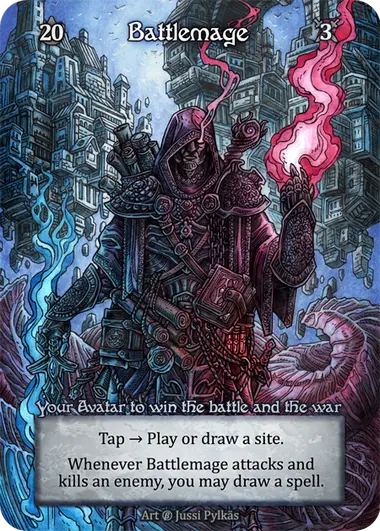
    At its best, Battlemage feels like Avatar of Earth with Sorcerer stapled to it. It’s faster and more explosive than Sorcerer, whilst being a more consistent Avatar of Earth as it has built-in card draw and the fixed three power.

    Battlemage is resilient against minion removal and control because it can always fall back on its own power. Other Avatars that utilise Grapple Shot need to stick a minion on the board or have the mana to play both in a single turn.

    Battlemage also has an incredible number of viable builds. Each element brings something to the table to help leverage its ability, demonstrated by my five diverse deck builds explored in this series.

    Lance tokens are especially powerful for Battlemage. Battlemage in general can leverage the power of weapons and armour Artifacts. So much so, that there are Battlemage builds that eschew minions altogether and go all in on the Voltron style.

    Weaknesses:

    Battlemage must consider its deckbuilding carefully to ensure it can use its ability effectively and perform optimally. You need minions, movement spells, minion removal, and then have to find room for your fun additions. Difficult choices need to be made in deck building Battlemage.

    A slow Battlemage is a losing Battlemage. You need movement effects to be able to maneuver around the board effectively.

    Battlemage can feel weak if the opponent isn’t playing minions and some of your cards might be ineffective – for example, Shrink and Pollimorph.

    Battlemage gets weaker the longer the game goes on. If the opponent can stabilise, play large threats, and whittle down your life, then you are at a disadvantage in the late game.

    Battlemage is weak on Death’s Door. It becomes more difficult to use your ability, and being on the opponent’s side of the board leaves you vulnerable. Screaming Skull is a staple Battlemage card, but is possibly the worst card to draw whilst on Death’s Door.

    Overall, the resource you’re trying to leverage is your life, which is convenient for your opponent as it’s also the resource they’re working to deplete. Battlemage needs to get into the firing line and trade life for board control.

    Further Considerations:

    Is Battlemage a combo deck?

    Battlemage can sometimes feel like a combo deck. You need to draw your cards in the right order and combination to achieve victory. Battlemage needs to have a plan to move around the board, deal with minions whilst attacking the opponent’s life, all whilst preserving their own life total.

    Battlemage cannot afford to dead cards.

    Battlemage cannot afford dead draws. By this I mean cards you’re unable to play or can’t afford to play. Getting your threshold requirements efficiently is important to be able to execute your game plan. I’ll often talk about ‘greedy’ mana bases. Decks that have lots of double-threshold cards in two (or more) elements can be described as greedy because you’re at a higher probability of not drawing the sites you need in order to play the cards you’ve put in your deck.

    One site can shut down all your plans.

    Certain sites can completely shut down your game. Perilous Bridge, Gnome Hollows, and Free City can all singlehandedly do so. Perilous Bridge and Gnome Hollows are especially rough as they can shut down your Grapple Shot. Grapple Shot is probably the most used Battlemage spell as it’s a powerful movement spell, minion removal, and damage spell all in one.

    You need to have a plan to deal with powerful minions.

    Minions with four or more power are more difficult to deal with. Battlemage can always tap to deal with anything three or lower. Much like a picnic, a single Brown Bears is enough to ruin your day. This is where you hard removal options come into play such as Pollimorph and Disintegrate. Two underused options I especially like using are Iron Shackles and Sacred Scarabs.

    Charge minions change the tempo of the game.

    Charge minions pull double duty against Battlemage because they deal immediate damage and if you have to strike them to remove them, they’ve done their damage twice. Beware decks that have a charge minion strategy as you might have to change your entire game plan to cater to the aggressive tempo of the game. Against such a deck, it might be prudent to leave more minions to block or even keep your Battlemage back entirely.

    Airborne minions are difficult to interact with.

    Battlemage can struggle to interact with Airborne minions. They can get away with attacking for free without recourse. Because of this, they can change the tempo of the game more drastically than charge minions. Saving your Grapple Shot to take down the opponent’s Gyre Hippogriffs instead of using it aggressively might be the prudent strategy against opponents utilising airborne strategies.

    Deck List Two: Fire-Air Battlemage

    Fire and Air is a dangerous combination: Charge minions, Airborne minions, powerful removal spells, and crazy maneuverability. Fire and Air is my preferred elemental combination for Battlemage, and this list was looking good to be my Cornerstone contender:

    https://curiosa.io/decks/cmctpwjep00bjle04pxcw777g?tab=view

    However…

    Sorcery has Changed

    Last week was a wild ride – rules changes, the reveal of the Collection mechanic, and more cards spoiled for Gothic. Wow. If this is a taste of how things will be going into Gothic, then I’m excited. There’s so much to wrap my head around. Overall, I am positive on these changes. The rules changes iron out issues and get rid of some weird quirks. 

    Here are the changes that impact my Battlemage the most and will impact my deck builds and testing going into Cornerstone Season.

    Immobile:

    Now Immobile minions cannot move, but they can attack. This is a big nerf to Earth decks using Quagmire to slow down the opponent and get into the late game. This also impacts Battlemage decks using Entangle Terrain.

    Free City:

    In short, if Battlemage attacks a Free City and the opponent defends with their Free City, they will also lose life. This is a huge nerf for Free City. It’s still useful as a tool to take out small minions, but it’s no longer a free and eternal roadblock.

    Strike Damage on Sites:

    Firstly, this means that Daperyll Vampire gains you life when they strike sites. This is an insane buff, and I fear that the Vampires will soon become the most hated and most played minion in the game.

    Grim Guisarme and Mask of Mayhem’s doubling effect occur when striking sites. In the previous article, I talked about using Grim Guisarme to smash down Archimago quickly. Now, this tech is even stronger.

    Lances break on sites:

    I believe this is quite a significant nerf for Battlemage. It’s nice to be able to get that extra one point of damage when attacking a site, but the real strength of Lances was them being a removal spell that could be used at the appropriate time. Now the minion or Battlemage carrying a Lance can’t keep it in hand and wait to use it later.

    Avatars can be Airborne:

    Over the weekend, I put this to the test, bringing my Flying Ponies Fire-Air Battlemage. The tech is that while Battlemage is being carried by a War Horse or Fine Courser, then you play Power of Flight on your mount, thus giving the Battlemage Airborne as long as he’s in the saddle. This can be used to buy a turn of safety in dangerous territory or provide crazy mobility to the Battlemage. 

    Overall with these changes, I think Battlemage got a significant power bump. Battlemage may now be a strong meta choice and its popularity might skyrocket. The chances of that Rainbow Foil Battlemage being won have just increased.

    Battlemage Flying Pony Club

    With the changes listed above, I went and changed up my Fire-Air Battlemage to try out the new tech and in particular Power of Flight. The first change I made was to remove any card that required two Fire threshold. This meant that I lost Hamlet’s Ablaze. This makes me weaker to Gnome Hollows. To counter this, I added Blink to supplement my mobility options.

    I also lost Firebreathing – a card that I found incredibly strong and versatile but often difficult to cast with two Fire threshold. Being able to do four damage to something nearby is incredibly useful, and with more Daperyll Vampires around being able to deal four damage is so important.

    Here is the list:

    https://curiosa.io/decks/cmcy55oxv00arle046woeewkg

    Testing the Pony Club

    I had a good weekend of testing. Firstly step was to try it on TTS, Tabletop Simulator. It’s immensely valuable to have someone to play against where you can stop the game, discuss lines, maybe go back a few steps in the turn and see how different lines of play might go. This means you can get so much more out of your time and be able to see the game from the opponent’s point of view. Having a testing team or partner going into Cornerstone Season will allow you to get much more out of your practice time.

    I also participated in a three-round Win a Box tournament. I took the Flying Ponies Battlemage.

    Round one was against Earth-Fire-Air Archimago. Turn two, my opponent drops a Gnome Hollows in spot eight on the Grid, and I felt my chances of winning drop massively. This one site was going to be a major problem. Fortunately, I had the most powerful card in the game – War Horse.

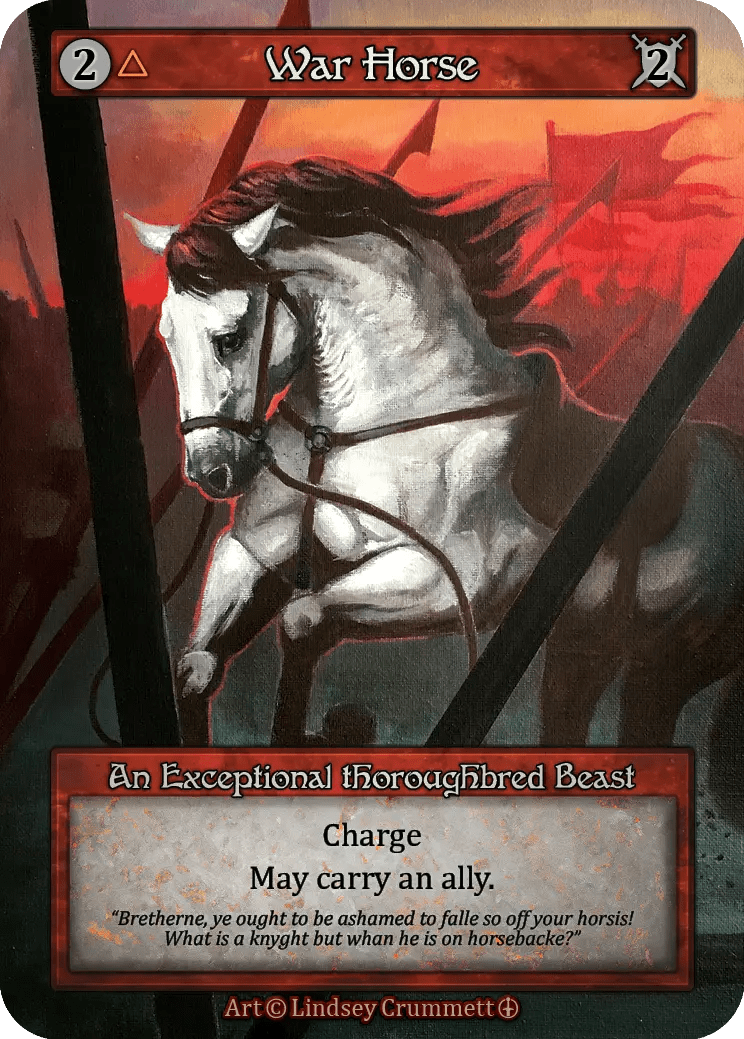
    War Horse is nuts. It feels like playing a Blink that then burns the opponent for two damage until removed. The mobility it provides is incredible. However, because of the Gnome Hollows, I had an interesting decision point: do I use the War Horse aggressively to get damage in, or do I leave the War Horse back to carry my Battlemage around and forgo damage? I figured that since I had five other horses to draw into, the damage was more important. And that decision decided the game for me. The consistent damage provided significant pressure and kept them on the back foot. It took 34 damage to get them to Death’s Door.

    The takeaway from this match is that mobility spells are essential. This list almost feels like there’s too many between Blink, Power of Flight, six Ponies, and Whirling Blades, but they never felt dead. Movement is step one in the requirement to win with Battlemage, after all.

    Round two was against Waveshaper. Turn one, Forge, Lance token. Turn two Ring of Morrigan, and I felt strongly favoured. Two Lugbog Cats were played early, but the Lance and Ring gave me plenty of options to deal with them effectively for free. Combined with Airborne minions to outmanuevre their high-powered water, I felt strongly in the driver’s seat.

    Mester Stoor Worm I think is an underrated card and almost turned the tide against me. Seven power is massive, and its ability provides incredible board control if it cannot attack sites. Updraft Ridge allowed me to play minions away from its breath attack, and then as the board got clogged with Pirate Ships and Tufted Turtles, allowed my Gyre Hippogriffs to attack the one undefended site to get my opponent to Door. At that point, Ring of Morrigan and Whirling Blades made the win inevitable.

    Third round was against Avatar of Air with Earth. This deck plays big beefy minions such as Dalcean Phalanx and Pudge Butcher and then uses all the mobility of Air to get around their innate limitations. The last time I played against this deck, I got destroyed.

    But I won the dice roll, so I got to be the attacking player, giving me an immense advantage. Turn two, my opponent played a Perilous Bridge on spot eight, which might otherwise stop all my offence. But fortunately, a turn two War Horse, then turn three Ruby Core, Blink on the War Horse to carry both of us over the Perilous Bridge gave me a massive tempo advantage to carry the game.

    The lesson here is the importance of being the attacking player. In Sorcery, it’s incredibly hard to turn the tempo, especially in Battlemage. Cards like Ruby Core and Philosopher’s Stone played early can be incredibly powerful. However, when drawn late game they are incredibly frustrating. Having a single Core or Stone in the deck gives you about a 20% chance to see it before turn four in a game (between three mulligans, four draws). This means that one in five games, you have this massive boost. Currently, I like the high roll that a single copy can provide. With Highland Princess to fetch it, I prefer Ruby Core over Philosopher’s Stone in this deck to provide threshold fixing. In decks that are more evenly split between two elements, I prefer Philosopher’s Stone as playing War Horse for a single mana is incredible value.

    Overall, it was a 3-0 showing for Battlemage. I felt like I was in the driver’s seat for all my games. The contribution of winning the dice roll and being on the play cannot be understated, though. It’s such a power boost for aggressive decks. War Horse was insane every game and it makes me reluctant to not include Fire in my Battlemage lists.

    In Conclusion:

    There’s so much to think about, and I’m glad that I have time on my side. Gen Con is two weeks away and there are some Cornerstone events starting this weekend, so some players are having to scramble to react to the rules changes and adapt their strategies accordingly.

    I’m seeing an uptick in events and excitement for Cornerstone Season. So if you haven’t read part one, which outlines my goals and plans for Cornerstone Season, then please give it a read:

    There are three more Battlemage decks to go over, so the next part of this series will go through the remaining three and I will give my verdict on my preferred list.

  • Part One: Battlemage is my Cornerstone Champion

    Part One: Battlemage is my Cornerstone Champion

    9 July 2025

    Sorcery Organised Play

    The second half of 2025 is shaping up to be an exciting time for Sorcery. Dragonlord and Gothic are on the horizon. The recent announcement of the partnership between Erik’s Curiosa and Star City Games means that there are plenty of high-level events on the horizon. But I want to bring some focus to Cornerstone events.

    Sorcery Organised Play is split over three tiers. The first tier, and the focus of this article, is Cornerstone events. To learn about Sorcery Organised play, click here:

    https://sorcerytcg.com/organized-play?tab=overview

    What is Cornerstone Season?

    Cornerstone Season is August to December 2025, when the first wave of Cornerstone events will occur. These events are a chance for Sorcery players to challenge themselves and experience Sorcery in a more competitive tournament setting. I will be pushing myself to attend as many events as I can and then sharing my experience on the Bardsword blog.

    Leading up to Cornerstone Season, in a series of articles, I will go over my preparation and planning. I will share deck building ideas, strategy tips for my favourite Avatar, and then tournament reports afterwards. This first article is about my preparation and goals leading up to the first event next month.

    New Zealand has been lucky to get eight Cornerstone tournaments in the first wave. These are spread out all over the country, with the earliest scheduled for the 23rd of August and the latest on the 25th of October, creating an exciting two-month block of events. The biggest Cornerstone event will likely be hosted by FTW Event on the 5/6th of September in Auckland.

    That gives me six weeks to prepare for the first event, and there’s plenty to do, so let’s dive in.

    My Goals for Cornerstone Season

    So, with that in mind, for the upcoming Cornerstone season, I have come up with some goals to challenge myself. Starting from easiest to achieve to most difficult:

    1. Attend at least three events.
      I encourage everyone to attend Cornerstone events where possible. It can be daunting to make it to events and to put time and energy into preparation, but I think these events will be highly rewarding. I’d like to attend as many as I can, and three is a feasible number to aim for.
    2. Attend at least one event in the South Island of New Zealand.
      Going to tournaments is a great opportunity to travel. It’s an exciting chance to meet people that you’ve talked to on Discord and to visit new stores. The South Island is a plane trip for me, and I will do my best to make the journey.
    3. Make the top cut / make top eight.
      Making the top cut is always a great accomplishment. Cornerstone events are a great opportunity to tap into that competitive spirit and get a taste of what it’s all about. Even if you feel like you’re a casual player, this is a great chance to get a feel for a competitive environment. Perhaps you’ll find it highly rewarding and an encouragement to attend more Cornerstone events.
    4. Win!
      Winning a Cornerstone event would be incredible. If I start practising now, I might be in with a chance. New Zealand has many incredible players, so I don’t make this goal lightly.
    5. Bonus goal: Battlemage Rainbow Foil at a Crossroads Event.
      Crossroad events are the next tier up of organised play. I don’t expect to make a Crossroad event this year, as they are all overseas, so instead I am making this a community goal. I would love to see a Battlemage player place in the top four at one of these events and win a beautiful Rainbow Foil Battlemage. I will be watching the livestreams of these events eagerly and supporting any Battlemage players that make the top cut.

    My Cornerstone Challenge and Champion

    For this upcoming Cornerstone season, there is one other challenge I’m going to attempt. I’m only going to play Battlemage. There are a couple of reasons that I’m making this decision.

    The first is to make it easier for myself. The week before a tournament, my brain jumps from idea to idea, trying to figure out a deck list that can beat any and all. The end result is I settle on something like an Elementalist control pile that tries to do everything and achieves nothing. To help prevent that, I have decided to champion Battlemage for the duration of the Cornerstone series and put that energy into honing my deck list and improving my strategy instead.

    I think it’s important to state that experience piloting a deck and general game knowledge is the biggest advantage one can bring to a tournament. Practising with a deck and getting experience playing it against other strong decks is a far better use of time and energy than endlessly revising a deck list.

    So why Battlemage? A big factor is that I hate mirror matches. Choosing a less popular Avatar facilitates that. The second reason is that I dislike playing proven meta high performers. Battlemage is a popular avatar and has won tournaments over the years, so it isn’t a complete underdog, but I still think he is sufficiently underrated for my purposes.

    So why am I sharing my secrets so far out from the tournament? One part of me wants to jealously guard my secrets, but surprise factor only goes so far to win a tournament. I feel that by sharing my preparation, I can encourage players to get the most out of their own preparation time and get excited for upcoming events. I want people to start thinking about Cornerstone events as an opportunity to push themselves and to get involved in the community.

    My Battlemage Backstory

    Earlier this year, I had success with Battlemage, placing first on day one of Tūmatarau whakataetae o Aotearoa, and fourth overall after a top cut on day two, losing to our incredibly skilled resident Avatar of Air player, MattdogNZ. This was my list for day one:

    https://curiosa.io/decks/cm6u4q40h007hkz036nzi3sc3

    I piloted Water-Air Battlemage, with usual the suspects such as Shrink, Gyre Hippogriffs, and Screaming Skull, inspired by the works of Count Tolstoy. My innovation in that list was to use Grim Guisarme in an attempt to combat Archimago by being able to burst the opponent down to Death’s Door in a single turn. I managed to do just that in my first round match, and then dodged Archie for the rest of the event.

    It is important to note that – much like how Roots of Yggdrassil wasn’t popular amongst Kiwis in the late Beta meta – players in Auckland seem to prefer to not play Archimago for various reasons. This does result in a unique playing field compared to other events held around the world.

    Flavours of Battlemage

    Battlemage can be built in a myriad of different ways, in different combinations of the four elements. I think there are many viable builds, and part of my preparation for Cornerstone Season is to decide on which build I want to pilot.

    I have five different Battlemage decks to choose from, currently ranked in order of my personal preference. I will go over one deck list in this article, and the rest in later articles in this series, so stay tuned for more. Here are my top five Battlemage flavours currently:

    1. Fire-Air, featuring Hamlet’s Ablaze and Updraft Ridge to use site placement and destruction to my advantage.
    2. Water-Air – similar to my above deck list, but adapted below…
    3. Earth-Fire anti-aggro – featuring Pebbled Paths and beast synergies.
    4. Fire-Water-Air – all the toys with the greediest threshold requirements.
    5. Earth-Air – inspired by Anger Worm’s recent success at the Battle of Elverson Fields.

    Option one: Water-Air Battlemage:

    So, here is the first of my five deck lists. This is currently my second-ranked list in preference, but it is probably the most meta-popular of my five, so serves as a good springboard.
    This is my current version of Water-Air Battlemage:
    https://curiosa.io/decks/cm6phuex9002pl703lu4ccv1t?tab=view

    This list is a bit different to my previous Water-Air list, preferring Airborne minions over other strong minions like Phase Assassin and Blue Knight. This allows me to unlock the potential of Updraft Ridge.

    The strengths of this deck is that it has explosive power, being able to cheat the curve with cards like the Ordinary Tower sites and Mix Aer. Pond and Lugbog Cat is another common combo to get a powerful minion early. Hounds of Ondaros are also increasing in popularity because they’re a strong resilient threat.

    A major weakness of many Battlemage decks is that they have greedy threshold requirements. My definition of ‘greedy’ is a deck that requires hitting exact combinations of sites in the early stages of the game to properly execute its plan. This deck wants four or five sites providing at least two water and three air threshold. It’s important to note that Floodplain can provide two water threshold by itself through flooding your own site. Sinkhole is a powerful card and can be essential in overcoming problematic sites like Perilous Bridge and Gnome Hollows, but it does put strain on the threshold requirements of the deck. An important part of testing will be to see how many games I lose because I missed critical threshold points.

    I think the power of Air is obvious for Battlemage. Grapple Shot, Gyre Hippogriff, Daperyll Vampire are just excellent. But whilst Water has a handful of great cards, it feels less vital. Water brings to the table cards such as Pollimorph, Atlantean Fate, and Ruler of Thul, but their double threshold can be massively prohibitive. In my opinion, the strongest reason for including Water is to protect your minions from bury effects, such as Earthquake and Bury. Playing a Daperyll Vampire to a Water site so they’re protected through the opponent’s turn from bury effects can be the difference between winning and losing a game.

    Sisters of Avalon is a card I’m currently testing. It has many perks. Firstly, it’s a cheap spellcaster. This means that it can cast Shrink and Pollimorph and provide more board coverage. Secondly, it’s good against Maddening Bells, which Kiwis seem to love playing, by extending the effective range of your Disenchants. If you’re playing Magic Missile over Lightning Bolt, they can also help with creating effective angles of attack. Thirdly, they are a compromise to having a toolbox of answers in the deck. In this list, there are two Disenchant, two Geyser, two Screaming Skull, which each can be the strongest card in a particular moment or absolutely useless. Sisters of Avalon can help you effectively mulligan these cards and draw you to the cards you need.

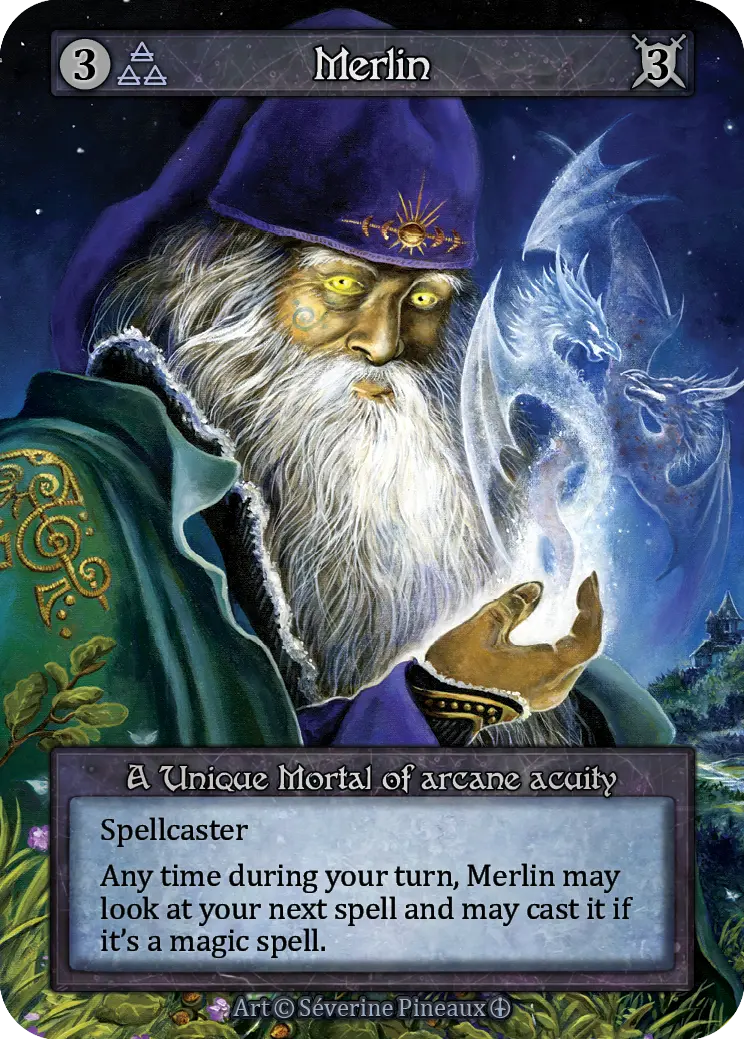
    Merlin is a contentious one. I enjoy the push-your-luck aspect of his design. Sometimes he can string together an unbelievable series of magic spells off the top. More often, he’ll do nothing. Merlin is one of those cards where good players would say they don’t enjoy luck and would rather have a weaker but more consistent card and rely on their personal skill to win the day. For me, I like rolling the dice. And in many ways, Battlemage as an Avatar choice is all about high risk, high reward.

    Updraft Ridge I think is an incredibly underplayed card. Airborne minions are already incredibly strong, and this site gives them such a power boost. This deck leverages Airborne minions to win the tempo race and get around the opponent’s problematic sites. The additional movement is something opponents can overlook, and I’ve won games where my opponent forgot to take it into consideration.

    Overall, looking at this list, there are definitely some things I’m not confident about. Trading consistency for power is the most critical factor to consider here. Testing will help reveal this line

    Start Your Engines for Cornerstone!

    Now is the time to start thinking and practising for these fantastic Cornerstone events. It might be worth organising events at your local store so you can earn Dust and test at the same time.

    Stay tuned to the Bardsword blog in the following weeks for the four other Battlemage deck lists and to hear how my testing is going. In part two of this series, I will also give more general Battlemage strategy tips that can help you play or play against Battlemage.

  • Some Context: My Game Journey from Magic, Board Games, to Sorcery

    Some Context: My Game Journey from Magic, Board Games, to Sorcery

    1/7/2025

    A Foil Bloodstained Mire

    Like so many, I grew up with Magic the Gathering. I was probably around 10 when I first played. It was at a school camp, and everyone was sharing their smuggled contraband. A pile of tatty cards featuring various monsters captured the attention of all the kids. At the time there was no way I could anticipate the impact that this game would have on my life. A friend graciously gifted me a pile of common goblin cards, and that became the seed of a 25-year-long collecting and gaming hobby.

    Urza’s Saga was on the shelves at the time, but we had our eyes on Craw Wurms and Shivan Dragons, so we spent our pocket money on bulk commons rather than ripping booster packs. Too bad I didn’t know about Tolarian Academy back then. But that era of pure innocence is irreplaceable. We played on pure joy and imagination.

    I would play Magic on and off throughout my childhood years, but I moved schools and lost touch with many friends. I played and collected Pokemon and Score’s Dragon Ball Z, instilling that sense of wanderlust that maybe the next best thing can be found in a completely new game instead of the tried and tested one. In the process of exploration, novelty was found, but at the cost of never quite being on the same page as everyone else. Not quite being in the right place at the right time became a frustrating theme.

    And then in 2002, the set called Onslaught drew me back in to Magic. I remember getting a tournament pack, and the excitement to be opening so many cards in one go was immense. The first card I saw beneath the cellophane was a foil Bloodstained Mire. How disappointing. A rubbish land, that costs life, and a waste of a foil as well. I think I sold it for about 40NZD soon after and was pretty happy with that at the time. Probably immediately grabbed another four or so booster packs. I sometimes look up and see how expensive that card is now, but ultimately that feeling is just part of the hobby. Sometimes regret can be a useful emotion in the collecting hobby, or maybe it just helps create a hoarding mentality…

    The Onslaught block was also the only Magic set that I have ever collected in its entirety, completing Onslaught, Legions, and Scourge, giving me an appreciation for the difficulty and cost of pursuing such endeavours. My greatest Magic the Gathering success was winning a Champions of Kamigawa prerelease on my 15th birthday. Meloku the Clouded Mirror was one hell of a card, and I had two in my sealed pool, so I think that win was more luck than skill. But when things align, it does create a sense of serendipity that is quite intoxicating.

    But the overall feeling that I learned about competition in Magic was that it wasn’t for me. I enjoyed the thrill of playing with actual stakes, with prizes and pride on the line, but it was all too often not enjoyable. I learned about zero-sum fun. This is the perception where there needs to be a loser for there to be a winner. This attitude extended to the other parts of the hobby, and trading often felt like a hustle rather than something mutually beneficial.

    The only trade I remember fondly through all of this was at a prerelease, probably around the Kamigawa block, where my goal was to trade for a Mirari’s Wake for a kitchen table deck. An older player had a foil copy that was well beyond the scope of what I had to offer, but he generously gave it to me seeing my enthusiasm for it. It’s a shame I don’t remember who that player was, but it left a permanent mark on me that sometimes the best trade deals are the ones where dollar amounts aren’t considered. I try and remember that lesson whenever possible.

    Eventually, I developed an all-consuming World of Warcraft addiction and there was no longer time for Magic.

    The Board Game Era

    During university, I stopped playing Magic altogether. Completing that Onslaught block set taught me the difficulty and cost of pursuing completionism, and now there was beer and World of Warcraft subscription time to buy. I did dabble in the Spoils card game and the World of Warcraft TCG, but was unable to afford to go beyond starter decks and a few boosters. Getting a taste of a fun new game and being unable to delve further in was more frustration than it was worth.

    Then I saw the Summoner Wars board game. I couldn’t believe that in a single product I was getting all the cards I needed to play, all at an affordable price. I quickly made my purchase and walked out of the store feeling like I had robbed the place. But the first taste is free for a reason.

    But my board game was missing a crucial ingredient – people to play it with. World of Warcraft had given me hours of entertainment, but it had withered away my social networks and social skills. I had spent years with faceless players, grinding away in a video game. Meeting and playing with new people was certainly too much for me at the time. Thus began convincing uninterested friends (the few real-life friends I still had from school) to play board games with me. If only Discord existed back then.

    Then came the Lord of the Rings Living Card Game by Fantasy Flight. This was a solo board game. Now I didn’t need to find an opponent, and I could dive in to the mechanics and adventure all by myself. Thus starting a long and expensive hobby of collecting and sourcing packs from around the world. If I’m honest, my favourite part about the LotR LCG wasn’t collecting or playing it; it was listening to a fan podcast, Cardboard of the Rings. The sense of being in a community, of listening to other people’s stories and experiences of the game. Year after year, I heard about all these incredible conventions held in the States. Later on as the internet and social media developed, terms emerged such as ‘parasocial relationship’ and ‘FOMO’ which may better describe the situation here.

    Over the years, I leaned heavily into collecting board games. I was the guy that rocked up to a social event with a bag full of games that no one really wanted to play, but if things got boring enough, then perhaps a board game would be acceptable. There were some incredible nights where a board game absolutely landed and left everyone wanting more, spurring me on to buy more and more. But more often than not, it didn’t last past the rules explanation before we decided to play a drinking game instead.

    But that’s the beauty of competition. It’s a shared desire to attend an event and participate in an activity. That’s the secret weapon of card games like Magic. That people converge in time and space to play together. People bring energy and a desire to share ideas, to put those ideas to the test. I was lost in the hypothetical without enough opportunity to channel that latent energy into something meaningful and useful.

    Ultimately, I feel that board games suffer from that failure of time and place. It often feels like no one is ever quite on the same page, even at a dedicated board game event. When sitting down with a group, there is disconnect right from ‘what game should we play?’ Then through a rules explanation, there is a further gulf created from the knowledge, skill and what people want to achieve from the game. Add a few cell phones, side conversations, rules questions, and drinks and… it often just doesn’t quite work. It’s the unsatisfying feeling of a buffet restaurant, of quantity over quality.

    By this time, I was longing to go back to Magic. The structured format of organised play has merit, especially for anxious and awkward young men like myself. Even if the vibe got a bit too cutthroat, at least everyone was on the same page.

    Netrunner: the Best Game Ever Made

    Then came Android: Netrunner. Netrunner was everything I wanted out of a game. It was competitive. It was deeply thematic. It was novel in its mechanics and gameplay. Then events started popping up, and I braced myself to dive back into ruthless competition, but, unexpectedly, it was different to Magic. Everyone was having fun.

    Netrunner did not have that savage competition, that zero-sum brutality. I realised that it was more about the shared story space that emerged between two humans and their piles of cards. The game invited you to understand your opponent, to see them as creative and cunning and capable. The game wasn’t played on the table. Heads were raised, we looked each other in the eye, and we asked each other questions – ‘Is that a Snare or an Agenda?’

    Perhaps because of this, perhaps because the genre and subject matter encouraged inclusivity and empathy, Netrunner seemed to attract the best players in the community. People were friendly, welcoming, and engaging. Competition could occur without negativity. Suddenly, it didn’t quite matter as much if you won or lost. There was something else being generated, something worth more than prize money and rare promo cards.

    Unfortunately during that time, I had a difficult work schedule, so I couldn’t play for weeks at a time, and then when I did have time, I was too tired to attend events. Combined with a format that changed constantly due to the monthly release model, I just couldn’t keep up. I regret not pushing myself to attend more events. When the Fantasy Flight run ended with Reign and Reverie, I was left wishing I had done more. I had found myself at the finish line with gas left in the tank.

    Chasing the Dragon

    I had experienced the best of what games could offer. I had also experienced many lows. There were some incredible moments, but there was much more discontent. I was now in my 30s and becoming disillusioned with the hobby. In many ways, games – the thought of games – became a coping mechanism, an addiction to get me through the long work days. Retail therapy.

    Instead of playing board games, I became a board game collector. I would dream up situations where a game would be the perfect activity for a particular situation with a particular group, and that would be enough to click buy. Receiving a package, unboxing it, putting it on a shelf… well, that was about as far as it got for 90% of my board games.

    In Magic, Commander, or EDH, was on the rise, seemingly offering the Holy Grail of gameplay. A chance to play with three friends, to utililse your entire collection, singleton, and actually have fun playing Magic. I poured money into Commander chasing that dragon, building decks and stockpiling singles.

    But Commander was a poisoned chalice. For many players, it was a platform to destroy and demoralise three people at a time. Bad-faith actors could never operate with more efficiency at a gaming table. I’ll reiterate that I’m not saying all Magic players are like this, but with four players, the odds are high that at least one person can spoil the experience for one reason or another. Commander is the worst of Magic combined with the worst of board games.

    By this point, I had tried everything. I was burnt out on board games and Magic. COVID had done its damage and changed the landscape of interacting with people and going to public spaces. At this point, I decided I was done with games and it was time to move on to something else.

    Ensorcelled

    And then I saw Sorcery advertised on Kickstarter, and I changed my mind.

    Well, no. The Kickstarter looked amazing, but I looked at my shelf of games, and closed the browser. I can’t do another trading card game.

    But it stuck in the back of my mind over the next few weeks.

    Throughout the pandemic, Team Covenant kept many of us sane by streaming various games on their Youtube channel. I enjoyed watching their content because of the friendship and comradery they showed. I sensed a genuine passion for games in the way they talked about the hobby and the wider industry. They certainly were putting in the hours during a time where most people opted to opt out.

    I had found their channel years before by searching for Netrunner content. They often talked about how they’d had a similar experience as I did with Netrunner, experiencing similar positivity, so I sensed that I was on a similar bandwidth as them when it came to gaming.

    So when Team Covenant began talking about Sorcery, I listened. Now I was ready to back the Kickstarter.

    What appealed to me the most about this fledgling project was that it wasn’t going to be a competitive game. It was a trading card game where I could set my pace. One set a year meant I could build decks and attend events at a nice relaxed pace. I didn’t need to put more money into it than I was comfortable with. Sorcery didn’t demand anything from me.

    With Alpha in hand, and Beta starting to hit the shelves, something happened that I did not intend. I started playing and enjoying Sorcery as a competitive game.

    Positive Feedback Loop

    As with most things, that shift from zero to competitive Sorcery player didn’t happen overnight. It was a series of small and vital steps. The first and most crucial step was that I met incredible people playing Sorcery. The game seemed to attract likeminded individuals that shared my frustrations of the wider hobby and had found a reignition of passion in Sorcery.

    I was still in a COVID mindset so there was some re-acclimatising that needed to happen to get back to being comfortable in public. Social anxiety had crept back in during the isolation, so it took some work to overcome that. Fortunately, I found a player interested in trying the game who lived out in the same rural area of Auckland as I did, so he graciously offered to pick me up on his way through to the store to play some games. It was only much later that he revealed how nervous he was that I might be a complete nutjob weirdo and was relieved that I was all right. So, shoutout to Rich, and thank you for taking that risk.

    Sorcery has a steep learning curve, so luckily everyone was on the same page in terms of game experience. It was an enjoyable time muddling through the rules, discussing scenarios, and talking strategy, all with an easy grace of likeminded and easygoing individuals. There was no ruthlessness, but competition was active and engaging. I wish there was some way to capture this experience and package it for new players. An issue currently is that new players find it challenging to learn the rules of a very complex game, whilst also dealing with the gulf of knowledge between them and enfranchised players. If anyone resonates with this point and is struggling, then please persevere. It is a challenge, but it’s worthwhile, and everyone will help you to the other side if you ask for help.

    During that initial league at Baydragon, I started meeting the people that would become the familiar faces of the Auckland scene. Community events hosted by FTW Events in Auckland gave this spark kindling, and I began feeling the call of the competitive spirit, encouraged by the positive feedback loop of great experience after great experience. Soon I found myself flying to Melbourne to play in my first ever international tournament.

    That event in Melbourne cemented Sorcery in my mind as something worthwhile, not just as a game, but as something that I can put my time and effort into. The energy at Plenty of Games was electric. Everyone was smiling, eager to share stories, show off their cards, and make trades (trades based on vibes and not online prices). The store itself is fantastic and well-equipped. The staff are all lovely. And there are actually plenty of clean bathrooms.

    At this tournament, I also somehow managed to make the top eight. I was having fun and doing well. Though, my standings were salvaged by the draft portion of the event more so than the prowess of my constructed list. I remember returning back late after lunch on the second day and missing the announcement of the top eight. I was informed that I had made the cut. I rocked up last as Jesse, the tournament organiser and community legend, was trying to herd players to take a photo, so he was surprised to see me holding out my hand for a Crown Sorcerer. To be fair, I was surprised too.

    There exists Youtube footage of me being crushed in my top-eight match. It was the first time I had properly played against Enchantress. I was exhausted and mentally drained. There were some boisterous Warhammer players nearby, so it was hard to focus. But still it was one of my favourite and most memorable games I had. My opponent was gracious, and Jesse was able to provide a level of clarity and expertise to the rules that made for a great learning experience. I played my Plague of Frogs into an on-board Wildfire, amongst many other obvious mistakes, and it was inevitable that I lost. But still, I left the event with something greater than any prize – a vigor to delve deeper into the hobby and give more of myself to the community.

    The Domino That Did Not Fall

    Over the following year, I played multiple times a week, attended more FTW community events, and even went back for another tournament in Melbourne. It was a whirlwind year, and I was cruising on a high of positive emotions. In that time, my collection goals ballooned, my spending increased massively, and going into Arthurian Legends was a feverish dream of ripping packs and going to every event on offer. 

    And despite all of that, it seemed that the set just didn’t quite land with the community. Attendance in Auckland quickly dwindled. People were disgruntled about various things. Players returned to Magic and other popular franchises such as One Piece. I think there are several reasons that could possibly explain this, such as economic downturn, a perceived barrier to entry to learn Sorcery, and a reluctance for players to embrace change – such as the increase in deck size.

    This is currently a challenging time for enfranchised players, but I think the tide is turning. There is a strong passionate core of players carrying the torch, new players are testing the waters, and Gothic has immense potential to reignite the wildfire. A firework in the sequence didn’t quite work with AL, but there’s still a whole display to detonate once the fuse is reignited.

    However, what the fanbase has done under its own steam is incredible. Every stumble is met with two hands held out in rescue. Things currently aren’t loud and flashy, but they’re there, and people are having fun. People genuinely love this game.

    Take a Look at Where We Are

    Sometimes it’s beneficial to take a step back and reflect properly. Climbing a mountain is more fun if you actually turn around and see the progress you’ve made.

    I hadn’t intended to write out this massive chunk of exposition, but I felt compelled to share, that it was important to set the stage for the blog and my writing. I expect my story isn’t unique. In fact, I think my story is very typical for Millennials. The threads of my story culminate into where I am currently and hopefully explain my thinking and position on many things.

    My story may sound gloomy and dismal, but there were many great times in the mix that I’m grateful for. However, the crushing industrial process of turning hobbies and nostalgia into a commercial product has left me pessimistic. That is why Sorcery is so refreshing to me. You can’t escape the realities of capitalism, but it’s nice when profit isn’t the number-one objective of a company. It has to be on the list somewhere, of course, but not being priority one makes a massive difference.

    Looking to the future, and Cornerstone and Crossroad events are on the horizon, and then Dragonlord and Gothic some time after that. There is a lot to be excited about.

  • The Dust Store is so much more than just a rewards programme.

    The Dust Store is so much more than just a rewards programme.

    With the Arthurian Legends refresh of the Dust Store, I have seen many people asking for advice on what they should spend their dust on. I’m here to make that decision even more complicated. In this blog, I’m going to list my favourite cards available through the Dust Store, both old and new, and explore the six ways that the Dust Store is much more than just a rewards programme.

    • The Dust Store is an opportunity to provide alternate art promos to entice collectors.
    • It rewards players for playing.
    • It allows for design innovation from the designers.
    • Provides practical solutions to enhance gameplay through accessories.
    • Celebrates artists.
    • Preserves the history of Sorcery.

    For each of these points, I have chosen one item from the Dust Store that exemplifies the point. My goal with this blog post is to generate excitement for the Dust Store and get more out of their rewards.

    I think it’s important to state how easily dust can accumulate through consistent participation over time to allay negative feelings. Between participating weekly, opening one or two booster boxes, and winning an event or two, it’s entirely feasible to earn 1500 dust in a year. So far, we haven’t seen the Dust Store go out of stock on anything, so there is time to earn and spend down the road. The marketplace aspect of the Dust Store promos is important but beyond the scope of this blog post. I’m just focusing on fun for now.

    The Dust Store is an opportunity to provide alternate art promos to entice collectors – Camelot (1500 Dust)

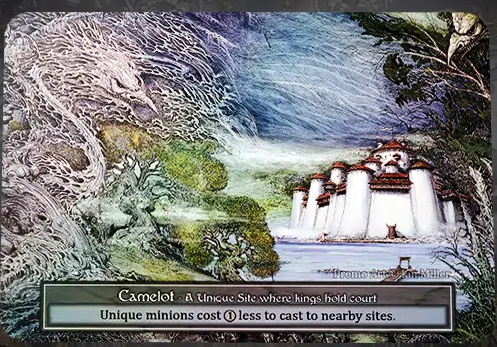
    Camelot is my favourite addition to the Dust Store. It’s the perfect encapsulation of what the store can offer. Collectors are rewarded by being given the opportunity to get these amazing alternate art cards. Whilst I’m certainly looking forward to playing with my Dust Store foils, I know most players are picking these up to add to their collections. The Dust Store does serve to provide that little bit extra value for people who are buying a lot of product.

    I love this alternate-art Camelot for many reasons. Firstly, Camelot, in my opinion, is a strong, fun, and powerful site. Currently, meeting threshold requirements is incredibly important due to having fewer proportionately sites that produce multiple threshold in a 30-card Atlas, powerful cards that attack sites directly, such as Hamlet’s Ablaze and Sinkhole, and the intense requirements of powerful cards such as Morgana le Fay. Due to this, I feel like we haven’t seen Camelot really hit its stride in the current meta, but I expect it to be a strong card into the future.

    The main reason I enjoy this card so much is that I’m a huge fan of Ian Miller’s artwork. This version offers a grim reinterpretation of the original version. 

    In the Jeff A. Menges piece, we see a resplendent Camelot, with triumphant knights returning home, banners waving in the breeze, and the castle gates wide open to welcome the heroes home. For me, this art depicts the height of King Arthur’s reign. However, in the Ian Miller artwork, I see Le Morte d’Arthur, the death of King Arthur.

    In the Ian Miller piece, the bridge from the shore to the castle has been severed, the gates are closed, and the angle looking up to the wall presents an insurmountable cold cliff. The transition of colour from the white castle walls to a lush green forest being drained of its colour, all shadowed by a dark sky and encroaching evil. This pieces says to me that the good times ushered in by the reign of King Arthur are over. This is the end of the Arthurian Legends.

    And we’re going into Gothic. Ian Miller is no doubt going to be featured heavily in the upcoming set of Gothic, so to me, this feels like a deliberate tie-in between two otherwise very disjointed sets. Arthurian Legends feels light, whimsical, and playful; whereas Gothic certainly won’t be. The Ian Miller Camelot is a perfect middle ground from where we are to where we’re going next.

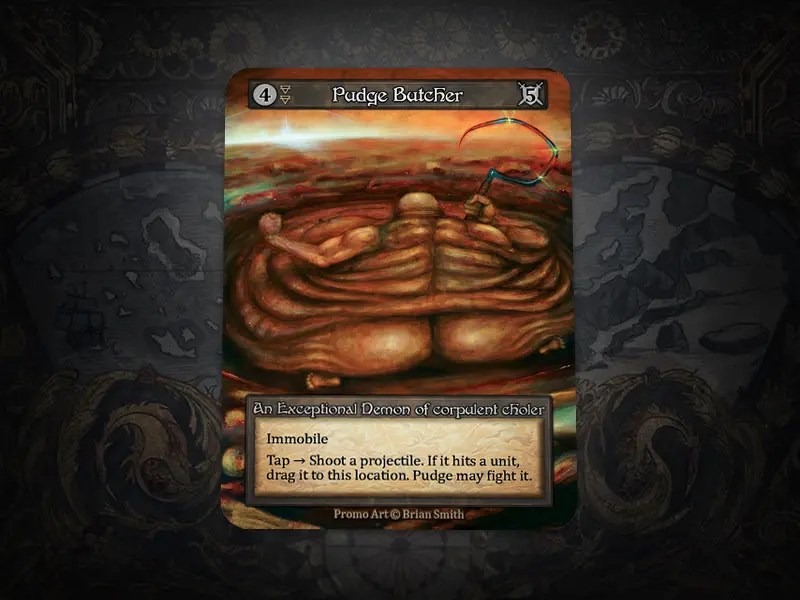
    It rewards players for playing – Pudge Butcher (200 Dust per copy)

    Pudge Butcher might be the card that has hooked more new players into Sorcery than any other, so it’s always fun to see it being celebrated.

    The Pudge Butcher promo also showcases the benefit of the change from one copy per customer per lifetime to three, as players can now get a full playset of three copies of this Exceptional rarity card from the Dust store without having to go to the secondary market.

    Before this change, it was a mission to get a second and third copy, and players who achieved this often then kept them sealed, not quite making the leap to putting them into a deck. Now that everyone can get a playset, I expect this will open the floodgates to the idea of people using their Dust Store promos in decks instead of keeping them sealed in plastic or locked away in a binder.

    Pudge Butcher represents how the Dust Store rewards and celebrates players playing the game. Taking powerful constructed cards and giving them alternate art is a celebration of players. I hope to see other constructed staples get similar treatment in the future through the Dust Store, but I expect such cards are being saved for store promotions, such as the teased Apprentice Wizard and Grandmaster Wizard from Severine Pineaux.

    It allows for design innovation from the designers – Druid four pack (1000 Dust)

    The Druid Dust Store promo highlights how the store is a powerful tool to help the designers break out of the limitations and challenges imposed by the requirements of the printing process.

    The Druid as a double-sided card could have been handled in many different ways. I think the option of putting the foil Druid cards in booster packs as three or four separate cards would have had serious drawbacks.

    Firstly, combining the two Druids into one foil card would mean we’d lose the beautiful full-art back for two cards. And in my opinion, players opening the tokens would have caused more confusion and bad feelings than positive because of the connotation created by other card games that token cards are low value.

    This Dust Store package gives a feasible way to print all four in the way they deserve whilst preserving their perceived value. This shows how experimentation in design can be facilitated by the Dust Store, and I expect to see more of this in the future.

    Provides practical solutions to enhance gameplay through accessories – Soldier Tokens (200 for AL four pack, 400 for Alpha-Beta three pack)

    The tiny Foot Soldier tokens are a tidbit from the Kickstarter when the tokens were accidentally printed quarter size instead of half size. The fanbase loved this, and it was kept this way. 

    There are pros and cons to tokens at this size. An advantage is they help reduce clutter on the board and can be easier to handle in larger quantities. The downside is that they are easier to overlook and be obscured by other cards.

    For ease of game play, using full-sized Foot Soldiers tokens could be beneficial. I find often a Foot Soldier that comes down on turn one through an ordinary Village site can be easily overlooked and forgotten until it causes a critical error. They can easily be covered artifacts held by the avatar and minions played to the back row such as Highland Princess. Larger tokens helps prevent this issue by making the token have the same presence as other minions.

    The tokens help players customise their game experience and have options for how they want their game to look. I think there’s a lot of value in offering these options and provide players with personalisation options in the Dust Store.

    Celebrates artists – playmats, Watchtower, Roots of Yggdrasil, Mirror Realm, Primordial Spring (800 Dust each)

    Did you know that you can win the game before you start playing? If you put down a Roots of Yggdrasil playmat, the opponent will be so tilted by their strong emotional reaction to the power of this card, they’ll be unable to play at their best.

    I think the one thing players, collectors, and everyone involved in Sorcery universally agrees upon is that the artwork in the game is incredible and important. People are generous in giving their support and appreciation to the artists, and the Dust Store is another way in which this can be achieved.

    This is a bit of a cheat category as everything in the store proves this point, but I chose the playmats in particular to represent this. They showcase the passion and consideration that Erik’s Curiosa has for their artists in supporting them and championing their craft. The artwork comes to life at the larger size and small details can be noticed and appreciated at this scale.

    I would like to encourage players to embrace the half-sized mats and use them more often and bring them more often to events. I think it’s fun to sit down, place down your mat next to your opponent’s and share a moment to share and appreciate the art. It’s a great way to ease into a game and get into that positive mindset that makes for an enjoyable experience.

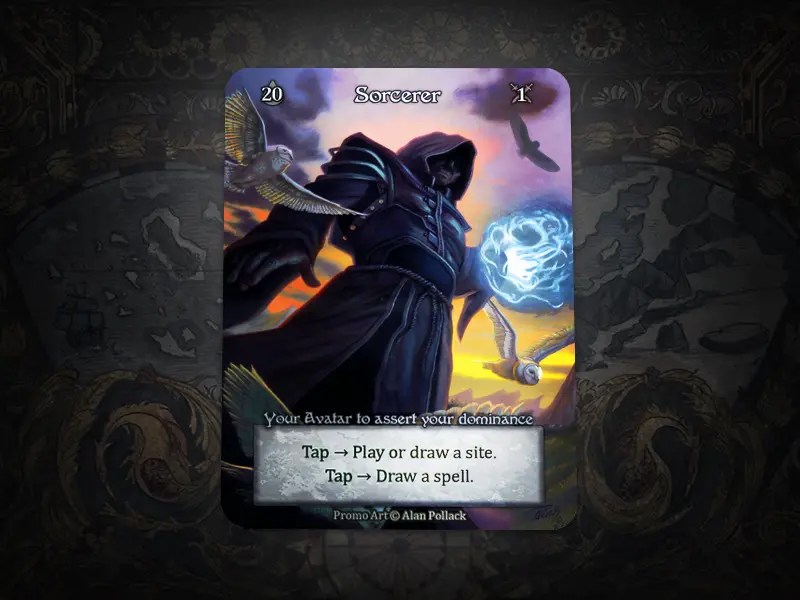
    Preserves the history of Sorcery – Sorcerer (300 Dust)

    The Dust Store can be used to preserve the history of the game. The Sorcerer is an iconic avatar, and this version gives a chance to preserve the Alan Pollack artwork that was previously only available through the Kickstarter and make it more accessible.

    I think perhaps the Sorcerer promo has been unfairly maligned, with players questioning why they would spend dust on yet another copy of the Sorcerer and that it might not be worth the dust, especially considering the availability of the box topper foil Sorcerers. I think this perceived negativity is perhaps the reason we did not see the previously spoiled Common Cottagers in this Dust Store update.

    It is unfortunate for something to be put on to the Dust Store and then rejected by the fanbase. Dust is a precious commodity, and players want to save their currency for when it really matters. I do hope that we see more items like the Sorcerer in the future, but perhaps we will see historical pieces like the Common Cottagers distributed in other ways. The Dust Store can’t quite resolve all issues, but it is still a powerful tool in the arsenal to help.

    I enjoy the Sorcerer promo and am grateful to have it in my collection. I think it gives an insight into the creative process that goes into the game, and that’s something I hold high value for.

    Concluding remarks:

    As I finish up writing this blog, I am eagerly awaiting my promos to arrive in the mail. I am definitely an overthinker and I enjoy musing about these things. As the store refreshed with the AL offerings, I acted a bit too quickly and missed getting Briar Patch because at the time I thought it was only one copy per 500 dust. Due to shipping to my part of the world being so expensive, I save up and do a single big order, so the Briar Patch will have to wait another year. Last year, I couldn’t afford Cloud City, so that was the first thing I put in my cart this time.

    Thinking about that Cloud City promo was a bit of a past-time over the last year, including accidentally bidding on a regular foil Beta version on Ebay thinking it was the promo. Fortunately, I didn’t win that one. Though, at the time I did need a Beta foil for my collection, so it wouldn’t have been a total fail if I had. It was incredibly satisfying a few months later when I opened a foil Cloud City in a booster pack, though. All that to say is that sometimes overthinking can be positive, especially when it’s about cardboard and our hobbies that bring us so much joy. If you’ve read this far, you’ve probably already picked that up about me, and you can expect much more of that in my future posts.

    The Dust Store is a privilege. It’s an example of how Erik’s Curiosa goes above and beyond in many regards. For players and collectors, it’s a chance for us to show our appreciation by using it and taking the time to share our thoughts with the community. If anyone sits down to a game with me and has three copies of Melissa A. Benson’s Warhorse, you will have my immense respect.

  • Five Predictions for Gothic

    Five Predictions for Gothic

    13/6/2025

    Note: this was written and not published before the spoilers on 13/6/2025, so I will resist the urge to update this blog with those in mind.

    Note: Please forgive the current lack of graphic design. This blog is a work in progress, but most importantly for me is the writing, and I need to start getting that out into the world for feedback and to prevent procrastination, so please enjoy this old-school column. To look up cards, please visit: https://curiosa.io/cards

    Greetings. We’re currently in a lull period between sets, and whilst things have slowed down a touch, the whirring in my brain has not. Sorcery has taken over my life in the best way possible, providing me an opportunity to socialise, enjoy an incredible new hobby, and occupy my brain with something somewhat more constructive than its usual overthinking. I am constantly thinking about new decks, new strategies, and with a new set on the horizon possible new cards.

    So, here are five of my personal predictions for the upcoming Sorcery set of Gothic. Some of these are pretty wild and some are probably pretty obvious. It will be interesting to see how far off the mark I am once the set has been released. This is a big of a long-form article, and hopefully my thoughts aren’t too meandering. Number five is a bit of a controversial one, and I have included a prediction on the release date at the bottom.

    These ideas and thoughts came about by thinking (probably too much) of cards and mechanics that would benefit current competitive and casual gameplay, how cards interact with other cards from Alpha-Beta and Arthurian Legends, thematic ideas that would fit into a dark and gritty Gothic set, and parallels to other card games that might have influenced the designers.

    1. New and more minion tokens:

    This is an easy one to start off with. In many games of Sorcery, it feels like the board gets simplified too easily. Minions trade, spell removal is clean and efficient, and the board gets cleared quickly through these interactions. There are plenty of cards that easily clean up small minions, such as the Desert sites and Magic Missiles. We even already have a silver bullet card with Rain of Arrows. Even the design of The Great Famine and the Black Plague feel like precursors to more complex boards and the expectation that number of token-generating cards will increase.

    An advantage of having more small minion and minion tokens is that they can protect your larger and more expensive minions by ‘chump blocking’. One of the disappointments in Arthurian Legends is that the awesome knights get easily taken down by the usual suspects of efficient minions and removal spells. All the minion token generating cards in AL are expensive, such as Guards! and Invasion, so it often felt like the Sirs and Dames didn’t have the necessary backup to stick around on the board long enough to do anything meaningful.

    Lance tokens were a good design choice to help remedy this, but it feels like Lance tokens were cost slightly too high to really achieve this purpose as they function more like removal spells than speed bumps.

    So minion tokens are the perfect compromise to this problem. Already we have seen Gift of the Frog spoiled for Gothic. This is a strong early game roadblock for water decks, but requires a one-drop minion to function on curve, so my prediction for this category is a basic Ordinary site: 

    Lily Pad Pond.

    Water threshold.

    An Ordinary site emits a lonely croak.

    Genesis – create a submerged frog token.

    This helps fill the one-two curve for water decks with Gift of the Frog. Having the token enter submerged makes it play similar to Tadpole Pool, so it functions how players would expect it to. Having the token entered submerged lowers the power of the site by making the chump blocker be more constrained by having to unsubmerge to protect adjacent sites. It’s a choice to make the genesis effect free, compared to the ordinary village sites, but I think the zero power minion and entering submerged is enough of a drawback to justify this.

    1. Tribal archetypes (that use new minion token types)

    Tribal synergies are a fan favourite in many games. Elves and Goblins are fantasy classics, and it’s time that they come to take the throne from the frogs and wolves in Sorcery. Though, I can easily see Erik’s Curiosa deciding to eschew the tropey classics in favour of something else. But we’re definitely getting more Undead tribal in Gothic, and likely more Demons and Spirits based on Sir Galahad.

    My prediction is that in order to support these new tribal synergies, we will see one or two new Minion Tokens. The first is the Skeleton minion token  – a zero power undead Minion that is created by Earth and Air threshold cards. Such as:

    Rank of the Damned.

    3 cost. Air, Air Threshold.

    An Exceptional Magic that demands service.

    Choose a row. Summon a Skeleton token to each site you control in that row.

    This means you can get one to five tokens for the cost of three, putting it at a similar rate as Border Militia, but forces you to play your sites in a very different formation. A design issue is that Skeleton tokens need to be flavourfully and mechanically distinct from Soldier tokens, so limitations such as summoning to a row versus summoning nearby is important and help create different play patterns.

    Earth and Air could both share skeleton tokens but use them very differently. Both elements will benefit from the tokens slowing the game down. The Air element has an existing archetype of expensive and powerful effects such as Lord of the Void and ramp spells to help play them, but this didn’t really take off because aggressive Air strategies are too dominant. 

    Then Earth and Air elements could utilise these tokens in distinct ways. Earth can synergise Skelton tokens with power boosting effects, such as House Arn Bannerman and the spoiled Death Knight. Air could specialise in upgrading these skeleton tokens, such as into Mages and Archers. Even in death, we have to go to school and specialise in a subject that will define our entire lives:

    Scholomance.

    Air threshold.

    An Elite site of profane knowledge.

    Your Skeleton tokens gain Spellcaster.

    Tap four Spellcasters here to draw a card.

    I just really want to see the day where Occult Ritual is a staple and I can use that awesome Frank Frazetta art in my deck.

    Finally, on this point and going into a lot less detail, my second guess for a new minion token is a token for Fire and Water, the Cultist. These will be one-power minions, but there will be a focus on sacrificing them for fun and power. Feed them to the Cauldron Crone for a card draw. Then similar cards can turn them into life, damage, mana, threshold, or sacrifice them to summon the big bad. 

    1. An aggressive Avatar that utilises sites and ramp.

    One thing I feel that Sorcery is missing is an Avatar that wants to be aggressive and also ramp to play larger minions on curve beyond four cost. Avatar of Earth is almost like this, but it needs to stop playing sites so that it can try to actually win the game before it gets stopped by the opponent’s card advantage. Currently, we’re seeing a bit of it out of Flamecaller and Druid playing Fire threshold going up to Infernal Legion on the curve, but I think that’s more due to Fire’s strength in the meta rather than the Avatars actively encouraging this play style. Seer is also able to play like this because its scrying ability can allow it to play a wider curve and actually draw the minions at the appropriate part of the game. But all of these still don’t quite hit the mark, so my suggestion is:

    Titan – 2 power.

    Your Avatar shapes the land through mighty deeds.

    When Titan kills a minion, replace an adjacent Rubble with a site from your hand.

    Titan is a mash up of Battlemage and Geomancer. Note, that it doesn’t require attacking to trigger its ability. Playing Firebolts to kill three minions would create three triggers. The limitation is that it requires adequate Rubble tokens adjacent and Site cards in hand to fuel this ability, so it would likely be slow off the mark and then have explosive turns later in the game. It also would probably require a bunch of new cards. These cards would likely also help Avatar of Fire, which is a good thing. Existing cards that play into this strategy include: Star seeds of Uhr, which can provide plenty of Rubble. Scorched Earth can trigger the ability multiple times and provide rubble. And Tithe is an all-star that with this avatar will be great even later into the game. 

    The biggest clue that had me thinking about this Avatar was how out of place in Arthurian Legends Stone Rain felt. Just something about it made me feel that it had received changes late into the piece. Stone Rain requires you to have three sites in hand to make it a four-cost Minor Explosion, and this feels weak. Maybe it was changed late in development because it was too strong or there were cards that supported it that didn’t make it into the set. Perhaps for Limited play considerations, these cards were broken up into different sets. So my far-out prediction is we’ll see a lot more cards that draw sites in Gothic and support Stone Rain and a possible avatar like Titan.

    And talking of sites…

    1. Something to rival the Ordinary Towers

    Bans and restrictions are always a contentious issue, and I think Erik’s Curiosa has shown that it doesn’t want to go down that route. The three towers from Alpha and Beta (Lone, Gothic, and Dark) are incredibly powerful, and I think there could be sites that rival their power.

    Also, it’s very likely that similar to how we got the fourth ordinary village in Arthurian Legends (and technically the fourth ordinary river in Alpha), Gothic will give us the fourth ordinary tower.

    So here is an incredibly broken site:

    Crumbling Castle. No Threshold.

    An exceptional site that is doomed to disintegrate to dust.

    Genesis – gain Three this turn.

    At the start of your turn, replace Crumbling Castle with Rubble.

    A three-mana burst is probably far too strong, but it needs to be three to clear the towers. The timing of when it becomes Rubble is also another issue. If it generates mana on the turn it becomes rubble, that boosts this card’s power further. This is an example of how complex design is, as there are so many little things that have complex implications and  small flow-on effects – my utmost respect to the team for the great work they do on this game. Mostly, I designed this card as a homage to the band King Gizzard and the Lizard Wizard, so this card is a top-down design that might just need to go right back to the drawing board.

    1. A Jesus Christ Minion Card

    Depicting Jesus on a trading card is a contentious issue. It’s a culturally sensitive issue and one that many would say is inappropriate. We have seen with Crusade and Jihad, where Erik’s Curiosa possibly stand on that debate, so we can go ahead with the thought experiment without getting bogged down in the cultural debate.

    There are already references to the Christian religion in the game. The Spear of Destiny is famously the one that pierced Jesus’ side. We have Sir Balin wielding it to deliver his dolorous stroke. We have references to the cross with the spoiled Day of Judgement. We have Pact with the Devil referencing the devil. It’s impossible to separate Arthurian mythos from Christianity, so the entire set is steeped in it.

    The most convincing reason for me is that in Gothic art, as in the style from the 12th Century, depictions of Christian figures and Jesus were incredibly prominent and important. As art is such a core inspiration to this game, it would be a shame to not delve into that rich source and have the opportunity to take inspiration from that era of art fully.

    So could we get a Jesus Christ minion to move, attack and block for us in a game of Sorcery? It certainly would create a marketing buzz for good or ill. Here we go:

    Jesus Christ.

    A unique Mortal of the divine trinity.

    4 Cost – Earth, Water threshold. 0 power.

    Other minions nearby can’t be destroyed.

    Already in that design there’s plenty of issues, thematically, power level, and theologically. Is this idea a worse White Hart or an overpowered monster?

    I think ultimately there will be a card that is essentially Jesus, but they won’t use the name directly. Instead, it will be a minion called The Messiah or something similar and have a much more interesting twist to it than what I have come up with.

    But the ultimate takeaway point is that there are so many fascinating ways to take Sorcery, and I think the team are willing to go further and take more risks than other current card games through complex and fun designs, concepts that encourage thought and discussion, and incredible art.

    Bonus – release date prediction:

    My final prediction is the release date. I’ve always been optimistic, and my guess is November 2025. It feels like Erik’s Curiosa has been working diligently over the last year and didn’t even pause to rest following the release of Arthurian Legends. They’ve resolved many problems with production, and where other companies might struggle in the face of this year’s political uncertainty, I think they have enough momentum to clear that hurdle.

  • Welcome to Bardsword Sorcery Blog

    Welcome to Bardsword Sorcery Blog

    This is a fan blog to talk about Sorcery: Contested Realm TCG made by Erik’s Curiosa.


    For more information, please visit https://sorcerytcg.com/