Tag: fantasy

  • Part Two: Battlemage Tech and the Flying Pony Club

    Part Two: Battlemage Tech and the Flying Pony Club

    16 July 2025

    General Battlemage Strategy Tips

    In this article, I will go over some general tips for playing Battlemage, offer my second deck list in the series, and go over some of the recent rules changes and how they will affect me and my preparation going into Cornerstone Season.

    Battlemage 101 – Strengths and Weaknesses

    Strengths:

    At its best, Battlemage feels like Avatar of Earth with Sorcerer stapled to it. It’s faster and more explosive than Sorcerer, whilst being a more consistent Avatar of Earth as it has built-in card draw and the fixed three power.

    Battlemage is resilient against minion removal and control because it can always fall back on its own power. Other Avatars that utilise Grapple Shot need to stick a minion on the board or have the mana to play both in a single turn.

    Battlemage also has an incredible number of viable builds. Each element brings something to the table to help leverage its ability, demonstrated by my five diverse deck builds explored in this series.

    Lance tokens are especially powerful for Battlemage. Battlemage in general can leverage the power of weapons and armour Artifacts. So much so, that there are Battlemage builds that eschew minions altogether and go all in on the Voltron style.

    Weaknesses:

    Battlemage must consider its deckbuilding carefully to ensure it can use its ability effectively and perform optimally. You need minions, movement spells, minion removal, and then have to find room for your fun additions. Difficult choices need to be made in deck building Battlemage.

    A slow Battlemage is a losing Battlemage. You need movement effects to be able to maneuver around the board effectively.

    Battlemage can feel weak if the opponent isn’t playing minions and some of your cards might be ineffective – for example, Shrink and Pollimorph.

    Battlemage gets weaker the longer the game goes on. If the opponent can stabilise, play large threats, and whittle down your life, then you are at a disadvantage in the late game.

    Battlemage is weak on Death’s Door. It becomes more difficult to use your ability, and being on the opponent’s side of the board leaves you vulnerable. Screaming Skull is a staple Battlemage card, but is possibly the worst card to draw whilst on Death’s Door.

    Overall, the resource you’re trying to leverage is your life, which is convenient for your opponent as it’s also the resource they’re working to deplete. Battlemage needs to get into the firing line and trade life for board control.

    Further Considerations:

    Is Battlemage a combo deck?

    Battlemage can sometimes feel like a combo deck. You need to draw your cards in the right order and combination to achieve victory. Battlemage needs to have a plan to move around the board, deal with minions whilst attacking the opponent’s life, all whilst preserving their own life total.

    Battlemage cannot afford to dead cards.

    Battlemage cannot afford dead draws. By this I mean cards you’re unable to play or can’t afford to play. Getting your threshold requirements efficiently is important to be able to execute your game plan. I’ll often talk about ‘greedy’ mana bases. Decks that have lots of double-threshold cards in two (or more) elements can be described as greedy because you’re at a higher probability of not drawing the sites you need in order to play the cards you’ve put in your deck.

    One site can shut down all your plans.

    Certain sites can completely shut down your game. Perilous Bridge, Gnome Hollows, and Free City can all singlehandedly do so. Perilous Bridge and Gnome Hollows are especially rough as they can shut down your Grapple Shot. Grapple Shot is probably the most used Battlemage spell as it’s a powerful movement spell, minion removal, and damage spell all in one.

    You need to have a plan to deal with powerful minions.

    Minions with four or more power are more difficult to deal with. Battlemage can always tap to deal with anything three or lower. Much like a picnic, a single Brown Bears is enough to ruin your day. This is where you hard removal options come into play such as Pollimorph and Disintegrate. Two underused options I especially like using are Iron Shackles and Sacred Scarabs.

    Charge minions change the tempo of the game.

    Charge minions pull double duty against Battlemage because they deal immediate damage and if you have to strike them to remove them, they’ve done their damage twice. Beware decks that have a charge minion strategy as you might have to change your entire game plan to cater to the aggressive tempo of the game. Against such a deck, it might be prudent to leave more minions to block or even keep your Battlemage back entirely.

    Airborne minions are difficult to interact with.

    Battlemage can struggle to interact with Airborne minions. They can get away with attacking for free without recourse. Because of this, they can change the tempo of the game more drastically than charge minions. Saving your Grapple Shot to take down the opponent’s Gyre Hippogriffs instead of using it aggressively might be the prudent strategy against opponents utilising airborne strategies.

    Deck List Two: Fire-Air Battlemage

    Fire and Air is a dangerous combination: Charge minions, Airborne minions, powerful removal spells, and crazy maneuverability. Fire and Air is my preferred elemental combination for Battlemage, and this list was looking good to be my Cornerstone contender:

    https://curiosa.io/decks/cmctpwjep00bjle04pxcw777g?tab=view

    However…

    Sorcery has Changed

    Last week was a wild ride – rules changes, the reveal of the Collection mechanic, and more cards spoiled for Gothic. Wow. If this is a taste of how things will be going into Gothic, then I’m excited. There’s so much to wrap my head around. Overall, I am positive on these changes. The rules changes iron out issues and get rid of some weird quirks. 

    Here are the changes that impact my Battlemage the most and will impact my deck builds and testing going into Cornerstone Season.

    Immobile:

    Now Immobile minions cannot move, but they can attack. This is a big nerf to Earth decks using Quagmire to slow down the opponent and get into the late game. This also impacts Battlemage decks using Entangle Terrain.

    Free City:

    In short, if Battlemage attacks a Free City and the opponent defends with their Free City, they will also lose life. This is a huge nerf for Free City. It’s still useful as a tool to take out small minions, but it’s no longer a free and eternal roadblock.

    Strike Damage on Sites:

    Firstly, this means that Daperyll Vampire gains you life when they strike sites. This is an insane buff, and I fear that the Vampires will soon become the most hated and most played minion in the game.

    Grim Guisarme and Mask of Mayhem’s doubling effect occur when striking sites. In the previous article, I talked about using Grim Guisarme to smash down Archimago quickly. Now, this tech is even stronger.

    Lances break on sites:

    I believe this is quite a significant nerf for Battlemage. It’s nice to be able to get that extra one point of damage when attacking a site, but the real strength of Lances was them being a removal spell that could be used at the appropriate time. Now the minion or Battlemage carrying a Lance can’t keep it in hand and wait to use it later.

    Avatars can be Airborne:

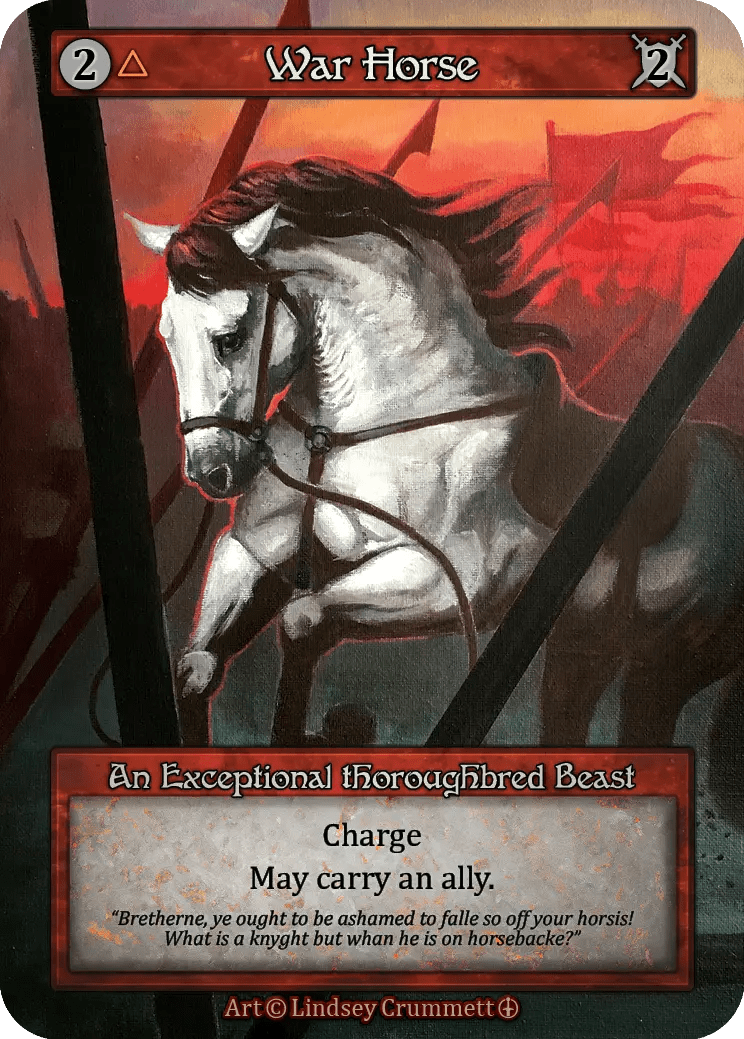
    Over the weekend, I put this to the test, bringing my Flying Ponies Fire-Air Battlemage. The tech is that while Battlemage is being carried by a War Horse or Fine Courser, then you play Power of Flight on your mount, thus giving the Battlemage Airborne as long as he’s in the saddle. This can be used to buy a turn of safety in dangerous territory or provide crazy mobility to the Battlemage. 

    Overall with these changes, I think Battlemage got a significant power bump. Battlemage may now be a strong meta choice and its popularity might skyrocket. The chances of that Rainbow Foil Battlemage being won have just increased.

    Battlemage Flying Pony Club

    With the changes listed above, I went and changed up my Fire-Air Battlemage to try out the new tech and in particular Power of Flight. The first change I made was to remove any card that required two Fire threshold. This meant that I lost Hamlet’s Ablaze. This makes me weaker to Gnome Hollows. To counter this, I added Blink to supplement my mobility options.

    I also lost Firebreathing – a card that I found incredibly strong and versatile but often difficult to cast with two Fire threshold. Being able to do four damage to something nearby is incredibly useful, and with more Daperyll Vampires around being able to deal four damage is so important.

    Here is the list:

    https://curiosa.io/decks/cmcy55oxv00arle046woeewkg

    Testing the Pony Club

    I had a good weekend of testing. Firstly step was to try it on TTS, Tabletop Simulator. It’s immensely valuable to have someone to play against where you can stop the game, discuss lines, maybe go back a few steps in the turn and see how different lines of play might go. This means you can get so much more out of your time and be able to see the game from the opponent’s point of view. Having a testing team or partner going into Cornerstone Season will allow you to get much more out of your practice time.

    I also participated in a three-round Win a Box tournament. I took the Flying Ponies Battlemage.

    Round one was against Earth-Fire-Air Archimago. Turn two, my opponent drops a Gnome Hollows in spot eight on the Grid, and I felt my chances of winning drop massively. This one site was going to be a major problem. Fortunately, I had the most powerful card in the game – War Horse.

    War Horse is nuts. It feels like playing a Blink that then burns the opponent for two damage until removed. The mobility it provides is incredible. However, because of the Gnome Hollows, I had an interesting decision point: do I use the War Horse aggressively to get damage in, or do I leave the War Horse back to carry my Battlemage around and forgo damage? I figured that since I had five other horses to draw into, the damage was more important. And that decision decided the game for me. The consistent damage provided significant pressure and kept them on the back foot. It took 34 damage to get them to Death’s Door.

    The takeaway from this match is that mobility spells are essential. This list almost feels like there’s too many between Blink, Power of Flight, six Ponies, and Whirling Blades, but they never felt dead. Movement is step one in the requirement to win with Battlemage, after all.

    Round two was against Waveshaper. Turn one, Forge, Lance token. Turn two Ring of Morrigan, and I felt strongly favoured. Two Lugbog Cats were played early, but the Lance and Ring gave me plenty of options to deal with them effectively for free. Combined with Airborne minions to outmanuevre their high-powered water, I felt strongly in the driver’s seat.

    Mester Stoor Worm I think is an underrated card and almost turned the tide against me. Seven power is massive, and its ability provides incredible board control if it cannot attack sites. Updraft Ridge allowed me to play minions away from its breath attack, and then as the board got clogged with Pirate Ships and Tufted Turtles, allowed my Gyre Hippogriffs to attack the one undefended site to get my opponent to Door. At that point, Ring of Morrigan and Whirling Blades made the win inevitable.

    Third round was against Avatar of Air with Earth. This deck plays big beefy minions such as Dalcean Phalanx and Pudge Butcher and then uses all the mobility of Air to get around their innate limitations. The last time I played against this deck, I got destroyed.

    But I won the dice roll, so I got to be the attacking player, giving me an immense advantage. Turn two, my opponent played a Perilous Bridge on spot eight, which might otherwise stop all my offence. But fortunately, a turn two War Horse, then turn three Ruby Core, Blink on the War Horse to carry both of us over the Perilous Bridge gave me a massive tempo advantage to carry the game.

    The lesson here is the importance of being the attacking player. In Sorcery, it’s incredibly hard to turn the tempo, especially in Battlemage. Cards like Ruby Core and Philosopher’s Stone played early can be incredibly powerful. However, when drawn late game they are incredibly frustrating. Having a single Core or Stone in the deck gives you about a 20% chance to see it before turn four in a game (between three mulligans, four draws). This means that one in five games, you have this massive boost. Currently, I like the high roll that a single copy can provide. With Highland Princess to fetch it, I prefer Ruby Core over Philosopher’s Stone in this deck to provide threshold fixing. In decks that are more evenly split between two elements, I prefer Philosopher’s Stone as playing War Horse for a single mana is incredible value.

    Overall, it was a 3-0 showing for Battlemage. I felt like I was in the driver’s seat for all my games. The contribution of winning the dice roll and being on the play cannot be understated, though. It’s such a power boost for aggressive decks. War Horse was insane every game and it makes me reluctant to not include Fire in my Battlemage lists.

    In Conclusion:

    There’s so much to think about, and I’m glad that I have time on my side. Gen Con is two weeks away and there are some Cornerstone events starting this weekend, so some players are having to scramble to react to the rules changes and adapt their strategies accordingly.

    I’m seeing an uptick in events and excitement for Cornerstone Season. So if you haven’t read part one, which outlines my goals and plans for Cornerstone Season, then please give it a read:

    There are three more Battlemage decks to go over, so the next part of this series will go through the remaining three and I will give my verdict on my preferred list.

  • Five Predictions for Gothic

    Five Predictions for Gothic

    13/6/2025

    Note: this was written and not published before the spoilers on 13/6/2025, so I will resist the urge to update this blog with those in mind.

    Note: Please forgive the current lack of graphic design. This blog is a work in progress, but most importantly for me is the writing, and I need to start getting that out into the world for feedback and to prevent procrastination, so please enjoy this old-school column. To look up cards, please visit: https://curiosa.io/cards

    Greetings. We’re currently in a lull period between sets, and whilst things have slowed down a touch, the whirring in my brain has not. Sorcery has taken over my life in the best way possible, providing me an opportunity to socialise, enjoy an incredible new hobby, and occupy my brain with something somewhat more constructive than its usual overthinking. I am constantly thinking about new decks, new strategies, and with a new set on the horizon possible new cards.

    So, here are five of my personal predictions for the upcoming Sorcery set of Gothic. Some of these are pretty wild and some are probably pretty obvious. It will be interesting to see how far off the mark I am once the set has been released. This is a big of a long-form article, and hopefully my thoughts aren’t too meandering. Number five is a bit of a controversial one, and I have included a prediction on the release date at the bottom.

    These ideas and thoughts came about by thinking (probably too much) of cards and mechanics that would benefit current competitive and casual gameplay, how cards interact with other cards from Alpha-Beta and Arthurian Legends, thematic ideas that would fit into a dark and gritty Gothic set, and parallels to other card games that might have influenced the designers.

    1. New and more minion tokens:

    This is an easy one to start off with. In many games of Sorcery, it feels like the board gets simplified too easily. Minions trade, spell removal is clean and efficient, and the board gets cleared quickly through these interactions. There are plenty of cards that easily clean up small minions, such as the Desert sites and Magic Missiles. We even already have a silver bullet card with Rain of Arrows. Even the design of The Great Famine and the Black Plague feel like precursors to more complex boards and the expectation that number of token-generating cards will increase.

    An advantage of having more small minion and minion tokens is that they can protect your larger and more expensive minions by ‘chump blocking’. One of the disappointments in Arthurian Legends is that the awesome knights get easily taken down by the usual suspects of efficient minions and removal spells. All the minion token generating cards in AL are expensive, such as Guards! and Invasion, so it often felt like the Sirs and Dames didn’t have the necessary backup to stick around on the board long enough to do anything meaningful.

    Lance tokens were a good design choice to help remedy this, but it feels like Lance tokens were cost slightly too high to really achieve this purpose as they function more like removal spells than speed bumps.

    So minion tokens are the perfect compromise to this problem. Already we have seen Gift of the Frog spoiled for Gothic. This is a strong early game roadblock for water decks, but requires a one-drop minion to function on curve, so my prediction for this category is a basic Ordinary site: 

    Lily Pad Pond.

    Water threshold.

    An Ordinary site emits a lonely croak.

    Genesis – create a submerged frog token.

    This helps fill the one-two curve for water decks with Gift of the Frog. Having the token enter submerged makes it play similar to Tadpole Pool, so it functions how players would expect it to. Having the token entered submerged lowers the power of the site by making the chump blocker be more constrained by having to unsubmerge to protect adjacent sites. It’s a choice to make the genesis effect free, compared to the ordinary village sites, but I think the zero power minion and entering submerged is enough of a drawback to justify this.

    1. Tribal archetypes (that use new minion token types)

    Tribal synergies are a fan favourite in many games. Elves and Goblins are fantasy classics, and it’s time that they come to take the throne from the frogs and wolves in Sorcery. Though, I can easily see Erik’s Curiosa deciding to eschew the tropey classics in favour of something else. But we’re definitely getting more Undead tribal in Gothic, and likely more Demons and Spirits based on Sir Galahad.

    My prediction is that in order to support these new tribal synergies, we will see one or two new Minion Tokens. The first is the Skeleton minion token  – a zero power undead Minion that is created by Earth and Air threshold cards. Such as:

    Rank of the Damned.

    3 cost. Air, Air Threshold.

    An Exceptional Magic that demands service.

    Choose a row. Summon a Skeleton token to each site you control in that row.

    This means you can get one to five tokens for the cost of three, putting it at a similar rate as Border Militia, but forces you to play your sites in a very different formation. A design issue is that Skeleton tokens need to be flavourfully and mechanically distinct from Soldier tokens, so limitations such as summoning to a row versus summoning nearby is important and help create different play patterns.

    Earth and Air could both share skeleton tokens but use them very differently. Both elements will benefit from the tokens slowing the game down. The Air element has an existing archetype of expensive and powerful effects such as Lord of the Void and ramp spells to help play them, but this didn’t really take off because aggressive Air strategies are too dominant. 

    Then Earth and Air elements could utilise these tokens in distinct ways. Earth can synergise Skelton tokens with power boosting effects, such as House Arn Bannerman and the spoiled Death Knight. Air could specialise in upgrading these skeleton tokens, such as into Mages and Archers. Even in death, we have to go to school and specialise in a subject that will define our entire lives:

    Scholomance.

    Air threshold.

    An Elite site of profane knowledge.

    Your Skeleton tokens gain Spellcaster.

    Tap four Spellcasters here to draw a card.

    I just really want to see the day where Occult Ritual is a staple and I can use that awesome Frank Frazetta art in my deck.

    Finally, on this point and going into a lot less detail, my second guess for a new minion token is a token for Fire and Water, the Cultist. These will be one-power minions, but there will be a focus on sacrificing them for fun and power. Feed them to the Cauldron Crone for a card draw. Then similar cards can turn them into life, damage, mana, threshold, or sacrifice them to summon the big bad. 

    1. An aggressive Avatar that utilises sites and ramp.

    One thing I feel that Sorcery is missing is an Avatar that wants to be aggressive and also ramp to play larger minions on curve beyond four cost. Avatar of Earth is almost like this, but it needs to stop playing sites so that it can try to actually win the game before it gets stopped by the opponent’s card advantage. Currently, we’re seeing a bit of it out of Flamecaller and Druid playing Fire threshold going up to Infernal Legion on the curve, but I think that’s more due to Fire’s strength in the meta rather than the Avatars actively encouraging this play style. Seer is also able to play like this because its scrying ability can allow it to play a wider curve and actually draw the minions at the appropriate part of the game. But all of these still don’t quite hit the mark, so my suggestion is:

    Titan – 2 power.

    Your Avatar shapes the land through mighty deeds.

    When Titan kills a minion, replace an adjacent Rubble with a site from your hand.

    Titan is a mash up of Battlemage and Geomancer. Note, that it doesn’t require attacking to trigger its ability. Playing Firebolts to kill three minions would create three triggers. The limitation is that it requires adequate Rubble tokens adjacent and Site cards in hand to fuel this ability, so it would likely be slow off the mark and then have explosive turns later in the game. It also would probably require a bunch of new cards. These cards would likely also help Avatar of Fire, which is a good thing. Existing cards that play into this strategy include: Star seeds of Uhr, which can provide plenty of Rubble. Scorched Earth can trigger the ability multiple times and provide rubble. And Tithe is an all-star that with this avatar will be great even later into the game. 

    The biggest clue that had me thinking about this Avatar was how out of place in Arthurian Legends Stone Rain felt. Just something about it made me feel that it had received changes late into the piece. Stone Rain requires you to have three sites in hand to make it a four-cost Minor Explosion, and this feels weak. Maybe it was changed late in development because it was too strong or there were cards that supported it that didn’t make it into the set. Perhaps for Limited play considerations, these cards were broken up into different sets. So my far-out prediction is we’ll see a lot more cards that draw sites in Gothic and support Stone Rain and a possible avatar like Titan.

    And talking of sites…

    1. Something to rival the Ordinary Towers

    Bans and restrictions are always a contentious issue, and I think Erik’s Curiosa has shown that it doesn’t want to go down that route. The three towers from Alpha and Beta (Lone, Gothic, and Dark) are incredibly powerful, and I think there could be sites that rival their power.

    Also, it’s very likely that similar to how we got the fourth ordinary village in Arthurian Legends (and technically the fourth ordinary river in Alpha), Gothic will give us the fourth ordinary tower.

    So here is an incredibly broken site:

    Crumbling Castle. No Threshold.

    An exceptional site that is doomed to disintegrate to dust.

    Genesis – gain Three this turn.

    At the start of your turn, replace Crumbling Castle with Rubble.

    A three-mana burst is probably far too strong, but it needs to be three to clear the towers. The timing of when it becomes Rubble is also another issue. If it generates mana on the turn it becomes rubble, that boosts this card’s power further. This is an example of how complex design is, as there are so many little things that have complex implications and  small flow-on effects – my utmost respect to the team for the great work they do on this game. Mostly, I designed this card as a homage to the band King Gizzard and the Lizard Wizard, so this card is a top-down design that might just need to go right back to the drawing board.

    1. A Jesus Christ Minion Card

    Depicting Jesus on a trading card is a contentious issue. It’s a culturally sensitive issue and one that many would say is inappropriate. We have seen with Crusade and Jihad, where Erik’s Curiosa possibly stand on that debate, so we can go ahead with the thought experiment without getting bogged down in the cultural debate.

    There are already references to the Christian religion in the game. The Spear of Destiny is famously the one that pierced Jesus’ side. We have Sir Balin wielding it to deliver his dolorous stroke. We have references to the cross with the spoiled Day of Judgement. We have Pact with the Devil referencing the devil. It’s impossible to separate Arthurian mythos from Christianity, so the entire set is steeped in it.

    The most convincing reason for me is that in Gothic art, as in the style from the 12th Century, depictions of Christian figures and Jesus were incredibly prominent and important. As art is such a core inspiration to this game, it would be a shame to not delve into that rich source and have the opportunity to take inspiration from that era of art fully.

    So could we get a Jesus Christ minion to move, attack and block for us in a game of Sorcery? It certainly would create a marketing buzz for good or ill. Here we go:

    Jesus Christ.

    A unique Mortal of the divine trinity.

    4 Cost – Earth, Water threshold. 0 power.

    Other minions nearby can’t be destroyed.

    Already in that design there’s plenty of issues, thematically, power level, and theologically. Is this idea a worse White Hart or an overpowered monster?

    I think ultimately there will be a card that is essentially Jesus, but they won’t use the name directly. Instead, it will be a minion called The Messiah or something similar and have a much more interesting twist to it than what I have come up with.

    But the ultimate takeaway point is that there are so many fascinating ways to take Sorcery, and I think the team are willing to go further and take more risks than other current card games through complex and fun designs, concepts that encourage thought and discussion, and incredible art.

    Bonus – release date prediction:

    My final prediction is the release date. I’ve always been optimistic, and my guess is November 2025. It feels like Erik’s Curiosa has been working diligently over the last year and didn’t even pause to rest following the release of Arthurian Legends. They’ve resolved many problems with production, and where other companies might struggle in the face of this year’s political uncertainty, I think they have enough momentum to clear that hurdle.