23 July 2025
For part three of my series on preparing for upcoming competitive Sorcery events and brewing Battlemage decks, I’ve sought the wisdom of the community. I have a total of three Battlemage deck lists to share in this article. The first is a brew from one of Auckland’s community champions. The second is a tournament winner from the States. Then I’ve got another of my own lists that I took to an event this past weekend. Also in this article, I will be summarising two debates that I’ve seen discussed on Discord this past week.
Community Deck Lists
To start with, I’d like to share a Battlemage brew from StichflammeNZ, named I Made a Thing! (Or Stole It!)
https://curiosa.io/decks/cmczza9bz000nl804i1xczmb0
This deck is a flavour-forward concept. This Battlemage is an artificer wielding an arsenal of various weapons and spells that share a thematic tie. Everything in the list is something that they either learned, built, or stole to deploy against their foes. Playing against this deck highlighted the joys of emergent storytelling and played out in the shared space of the game.
I enjoy that this deck has low threshold requirements. This allows the inclusion of powerful utility sites, such as Bower of Bliss and Sinkhole. Telekinesis is one of those incredible cards that can swing the game. With power artifacts being played more frequently, such as Ring of Morrigan and Grim Guisarme, this is a card that can absolutely steal a game – a perfect encapsulation of this deck’s concept.
I love this type of deckbuilding as it not only celebrates the creativity and flavour that Sorcery is steeped in, but it approaches card selection from a different angle.
A lot of deckbuilding begins with, ‘Here is a list of staple cards that absolutely have to be included.’ Instead I like starting with an underexplored card or concept and then forming the deck around that. This means that ‘staple cards’ need to prove their merit to the concept rather than the concept having to squeeze its way into an already crowded room.
If you haven’t seen it yet, on Curiosa you can click on ‘Deck History’ and see the revisions that have been made to this list. This offers a fascinating insight into the mind of the creator.
Earth-Air Battlemage Deck List
The second community deck I’d like to showcase is one of the five decks from the first article, so it’s been on my mind for a couple so weeks. I enjoy looking at tournament results and finding inspiration from the winning lists. Whilst it’s great to start your own lists from scratch, it is also important to play tournament decks to understand how they function and why cards have been selected to be in them.
This is Anger Worm’s Earth-Air Battlemage from the Battle of Elverson Fields event, held 27-29 June.
https://curiosa.io/decks/cmcigprnj00izjr04dipnmkvx
What I like about this deck, and with the Earth element in general, is that it’s strong fundamental Sorcery. You have the big minions; you have control over the Grid with Earthquake and Atlas Wanderers; you have resilience with Shield Maidens and Royal Bodyguards; you have the toolbox package with Common Sense; Root Spiders are incredibly strong in Battlemage.
The threshold requirements of the deck also show a restraint and wisdom that I need to apply to my own deckbuilding (later in the article you will see an example of unrestrained threshold requirements).
I like how Battlemage can leverage the healing from Holy Ground and Divine Healing and turn it into more card draw. It also allows for more patient gameplay since there are tools to do well in the late game. Because of that, this is a very different list to my own, and there is a lot that I can learn from it. I have been playing this on and off throughout the weeks but haven’t yet taken it to an event, so I will give more feedback once I have done so. So, full credit to Anger Worm for sharing his list on Curiosa, and congratulations on winning the event.
This deck list also provides a great segue into the first discussion of debate:
Community Debate One: Battlemage or Avatar of Earth?
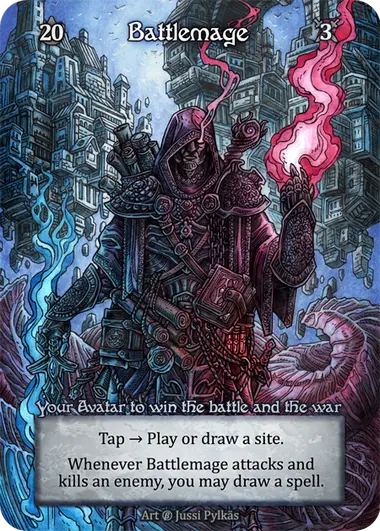
With great Earth threshold comes great opportunity to leverage Avatar of Earth. Battlemage and Avatar of Earth are two avatars that have built-in power over the standard one power (Templar too!). They have similar play patterns and encourage similar deck design, so the question is just how interchangeable are they? Could you replace the Battlemage in Anger Worm’s list with Avatar of Earth and do just as well – or better or worse? So, let’s dive into that question and have a closer look at Battlemage versus Avatar of Earth.
Let’s start with the basics:
Battlemage’s power is consistent and does not rely on nearby Earth threshold. This means that Battlemage has more variety in deckbuilding, and doesn’t suffer from site placement during gameplay. Battlemage is more resilient to opponents who are manipulating site placement and thresholds.
Avatar of Earth’s can have up to 10 power. If they have nine Earth-threshold sites nearby, then they can achieve this colossal power. More likely the Avatar of Earth will hover around four to five power, and perhaps even lower if they have to go into the opponent’s back line that has no Earth sites.
Battlemage’s ability means they will draw more cards throughout a game. Even drawing one or two additional cards can make a massive difference. This also means the Battlemage is more likely to draw into answers to solve the problems the opponent presents.
So, what does this mean in practice?
There is an ongoing arms race in Sorcery where the average power of minions played has been increasing. Ordinary Deserts and Firebolts have made it difficult to play one-power minions from day one. Two power gets Vile Imp’d and Quarrelsome Kobold’d. Three power gets outclassed by Lugbog Cats and Autumn Unicorns. So now four power feels like the sweet spot for minions. The larger the average minion is in the meta, the greater advantage Avatar of Earth has over Battlemage. It is always a bad feeling having to attack your opponent’s Pudge Butcher directly, but it’s a worse feeling when Battlemage has to use a Firebolts and a strike to kill it.
However, Battlemage’s greater freedom to include the other elements in deckbuilding means that it has more tools to deal with high-powered minions – Shrink, Pollimorph, Disintegrate, for example.
Battlemage has the card draw advantage over Avatar of Earth, but as games become more aggressive, and opponents are more experienced at playing against Battlemage, I’m finding that I only get one or two card draws from the Battlemage ability each game. But one or two extra cards can still make all the difference in winning or losing.
What is better against the strong meta decks?
Is Avatar of Earth or Battlemage better against Archimago? Archimago is the boogeyman of the current meta. Archimago excels at removing minions and then winning with a big spell such as Craterise. Both Battlemage and AoE can apply pressure without relying on minions. Both also can get up in Archimago’s face, meaning Craterise is harder to win with. Avatar of Earth perhaps has the slight edge as Archimago often plays Earth sites, so will have a higher power on average.
Against Druid… Let’s have a slight tangent about the power of Druid. Archimago might have been the big bad last month, but Druid is the new archenemy. Druid has a lot of free value in its ability. It gets a free Torshammer Trinket in the form of Tawny (that also is a spellcaster and costs zero), then it gets a free Royal Bodyguard (with Beast synergies as well), and then finally it gets to upgrade all of its nearby sites into Briar Patch. That is a lot.
This might be a bit of a hot take, but I think the Fire element currently is so strong, that you could play Avatar of Fire, never use its ability, and win events. Fire has aggressive minions, powerful removal and card advantage effects, and site disruption. So if you combine Fire with Druid, you have a lot going for you.
The most common Druid list is ‘Steam Druid’, which combines the strength of Fire with Water. The biggest advantage Water brings to the table is that your minions on Water sites cannot be buried. This shuts off a lot of Avatar of Earth’s removal, so as Druid becomes more popular, the advantage leans to Battlemage here.
Verdict?
I think currently Battlemage has the slight edge over Avatar of Earth, but it’s pretty close. In decks running heavy Earth, I still don’t think the AoE is the correct pick every time, but I don’t think they are easily interchangeable. There are still small differences in how they play that it will impact deckbuilding. In the next debate topic, I’ll show the subtle differences that go into individual card selection.
On the matter of which Avatar is stronger? As with a lot of things, this ultimately comes down to personal preference, and I think either Avatar is a competitive choice with the potential to win events in the current meta.
A New Contender Enters the Realm – Dragonlord.
A downside to writing these articles during spoiler season is that things can change so quickly (and in the middle of writing articles). With the spoiler of the Unique Dragon Talamh Dreig, Dragonlord becomes a contender in this discussion. First, check out the reveal from TCGPlayer here:
This means that Dragonlord can get up to six power for three mana. It does lose the power during the opponent’s turn, so that is a downside. What I like about this Dragonlord mode is that you can be aggressive on the board without overextending your resources. You can play one big minion at a time, and then spend excess mana on your ability. This means you are stronger against your opponent’s mass removal spells such as Poison Nova and Earthquake.
Now, does that make Dragonlord better than Battlemage or Avatar of Earth? We’ll see.
Community Debate Two: Infiltrate
The second interesting discussion I saw this week was on the topic of Infiltrate. There was some divide over whether it makes the 50 or not. It’s powerful, but its downsides make it a complicated choice. There’s merit for both including it and leaving it out. So, let’s go over the pros and cons.
Pros:
Infiltrate has a lot of flexibility in how you play it, what minion you choose to play it on, and then what you do with that minion. The most common play is to take the Infiltrated minion and run it into another of the opponent’s minions to take two off the board at once.
You can also keep the minion stealthed, waiting in the shadows to deal the final blow at Death’s Door. It is very satisfying to finish off your opponent with their own minion.
Infiltrate is also a tempo play. At worst, Infiltrate taps down the opponent’s minion, so you can keep attacking with your Avatar and on-board minions.
Stealing a utility minions with an ongoing effect. Shield Maidens is a great example of a valuable minion to Infiltrate. As it’s now got Stealth, the minion can safely sit there all game providing its ability for you.
Infiltrate is incredible against Druid. Saving Infiltrate to steal Bruin is big tempo swing as they had to take their turn tapping and flipping to get that bear. Bruin then provides you with its bodyguard effect. This play can turn the tide of a game. Even using Infiltrate on Tawny and keeping it safely tucked away can slow down the Druid player massively and reduce their options. If they kept an early Torshammar Trinket to play on Tawny, you can render a card in their hand less effective at the same time.
No proximity limitations on cast. Infiltrate doesn’t require nearby or adjacent. This means that you can be operating on one side of the Grid and still be able to deal with minions that have slipped past you. This is also really handy for dealing with evasive minions with Airborne and teleporting effects like Headless Haunt.
Only one Fire threshold. This makes it easy to splash in decks that aren’t primarily fire. An example of a card that competes for this slot in my decks is Firebreathing. Firebreathing is a removal spell that can deal with four-power minions, hit the opponent’s Avatar, and has an area of effect. Your horse can even cast it, as an added bonus. But the frequency in which I’ve missed hitting my second Fire site in Air-dominant lists is frustratingly high, so Infiltrate might be the more consistent choice.
Cons:
Infiltrate is dead if the opponent doesn’t play minions. Archimago is the biggest culprit of this, but I’ve yet to see a list that plays zero minions, so you will eventually be able to take something. Taking their Death Dealer is a great coup.
I like my removal spells to be able to deal direct damage to the opponent’s Avatar. As games get faster and more explosive, double Death’s Door situations become more common. Having your spells be able to deal that death blow is incredibly important to actually close out the game.
Four cost. Four is a lot, and for Battlemage this will likely be your entire turn. The effect of Infiltrate is so strong that you effectively take away your opponent’s previous turn, but it does cost you your entire turn.
This is compounded if the opponent is playing numerous smaller minions. Currently, the meta is about playing fewer big minions that individually impact the board by themselves. In such a meta, Infiltrate is a powerhouse. But if the meta shifts back towards favouring smaller minions and token generation, then Infiltrate might fall out of favour.
It has a built-in counter through Stealth removal effects. Infiltrate is such a powerful effect, it is good design that there is counter-play to it. Once the Stealth effect is removed, control of the minion returns to the owner. This means if the Infiltrated minion is Disabled, then control reverts. There is also a plethora of cards that remove stealth. The two most common are Scent Hounds (fetched by a Common Sense) and Watchtower. With the nerf to Quagmire, I also wouldn’t be surprised to see more Hunter’s Lodge being played. I’m also a massive fan of Sir Bors the Younger, so if Stealth does become an issue in the meta, this famous and handsome hunter may be called on more frequently.
My verdict:
I love playing Infiltrate. It’s powerful and impactful. It will be a contender for any deck running fire for many years to come. In this current meta, it makes the cut. I recommend keeping an eye on how the meta feels before events and to reevaluate this decision.
Testing Update on the Flying Pony Club
Testing is going well to help me decide on my favourite Battlemage list for Cornerstone season. Every match I’ve played has taught me valuable lessons. This week, I’ve been playing two different lists, the Flying Pony Club that was featured in Part Two of this series, and a new list that I will debut shortly.
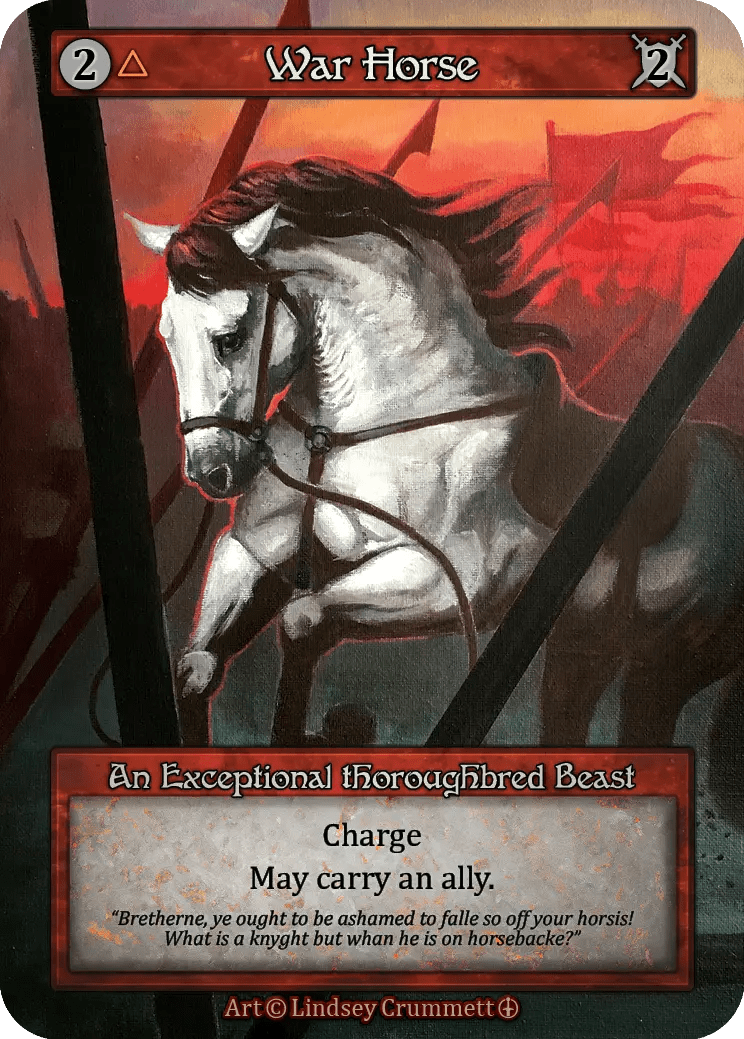
Flying Pony Club (FPC) is a lot of fun, but it has major problems. In the previous article, I pondered if Battlemage is a combo deck. The cards in the FPC exacerbated this issue by packing more two-card combos into the list. Power of Flight and Fine Courser made mulligans difficult because I didn’t want either in my opening hand. I’d much rather have more impactful cards like Blink and War Horse. I couldn’t afford to hold on to weaker cards that might potentially come together later in the game. Battlemage needs to start strong.
FPC also struggled to turn the tide of tempo. One of the greatest challenges is overcoming the disadvantage of going second. The first player gets to set the tempo of the game, gets to play and attack with their minions first, and be the aggressor. The second player has to first overcome this disadvantage and then leverage their cards to win the game. Useful cards that can turn the tide are things like Mix Aer, minions with Lance tokens that can trade up, and removal spells cards that destroy two or more minions, such as Earthquake and Poison Nova. FPC struggled to do this, so the more I played it, the more I preferred my other Fire-Air builds. Also after several games, the combo of being Airborne on the opponent’s turn never came up, so dedicating so many card slots to such a niche effect wasn’t worthwhile.
On to my next list:
Greedy Triple Threshold Battlemage:
This week, I tested deck four of five, the Fire-Air-Water Battlemage. This was the build to see if I could get away with including everything and the kitchen sink.
Turn two Lugbog Cat into turn three Hamlet’s Ablaze or Grapple Shot is what I was going for here. This requires getting lucky on site draws and relying on the much maligned Arthurian Legends Unique castles to provide enough threshold fixing. Here is the list:
https://curiosa.io/decks/cmdf6jxul001bk104kwt1cvgv
I managed to go 3-0 in a best-of-one, three-round testing event with this list, but I got lucky and didn’t stumble on my sites. When I played this outside of that event, I missed on my sites every time. This goes to show that sometimes it’s better to be lucky than good.
With Battlemage you have to draw the right cards at the right time. For example, with only two copies of Shrink in the list, I didn’t draw it once in the three games. However, that was beneficial as my first two matches were against decks that didn’t run many minions. StichflammeNZ was my first opponent and was playing the deck at the top of the article.
Panorama Manticore is my favourite card in Sorcery, so getting to play it off Pond or the Ordinary Towers is immensely satisfying. The fact that it can attack and then untap to be a defender is so powerful. It’s interesting how it’s the only card currently in the game that benefits from playing different thresholds in a deck, so I’m looking forward to similar effects in the future.
Geyser. Geyser is a card that I always want to include but then always cut it. The one time you annihilate a Root Spider to unlock your minions is worth 10 games where you just cast it to just draw a card (minus two mana for the turn). It is nice that it can do the Flying Pony Club effect with War Horse, so that increases its utility a few points in this list.
Overall, I like this list. I like being greedy, getting lucky, and having all the answers when I need them. I like Fire-Air the most, but I also love not having my Daperyll Vampires buried. In this list, I’ve already made some tough choices, such as not including Ruler of Thul, to help smooth over some of the threshold issues, and maybe I need to make a few more. Hamlet’s Ablaze is also a card I’m considering cutting. When it’s good, it’s incredible, but it can do nothing far too often. I also miss having Blink, so maybe Fire can become the tertiary threshold, but then you lose out on Morgana le Fay and Panorama Manticore. Siege Giant is also an incredible card that doesn’t quite get enough play. All in all, more testing is required.
My Meta Loves Grim Guisarme
An important thing to take note of through testing is to observe what your opponents are playing. If they are enjoying a certain card, deck, or strategy, then they’re more likely to take it to Cornerstone events. This last week has shown that Aucklanders love Grim Guisarme.
With the rules change and strikes to Sites benefiting from such effects, players have been enjoying tearing strips out of each other with Grim Guisarme. In the last six games I’ve played, four had my opponent playing the axe, and three games were decided by the axe, so that’s a pretty outstanding rate for an Elite rarity card. The grossest display was Sir Agravaine armed with the axe, meaning he’s chunking away for six from the safety of stealth. I lost that game.
There is also a brew developing in New Zealand that looks to one-hit kill from stealth, and Grim Guisarme helps achieve that. I won’t give away the list here, but it’s a scary deck.
It will be interesting to see if Grim Guisarme sticks around in the meta, as players might find the swinginess too much. Or perhaps this will usher in an entire meta shift, such as lists including designated blockers.
Next time – the Meta
Throughout this article, I’ve referenced ‘the meta’ a lot. The meta is everything external to you and your deck. It’s what other players are bringing to the event. It’s the thoughts and beliefs that people are bringing to the game. It’s the expectation of how games will play out. The meta changes between stores, countries, tournament levels (such as the meta for an online leagues versus Cornerstone events), so it can be a very tricky thing to actually pin down and predict in a meaningful way.
The final deck of my five was a dedicated anti-meta build. The problem is that the meta has changed so much over the last couple of weeks, the list I had is no longer applicable.
In the next part of this series, I will discuss the concept of the meta in-depth and see if things have settled enough that I can present a viable deck list. It’s highly likely that there will be a spoiler or a tournament result that will shake everything up again.
Cornerstone events have begun around the world. Gen Con is also imminent. Dragonlord could change everything. Every Gothic spoiler changes the lens of how the game is viewed. It’s an exciting and seismic time for Sorcery, so stick around for the next article, where I’ll try and pin it down long enough to say something interesting about it.


 Bardsword Sorcery Blog