6 February 2026
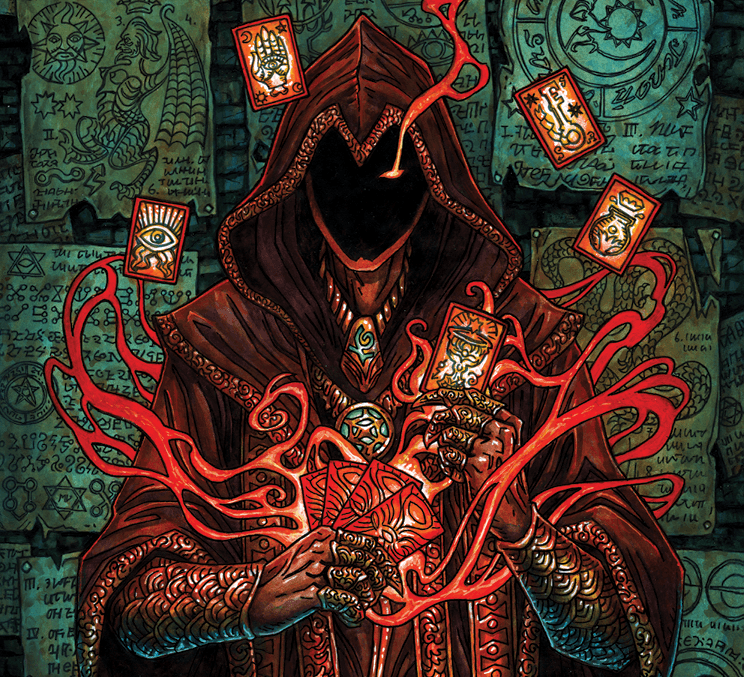
Welcome to the Brewers’ Almanac, a series where I share my deckbuilding process. That process is a lot of overthinking, going around in circles, and trying to justify subpar choices. But I derive great joy from that, so I’d like to share it with you to help inspire your own brews. We’re starting off with a new Avatar from Gothic – the Magician.
We’ve had a while to sink our teeth into Gothic and get a feel for the set and the evolving meta. Players are settling into the decks they enjoy and getting reps with their competitive lists. I have a big tournament in a couple of weeks, and season 10 of the Online Sorcery League is in full swing, so I should be practising and playing my tournament deck. But instead of doing that, I’ve been brewing jank.
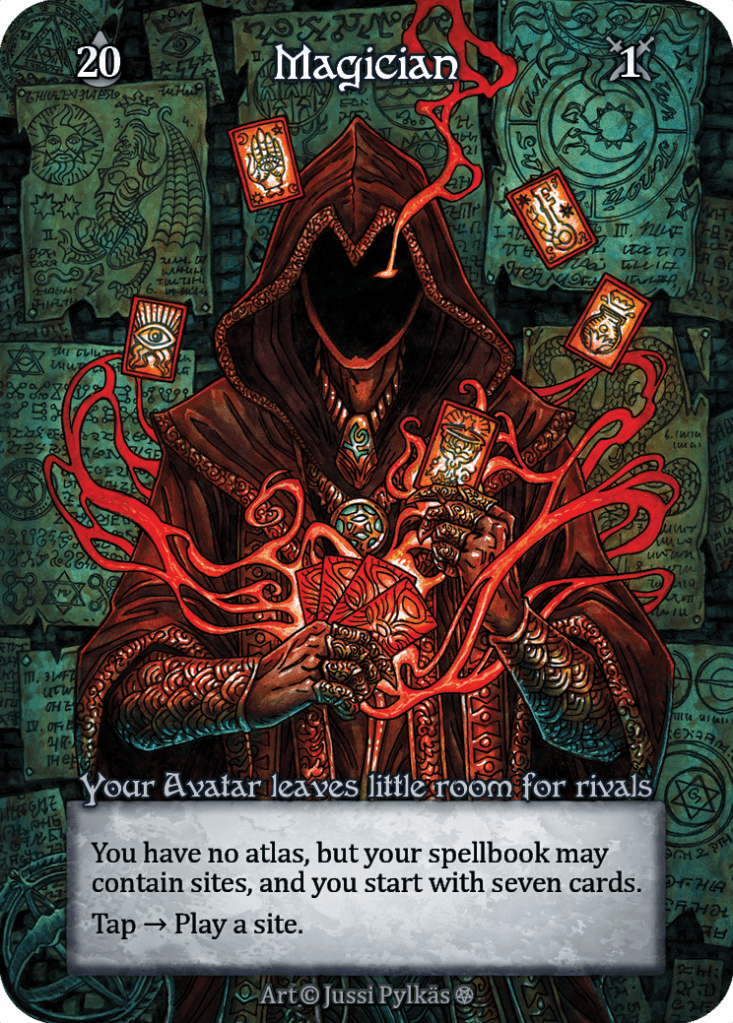
Magician has captured the hearts and minds of Sorcery players. This Avatar is one of the best cards to come out of Erik’s Curiosa. It’s a cheeky joke at the competition, a reminder of good times with a game that means so much to a lot of us, and features one of the most stunning pieces of art in the game. So, let’s brew up some Magician.
This article will be an insight into my thought process as I build decks. I’ve structured it to read more as a stream of consciousness piece, reflecting how my instincts and evaluations of cards and strategies evolve as the pieces come together.
Generally, I am a vibes-based deckbuilder, but it is good to crunch the numbers and see how the math is looking. For my calculations, I use this website: https://aetherhub.com/apps/hypergeometric
Inspiration
Despite the very real possibility that Magician is the wrong choice for any deck and archetype trying to wield it, the community has embraced the challenge and is having a lot of fun brewing Magician decks.
Have a look through Curiosa to see the diversity and creativity on display. There’s some great Primers exploring this topic, so thank you to anyone taking the time to write one up.
The two biggest sources of inspiration for this brew are The Assorted Animals and Tabletop Royale YouTube channels.
The Assorted Animals Youtube channel has featured a Chaoswish Magician a couple of times. Their list can be found here: https://curiosa.io/decks/cmix5za5n07m902fn4fw59mg4
And Tabletop Royale featured a Voidwalk Magician: https://curiosa.io/decks/cmjhd70e98aj71afqkg1zaxgx?tab=view
I highly recommend subscribing to both of these channels for their excellent gameplay and discussion. I particularly enjoy Tabletop Royale’s Card Game Necromancy series where they dig up games from the past. If you enjoy Sorcery, you’ll likely enjoy checking out that nostalgic series.
These videos and lists were the initial source of inspiration for my Magician journey, so I recommend having these lists open in other tabs whilst you read the article for reference.
Starting Point
Let’s rewind the clock a month to when I first started brewing Magician. There are many fun ways to take Magician, but the standout directions were Air for its plethora of Voidwalk minions to utilise the powerful new artifact Ether Core. Water is also a good source of Voidwalk minions, and the combination of Water and Air gives us the Chaoswish combo.
With Magician, there’s a lot of unique problems to solve. I’ll go over these points in more detail below, but Magician allows us to break the rules of deckbuilding in Sorcery and get a powerful opening hand. However, in playing this Avatar, we open ourselves up to some serious problems and opportunities to shoot ourselves in the foot.
On Voidwalk
The Voidwalk mechanic got expanded with Gothic with a bunch of powerful cards and new minions to help us reach a critical mass to properly exploit the mechanic. The strength of Voidwalk minions is that they can be deployed independently of your sites, allowing flexibility in both offense and defense. It can also be considered an evasion mechanic as you can retreat your minions back into the void. Ether Core is the most powerful addition to the archetype, giving us a strong payoff in the most explosive source of mana in the game.
On Chaoswish
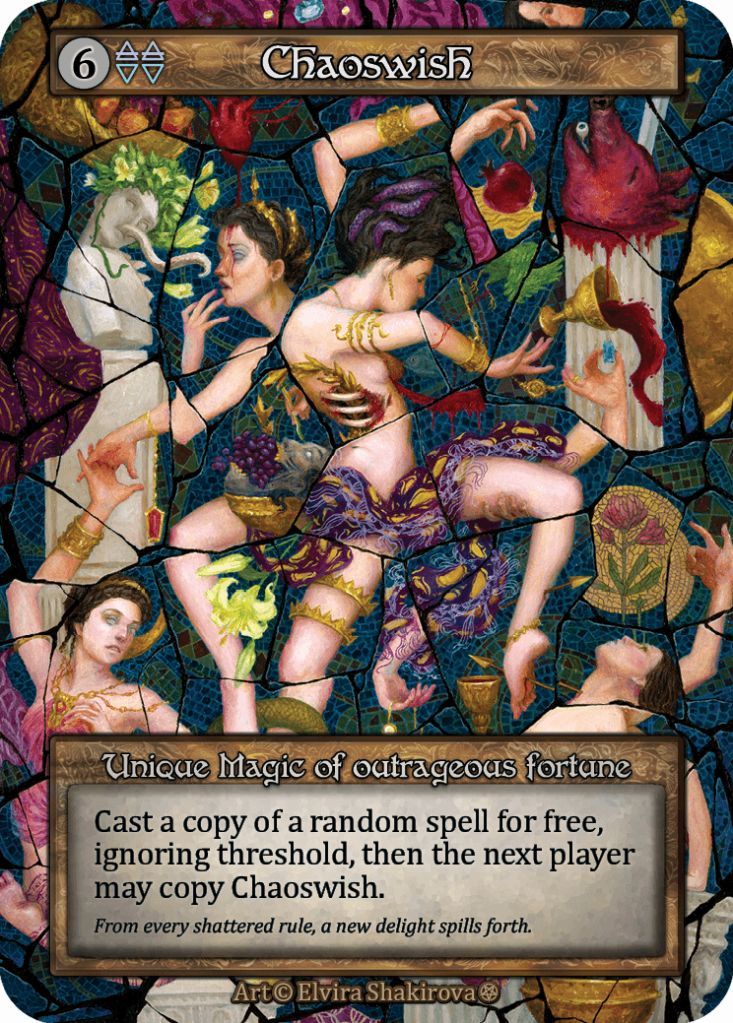
Chaoswish is a fun card that allows players to roll the dice and potentially hit big. I mean, just go the Curiosa page and have fun hitting the random button a couple of times: https://curiosa.io/cards/chaoswish
But of course, instead of being a fun card for good times, players instantly found the degenerate combo and began exploiting it. Using Kythera Mechanism to determine the random outcome of Chaoswish to chain additional Chaoswishes, Ring of Morrigan then turns those casts into damage. You can then use your final Chaoswish to cast Courtesan Thais or something equally poor for the opponent to close out the game. This three-card combo does require three different Unique cards, so it’s quite the task to assemble them, but the potential to win out of nowhere is very powerful.
Don’t forget that you need to be nearby the opponent’s Avatar for this combo, so you either need to spend turns positioning your Avatar or use a movement spell, such as Blink.
Chaoswish and Void Together
So, why am I talking about combining two very different strategies in a single deck? I enjoy playing decks that have a consistent A plan, such as beating down with minions, combined with a ‘secret weapon’ B plan that can snatch victory. The more overlap between the A and B plans, the better.
Ether Core is one such overlap card. It rewards us for having Voidwalk minions and then gives us the mana required to deploy the Chaoswish combo. As we often want to play out all three cards of our combo in a single turn to protect our artifacts from being destroyed or stolen, we need to be able to get up to eight or 10 mana. Chaoswish costs six by itself, Ring and Kythera Mechanism are one each, and then a Blink adds two. Ether Core goes a long way for that.
The second card that overlaps these two strategies is Stargazer.
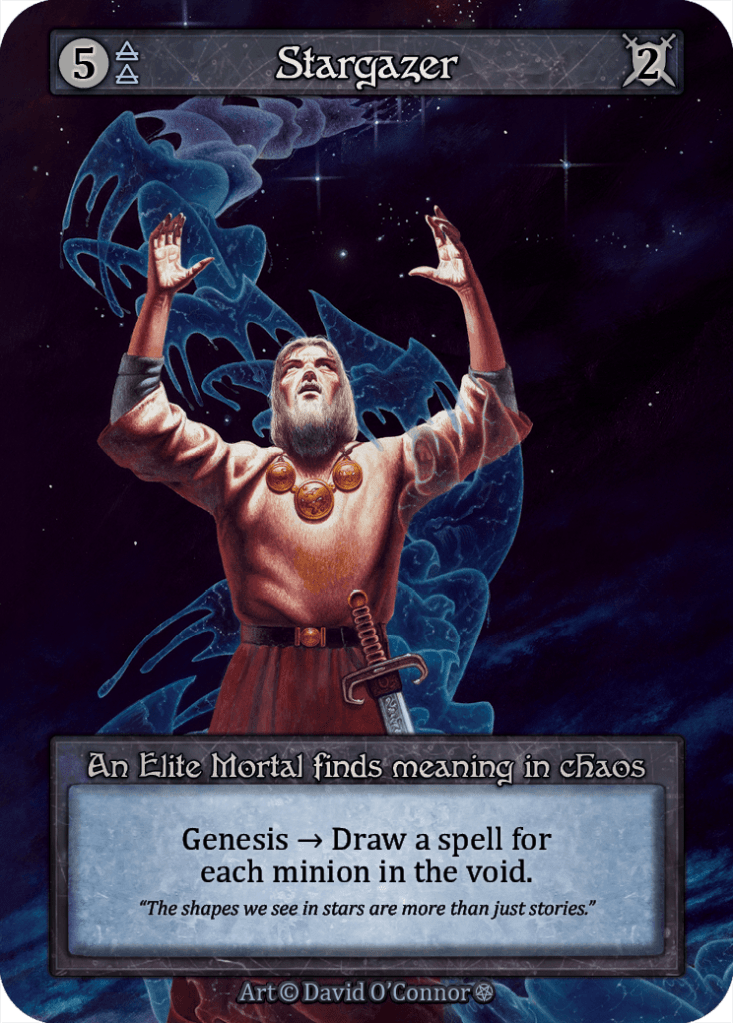
It’s easiest to compare this card to Grandmaster Wizard. Stargazer is cheaper, has two more power, but requires Voidwalk minions to draw cards. The difference between five and six mana doesn’t seem like much, but in practice is significant.
Stargazer ties these two strategies together. Voidwalk minions buy us time, they distract the opponent and keep the action on the opponent’s side of the grid, and they might even win the game by themselves. Stargazer allows us to either draw into our combo or provide the fuel to push our minion-based win condition.
Lucid Dreamers is a fun pairing with Stargazer, allowing us to cast the Stargazers into the void to net an additional card for themselves.
So… Why Magician?
So, we have our strategy and key cards. Why put Magician at the helm?A perfectly valid answer is because it’s cool and we want to play it. But we have to compare Magician against other Avatars, such as card advantage engines Sorcerer, Deathspeaker, and Archimago. Harbinger also does the Voidwalk strategy effectively, utilising its mana reduction ability to play out minions aggressively. Magician gets a unique opening hand, but so does Spellslinger, so we have to consider it as well.
Sorcerer can turn early game mana advantage into late-game card advantage by drawing two spells a turn. Deathspeaker and Archimago let us replay our important cards but require completely different builds. Any time I see a list with Grandmaster Wizard, I have to consider Deathspeaker.
Magician locks in its advantage during deckbuilding. During gameplay, it is at the mercy of luck and is even unable to tap to draw sites to help mitigate back luck. As the game goes longer, Magician’s inherent card advantage will erode away and it will likely fall behind other Avatars.
Magician gets a seven-card opening hand, like Spellslinger, but we can affect the expected composition of that hand in deckbuilding. To set it apart from Spellslinger, we want to be pushing towards one of two extremities – an opening hand of five or more spells, or one with four or more sites.
On a quick tangent, I’ve tinkered around with a site-heavy Magician that wants four or more sites in the opening hand, but I feel like there isn’t quite enough power to achieve this currently. Magician also doesn’t get to benefit from the new ramp spells Landmass and Overflow as it doesn’t have an atlas to draw from. But a site-focused Magician is an interesting deckbuilding challenge. I would love to see your attempt at this challenge. Message me if you come up with something cool.
Anyone who has ever said they want 40-20 is contractually obliged to only ever play Magician. The other benefit of Magician is by combining our atlas and spellbook, we effectively have a smaller spellbook. Our opening hand then comes entirely from this combined deck. This increases our chances of drawing into certain cards. We lose the ability to be selective with our draws, but have the potential of being much more explosive.
This means that we can expect to see powerful Uniques more frequently than other Avatars. With our mulligan, we get to dig 10 cards into our combined deck rather than six into a spellbook.
Another unique quirk of Magician is that gets to use Common Sense to tutor for Ordinary sites. Combos that require an ordinary site and a certain spell can be played effectively out of Magician – for example, Hamlet with Sylvan Splendour. In decks leaning into Chaoswish, having Common Sense to put together Fenvale Muse and an Ordinary River could provide immense value to then assemble the game-winning combo.
Flood, Screw, and Rocks
When it comes to evaluating Magician, it pays to use some Magic terms.
The Magic term ‘mana rock’ means an artifact that can produce mana. In Sorcery, mana rock are cards like the four Cores, Shrine of the Dragonlord, and Philosopher’s Stone. For Magician, these allow us to ramp up our mana generation faster than sites would normally allow.
Anyone who’s played Magic will have encountered mana screw and flood. Screw is drawing too few lands to execute your strategy, and flood is drawing too many lands so you can’t do anything meaningful. The Magician Avatar allows us to enjoy these extremes in Sorcery.
The Plan
So, what am I trying to achieve with this Magician deck? An optimal opening hand has sites, mana rocks, a couple of Voidwalk minions, and a wizard to refill the hand. Turn one, we can have lines like a Tower, Core, Forsaken. Turn two, Site, Phase Assassin. Turn three Mix Aer into a Grandmaster Wizard, attack for six. Vanishment and Fade allows us to keep chipping away at the opponent’s life without losing our minions.
We want to leverage an explosive start and be looking to win as soon as possible. With an aggressive minion start, we can overwhelm the opponent with evasive and strong minions, or stumble into our combo and win the game.
Like any good plan, there are multiple ways this can fail. With Magician, despite having a lot of redundancy – plenty of Voidwalk minions, lots of rocks, sites and spells that draw into more cards – we need these effects in the correct proportion. This deck can easily get into a position where it’s top-decking and fails to draw anything useful.
The other thing to expect from Magician is that you will have turns where you can’t do anything with your Avatar. It’s important to include cards in deckbuilding to mitigate this.
Board position is also critical to consider in our plan. So if you have nothing to do with your Magician, then you need to be considering a tap to move. We can preemptively position the Magician to then maximise the effectiveness of other cards, such as Disenchant and Poison Nova. This is particularly important for the Chaoswish Magician so that it can combo without requiring a movement spell.
There are a couple of cards that let us tap our Avatar for value. Pnakotic Manuscript is good for this. Combined with scrying effects, such as Observatory and Cradle of Etherrum, this gives us the opportunity to tap to draw sites for zero life,… turning Magician into any other baseline Avatar. But Pnaktotic helps us bridge the gap, allowing us to have an explosive start and then turn into a Sorcerer clone to then push pressure on the board. At this point in the game, we probably don’t even want sites, so scrying effects to put sites on the bottom of the deck is preferable. Since we’re hidden behind defensive Air sites, we should have a healthy life total to exploit.
Silver Bullet is also a good consideration. The tap cost can be prohibitive for other Avatars, but Silver Bullet gives us the exact card we need at any given moment.
If all else fails, don’t forget that we can also block with our Avatar to protect our minions. If the opponent needs to attack two minions into your Headless Haunt to kill it, having an untapped Avatar to block the second hit can be a game-winning swing. I’ve found that often players will miss an untapped Avatar and its potential to block, so use this psychological trick to your advantage. How did I learn this trick? By making this exact blunder and not seeing my opponent’s untapped Avatar.
How Many Sites?
This is the most interesting question when it comes to building Magician. Ideally, we want as few sites as possible so we don’t get flooded in the late game, but enough that we don’t get screwed in the early game.
In one build that I brought to a community evening, I was running 12 sites and 8 mana rocks. This is definitely greedy, but considering that the deck will lose games where it draws too many sites, perhaps this greed just front-loads the loss to occur in the first five turns rather than at turn 15. With 12 sites in the deck, the chance of seeing zero sites in our opening hand and mulligan is a miniscule 8.68%.
Though, when those odds land, it feels bad. The first game in paper, I hit that 8.68% and failed to draw a site in my opening hand. Then to add insult to injury, I then didn’t see any sites in my first five draws, which is a 2.06% chance of happening. I felt bad for giving my opponent a non-game, but then we did have plenty of time in the round to have a couple of friendlies, so easily remedied.
Looking at lists on Curiosa, no one else has been so greedy as to go as low as 12 sites, but I’m still not convinced that 12 is incorrect. In general, I see people often fielding 20 sites, which feels a bit much. If we’re getting ‘four spell, three site’ opening hands, we might as well be Spellslinger.
But going from 12 sites to 15 halves our opening hand failure rate, so 15 sites has become my starting point for Magician lists, where you get explosive opening hands often enough with a more tolerable failure rate.
On NPE – Negative Play Experience
A successful game is one where your opponent wants to play again. Negative Play Experience, or NPE, is another concept I first saw discussed in Magic. There are strategies in Sorcery that I would describe as NPE, so it’s important to be aware of them and the effect they can have on our opponent. This is particularly important if you expect to play against new players or are trying to convince people to invest their time, money, and energy into Sorcery.
Cards in Sorcery that seem to elicit the most negative emotions include theft effects such as Infiltrate, Betrayal, and Lilith. There is something demoralising about your opponent using your toys to beat you up. Site destruction can also be frustrating as it prevents you from even engaging with the game.
In general, Sorcery does a good job of mitigating NPE. We have lots of tools to shore up our weaknesses to any given strategy, so if there is a particular card that riles you up, then it’s up to you to play the counters. I’m not saying that players shouldn’t play these cards, but just be aware of the impact they can have outside of the game.
My main concern with Archimago last year was that it was NPE. Playing against Archimago, the games felt like a frustrating slog. If my minions ate a devastating Earthquake, that card was face up in the cemetery to wreck me a second time. Every time I played Archie, I didn’t even enjoy it. I don’t want my opponent demoralised and frustrated.
Losing to a combo that you didn’t see coming or have any meaningful way to interact with is not fun. Any time I have won with Chaoswish, I didn’t even enjoy the win. For that reason, I have dropped Chaoswish Magician from my brewing, making mono-Air Voidwalk Magician the winner of this brewing session.
My Magician Lists
After a few weeks of refinement and testing, these are the lists I’ve settled on. The Chaoswish list probably needs some fine-tuning for its threshold requirements.
Mono-Air Voidwalk aggro: https://curiosa.io/decks/cml8icpl800ei04l26pxm8iwn
Air-Water Voidwalk Chaoswish:
https://curiosa.io/decks/cml8rqr4400bp04l5m21608lt
Other Magician Brews – Joy and Suffering
Overall, I think what sets Magician apart is its ability to exploit single copies of a given Unique. If your strategy requires one particular card, then Magician is worth considering.
Magician is a fun, explosive Avatar that can get some crazy high-roll games. There is a joy in sitting down to Sorcery, and shuffling up a singular deck. In many ways, Magician’s strength is that it provides an experience. It’s not about what mechanics the card unlocks, but the joy in our hearts that it awakens.
Another brew I developed with Magician was a mono-Water deck looking to win with Putrid Presence. Aptly named ‘We Both Suffer’, I have yet to play it for fear of it being a slog for both myself and the opponent:
https://curiosa.io/decks/cmiza9uez2lo11rfpoio9e8ph
Conclusion
Magician is the kind of card I love seeing in Sorcery. The fact that one card can open up so much discussion and possibility without warping or breaking the game is incredible. With 13 new Avatars in Gothic, I find it amusing that Magician is the one that’s taken up so much of my bandwidth.
In terms of power, I don’t expect Magician to make waves in the meta, but I wouldn’t be surprised to see it win a tournament or two, piloted by someone who enjoys the vibes and challenge.
If you enjoyed this style of article, then please let me know. What Avatar would you like me to feature in the next Brewers’ Almanac?





 Bardsword Sorcery Blog