Tag: review

  • Gothic Avatar Inspiration Guide

    Gothic Avatar Inspiration Guide

    6 December 2025

    It is here! Gothic release day has finally arrived! I hope everyone is enjoying cracking their packs or starting their testing if product hasn’t quite made it to you yet.

    During this initial Gothic window, my goal with this blog is to share my experiments with deckbuilding. I want to provide decks for new players to get started with and provide some strategy tips for seasoned players to level up their game with.

    During the 2025 Cornerstone Season, I placed fifth at Crossroads Melbourne, placed first in a Constructed Cornerstone with Water-Air Battlemage, first in a Sealed Cornerstone, and finished second a handful of times at other Cornerstone events. So, the purpose in going quickly over my recent tournament credentials is to show that maybe my content is worth the read. I prefer longform written content, so I can share my thoughts in full with a bit of flair and artistry, and to hopefully inspire thinking and testing.

    In this article, I’ll go over the 13 new Avatars released in Gothic. I won’t be going into great detail for each as I don’t want to be overly proscriptive. Instead I want to start the brainstorming process and point out cards that might inspire others. This discovery phase of a new set is the absolute highlight of the year for me. There’s so much to find – combos, synergies, maybe some broken interactions that the developers didn’t quite catch. But it’s also the best time for self-expression. Pick your favourite Avatar and elements and just have fun with it. Iterate and reiterate to find the perfect deck for you.

    First Impression of Design Direction

    Quickly, I’d just like to mention my overall impression of the Avatars as a set of work, of what they represent for the direction and development of the game. Avatars are emblematic of the game and a great starting point to analyse the set.

    Overall, the Gothic Avatars feel to be more about creating archetypes, rather than being novel ways of generating card advantage. Sorcerer is iconic and the perfect design to start with. It’s simple, evocative, and sets the standard for every future Avatar. It’s card advantage in the purest sense.

    In Beta, Avatars such as Geomancer and Pathfinder looked to generate card advantage by not having to draw sites. This is a more obvious source of advantage as it takes away the opportunity cost of deciding to draw a site or spell for turn. But then it becomes more nebulous as designs become more complex. Now, the term ‘card advantage’ is one of those terms that can elicit as many arguments about what it exactly means as metal fans arguing about genre. Is Seer card advantage? It’s card selection, and in a game like Sorcery where draw is so rare, does that blur the line enough? Either way, it demonstrates the interesting point at which mechanics and card identity blur together to make something interesting. Am I calling the Beta Avatars uninteresting? No, not necessarily, but the Gothic Avatars are definitely much more interesting.

    This is because they leap the boundaries out of early set design and become something altogether novel. This shows the maturity and growth of the development team and their ability to play within their own system. The old adage is that you must first master the rules before bending them.

    Early Avatar design was largely restrained by tap abilities. The positive of this is that you can have some powerful effects that require timing and sacrificing the ability to perform other actions. The downside is that tapping for an ability means you can’t tap to draw and play sites. Avatar of Fire is an example of this not working well. It needs sites in hand for its tap ability, but then the more you use it, the less fuel you have. So, then strategies get stuck around making the most of fewer sites, but Avatar of Fire really wants to get to eight mana to throw two fireballs in one turn. This makes for an uncomfortable grinding of gears with this design.

    Flamecaller and Sparkmage are good examples of tap abilities. Removal in a game where minions are so central will always be powerful. They are also tap abilities that can directly win you the game. Conversely, Waveshaper and Witch didn’t quite make the mark. Temporary effects and hobbling your opponent proved to be insufficient to be worth tapping for. Waveshaper has many fans, but I’ve seen too many games where the Waveshaper’s plan fails to develop because they’re forced to use their ability too early and too often in the game. In the fast AL meta, this meant that Witch never had the opportunity to get off the ground at all.

    The downsides of tap abilities are exacerbated by how important moving around the realm is. Early in the game’s life, Avatars seldom moved. They started in their square and sat there for the entire game, playing sites, tapping for sites all game. Now, the game is more dynamic. There’s more nearby and adjacency requirements. There’s also more effects that let you move your opponent’s Avatar. This means that Avatars have to be more flexible with their actions to not be sitting ducks and get themselves out of sticky situations. Don’t let your Avatar get trapped in the Darkest Dungeon.

    So, with Gothic avatar design, we’ve moved away from tap abilities as a whole. Instead we see more deckbuilding opportunities, more movement and combat abilities to encourage Avatars to get into the fray, and more abilities that don’t get in the way of drawing and playing sites.

    Trust me to get so sidetracked in an article about the new Avatars. I hope I haven’t turned away readers or they’ve at least managed to scroll past successfully. But I think it’s important to reflect on the past to understand the future. So don’t forget to reevaluate older Avatars and cards alongside the new to see what’s been unlocked. So, let’s dive in.

    The Precon Four

    These four Avatars are the perfect ones to start with. They are emblematic of the set’s mechanics and flavour. They are elegant designs, but there are so many different routes to take them. I think these four will be the most popular Avatars for a long time in the Gothic meta.

    Savior
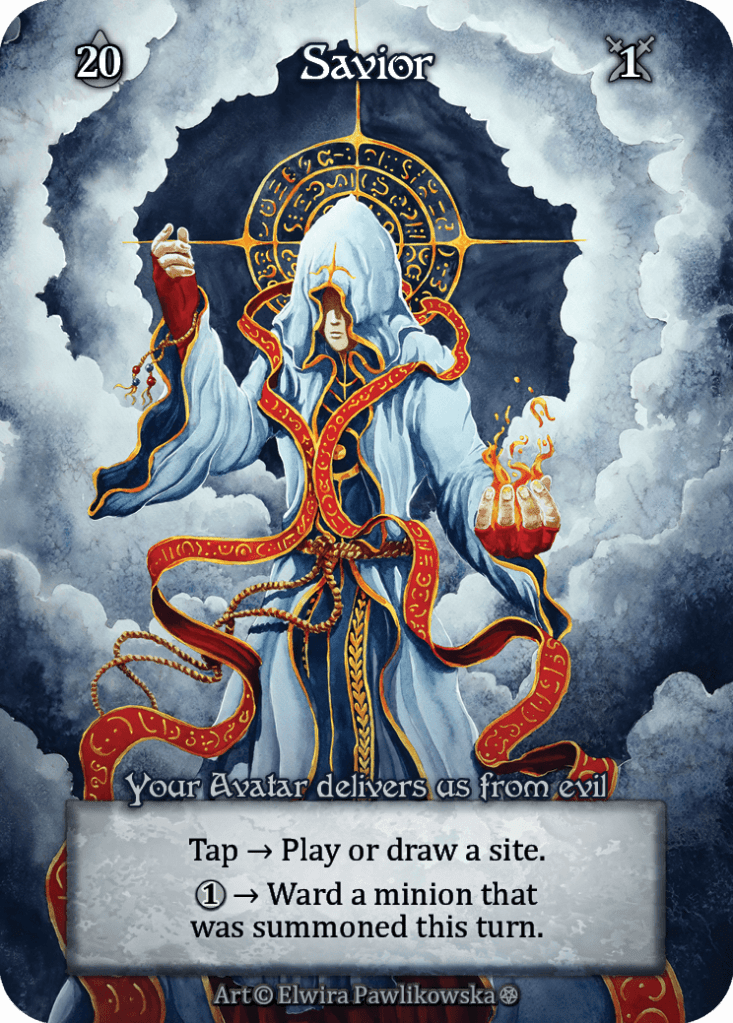
    Savior fundamentally shifts the cost curve of minions. Now, every minion essentially costs one more and comes with a Ward. There are plenty of good Ward synergies in the set, and I think the precon demonstrates this strategy well. Timing when to use your Holy Nova and other payoff effects will be interesting when piloting this Avatar.

    Savior’s ability scales well across archetypes. We can play cheap minions such as Pit Vipers with ward; we can midrange minions with Charge aggro getting in immediate damage with our Redcap Powries and making them a mission to deal with; or we can drop in expensive bombs that warp the game. When building your Savior deck, I think deciding upfront where you want to exist on this spectrum is an essential first step.

    Outside of combat, Ward can help us protect important minions. Lances in AL were useful to protect our valuable minions from combat, but didn’t help against a Lightning Bolt. Ward solves that problem. So this is a boon for cards like Mother Nature and Queen of Midland. I’m very interested to see if these value engines see more play now. Mother Nature was a lot of fun out of Dragonlord-Xeraphine, so I’m crossing my fingers.

    Important to note that Savior’s ability works on summon. Casting is what you do to summon a minion from hand. So this is a double benefit for Mother Nature, as you can protect her on cast and then protect what she summons to the realm. This also makes Adept Illusionist a terrible pest. Bodyguard minions like Old Salt Anchorman, who protects your minions from being submerged and burrowed, become incredibly resilient.

    Savior is single-handedly going to turn the wheels of the Meta. What will be the sweet spot of power to cost? Will small minions be the threat, or will large resilient threats be our bane? This is my favourite Avatar out of the precon kit, and I think will be a great choice for new players and experienced alike.

    Necromancer

    Necromancer is our token deck. The precon list gives a great starting point to get the most out of our tokens, whether that’s upgrading them, boosting their power, giving them more bang with Artifacts. Anything that boosts power is a winner here, so consider your Pendragon Banner and House Arn Bannerman.

    But for alternative strategies, you can consider your skeletons as sacrifice fodder to power out monsters from the deep. Your skeletons can lower the cost of cards like Gnarled Wendigo. Instead of making a beeline for your opponent, your skeletons can go to the corner void to summon forth the Dormant Monstrosity.

    I could also see a version of Necromancer that’s all control spells as you have a win condition printed on your Avatar. Punish your opponent for playing minions, punish them if they don’t by attacking their hand or sites. This could be a fun toolbox deck to explore the Collection mechanic with Toolbox and Silver Bullet.

    That’s three completely different archetypes to explore with this one Avatar. But I’m looking forward to seeing what the community comes up with. Necromancer is my pick for the Avatar that will be winning the first round of tournaments.

    Persecutor

    This is an interesting one. To me this feels a lot like Avatar of Water in that it has built-in movement and then the payoff isn’t immediately obvious. I think Persecutor will have a huge surprise factor where you’re not quite sure what your opponent is up to until it is too late.

    Poison Nova and proximity spells are a great starting point. The free movement lets Persecutor position efficiently to time their spells for the most devastation. Movement without a tap is super useful for effects like Love Potion. Will Persecutor finally be the Love Potion menace we all feared ever since that card was spoiled?

    This is the only Avatar in Gothic with more than one power, so is a contender for more aggressive strategies. Will it achieve what Templar couldn’t? Two power can be an awkward amount as it’s not enough to threaten burst damage like Avatar of Earth; and as Witch showed, two damage chunks aren’t super threatening.

    Town Priest is our most cost-efficient source of bounce so far in the game. Could this pairing be enough for a successful tempo deck? Persecutor makes good use of a large suite of anti-Evil tech in the set. If Evil decks become popular, then Persecutor’s stocks rise as well.

    Persecutor can embrace the dark side and consort with demons. It’s the perfect companion for Shackled Demon, which needs a Spellcaster to unchain it with a tap.

    Harbinger

    Precon Harbinger wants to go big and play big minions early. Harbinger is one of the best flavour Avatars as well, and I think many players will enjoy the storytelling opportunity of being the key and guardian of the gate to the dangers of the cosmos.

    I’m a big fan of stacking cost reduction effects. If you can get a Town underneath a summoning portal, you will have a lot of fun. The randomness of the effect does have to be mitigated, so Voidwalk minions are a great choice. Headless Haunt is an obvious choice, but maybe this will give Peregrine Apparition a new lease of life?

    Harbinger is going to be a deck where the roll of the dice could make or break it. The worst-case scenario is that you roll entirely on your back row. Will you build your Harbinger to be able to pivot into a more defensive deck if that happens? Or will you lean fully into the all-or-nothing aggressive strategy and just make do without your portals?

    Harbinger is the antithesis to Savior, shifting the cost curve in a different direction. Will resilient Warded minions trump big monsters coming down early? This will be a battle fought across local metas.

    Let Loose the Avatars of War

    In this next section, I’ll go over the three Avatars that point us in a more aggressive direction, where they directly take the battle to the opponent. Persecutor belongs in this category as well, so any tips here can apply to it as well.

    I’m a big fan of aggressive combat-orientated Avatars. Battlemage was my champion throughout Cornerstone season. I enjoy having an Avatar that can directly influence the board, deal with the opponent’s minions, and can thwart my opponent’s anti-minion strategies.

    Combat Avatars have unique deckbuilding considerations. They need to consider movement effects so they can influence the board efficiently. They need cards to boost their combat prowess. But it’s also important to bring minions of your own that support your Avatar and benefit from your combat spells and Artifacts.

    Ironclad
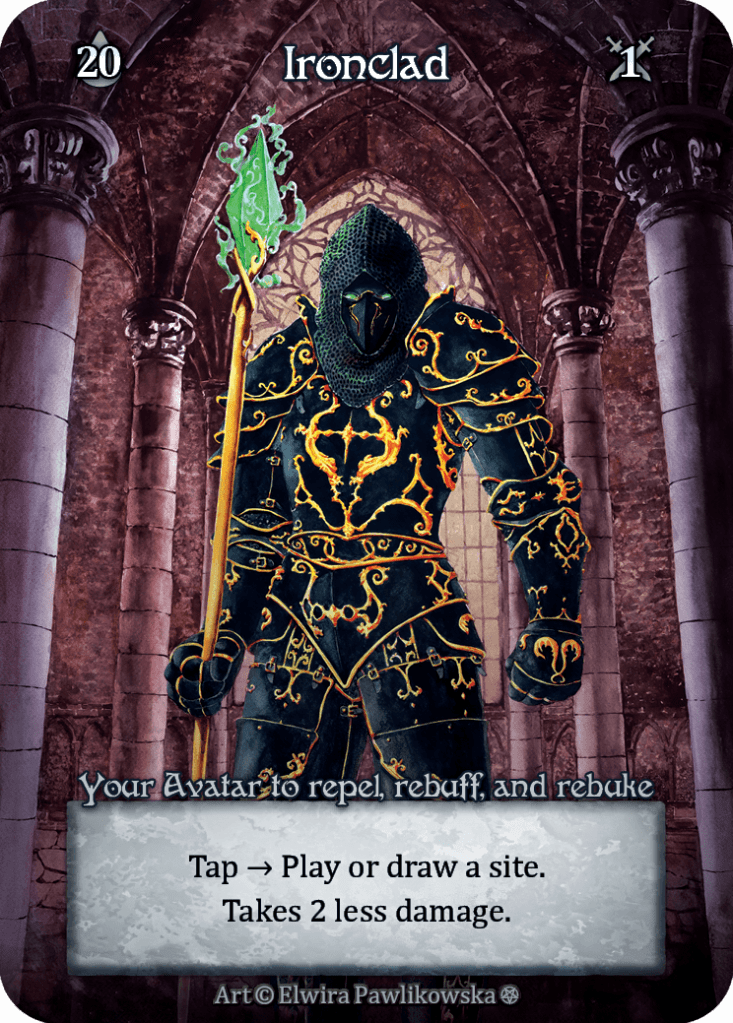
    Ironclad and Bladedancer are great Voltron style decks. This is where you load them up with Artifacts, such as Flaming Sword, and go all-in on this strategy. Ironclad is the more resilient and defensive flavour of the two, so I could see the possibility of building a deck and then swapping between the two Avatars depending on your local meta.

    Ironclad shines with untap abilities, such as Belfry, Sugarplum Pixies. Maybe this is even the moment where Silver Valkyries gets played. Ironclad makes it harder for your opponent to get in attacks on your sites, whilst also defending the valuable minions you’ve invested in. Ironclad will have your opponent scratching their head trying to find a way to break through your defenses, so you also need to be bold and aggressive so they don’t have the opportunity to solve that puzzle.

    Ironclad is also great with self-damaging effects. Note that life lost is not damage, so he doesn’t synergise with many demons like Lesser Blood Demon. However, Searing Truth is damage. Throughout this year, thousands of Ironclad decks will be started in Curiosa and the first thing added is three copies of Searing Truth.

    Ironclad’s downside is that it has no built-in mobility, so you will need to answer this. War Horse is a great pick. I love Blink and run it in nearly every air deck. Helpful Hob’s untap can pack a punch once you’re fully decked out in equipment.

    Ironclad is also a great meta answer to Necromancer, so if that pesky control Necro that wants to win with tokens gets too bothersome, then Ironclad might be the solution.

    Bladedancer

    This is going to be a fun avatar once it’s fully suited and booted. Too bad it doesn’t have Battlemage’s card draw ability, but I guess we can’t have everything on one Avatar. Bladedancer’s strength is that it gets to push through damage on the opponent and thin out the opponent’s minions. Battlemage has to choose which axis to focus on and commit to it, but Bladedancer can split the difference.

    Bladedancer does suffer from the problem of what do you do if the opponent doesn’t have any minions? There are a handful of cards that give your opponent minions, like Bitten, but is that even worthwhile? Battlemage gets to kill that token and draw a card from it, so Bitten is an efficient threat that replaces itself eventually for Battlemage.

    I think I prefer Ironclad out of these two, but I think I’m missing something. Let me know what you plan to do with Bladedancer. I’m sure I’ll get my butt kicked by her soon enough.

    Interrogator
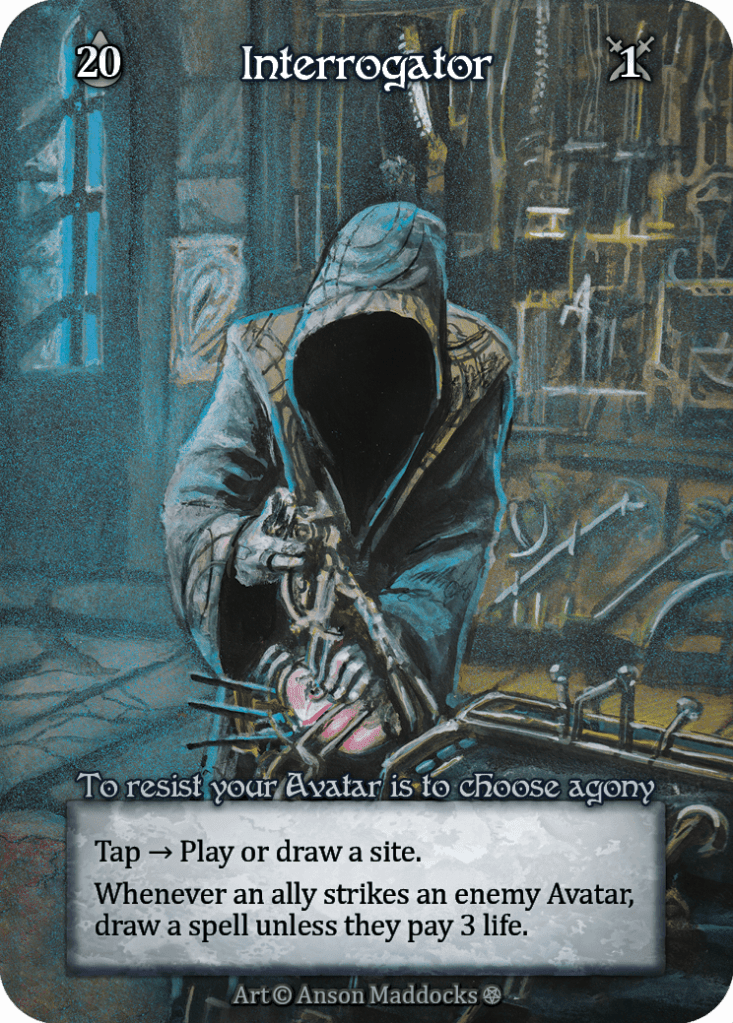
    This is my pick for the most popular initial Avatar out of the gates. Players love drawing cards, and unlike Battlemage, you can send your minions in to do your dirty work. The fact that this isn’t once a turn is scary. ‘Ally’ also includes your Avatar, so I’ve included Interrogator in the combat section as it can do the Battlemage plan of getting in your opponent’s face.

    Token minions are a good strategy here. Zero damage still counts as a strike, so Frog tokens are viable. But since they have to attack the Avatar directly, this means tokens are likely single-use as they will get struck back, but single use for a card draw is very powerful. You can leverage that with Shield Maidens.

    Denying the opponent life gain is strong in this build, so River of Blood is a strong contender here.

    Yeah, I’m scared of this Avatar. It’s like starting with a Boudicca in play as your opponent will likely pay the three life whilst they have life to spend. Your opponent will have to play extra defensive to deny the draw. Going all in on small minions could be a strategy, but just be careful of Poison Nova and Holy Nova wiping out your forces.

    This Avatar appeals to me a lot, and this might be the one that I take to my first tournament. I think there will be a large brain trust of competitive players working on this deck and perfecting it into a meta dominating force.

    Leverage Other Angles

    In the game of Sorcery, there are several things that can lose you the game. Losing to burn spells and minions attacking is the first and most obvious axis. You can also lose a game of Sorcery because you didn’t draw the threshold you require or because your opponent messed up your sites. The third axis of losing is being denied board access. Perhaps this is due to your opponent flooding sites to deny your Burrowing minions access. Maybe this is done with a Bailey or Mountain Pass.

    Site placement and moving sites is one of the most underrated axes of the game but might be the most powerful. If you can destroy an opponent’s site and replace it with your own, you’ve now given yourself access into the opponent’s line and given yourself immense opportunities. Just make sure you don’t give your opponent an easy site for their minions to chew through your life. In Gothic, we’ve been given the strongest Avatar yet that can exploit this axis. Say hello to the Real-Meater.

    Realm-Eater
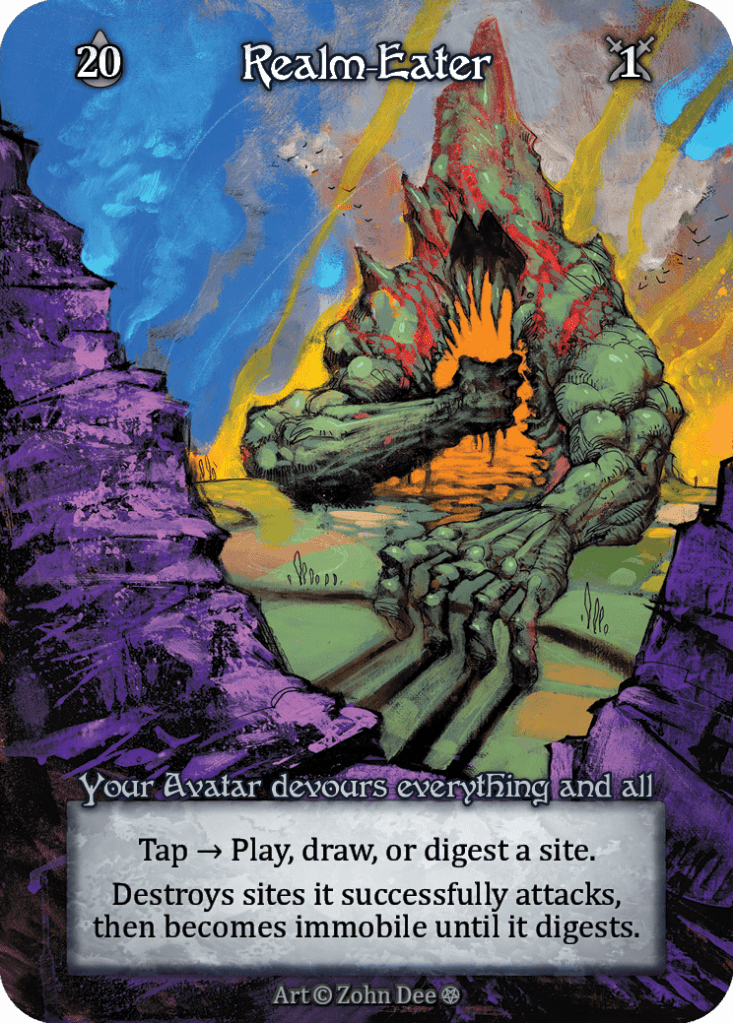
    When using Realm-Eater’s ability, this is the hierarchy of power:

    1. Denying threshold.
    2. Denying opportunities to defend.
    3. Denying your opponent mana.

    Denying threshold can prevent your opponent from playing threats for many turns, putting them at the mercy of drawing from the site deck. Whilst they’re trying to fix their threshold, they aren’t drawing threats or playing them. This is the attack that will have the greatest impact on your opponent.

    Denying your opponent board control is also very strong. Taking out defensive sites like Gnome Hollows so your attackers can get in is a big tempo swing. Breaking their line so your Airborne minions can easily attack their backrow is also very strong. Realm-Eater will require an untap to be able to destroy a site and play a site on the same turn, so this might be a bit more difficult to achieve with just the Avatar ability.

    The least impactful is taking your opponent off one mana. Sometimes this denies them a turn; most often they just play a different card. Similar effects like Witch and Tax Collector never really had much success. A common mistake with Realm-Eater will be taking the opponent off an inconsequential site instead of developing your own board. Since Realm-Eater has to digest before it can use the Move ability again, your opponent will look to play their important sites during your off turns when your belly is full. Such moments will be where Realm-Eater players lose the game without realising it, so be considerate with your timing. Often the threat is more dangerous than the action.

    It will be interesting to see how these decks shape out. I think initially we will see cards like Teleport played with the intention of being able to snipe any site early to try and take the opponent out of the game ASAP. If you spend your turn three playing Teleport and attacking a key site like Tintagel, you might throw your opponent off their entire strategy. But this costs you a turn, a card, and your own development. But my gut feeling is that Realm-Eater will work better with a longer and more deliberate game in mind.

    Like the combat-focused Avatars above, Realm-Eater needs movement effects to fully leverage its ability, and it also needs ways of taking out defenders. You have to successfully strike the site itself to feast on it. Immobile doesn’t prevent you from Attacking the site you are on, so effects like Blink are super powerful here to dance around defenders and strike deep into the enemy’s territory.

    The mere existence of Realm-Eater is an existential threat to greedy atlases and greedy players. The mere possibility that you might sit down to face this Avatar in a tournament is enough that every deck has to be prepared for it. My guess is that this Avatar will have a low play rate in tournaments (I think it will be quite popular in more casual settings), but will be an impactful and important deck with a high win rate. The players who take this to tournaments will be dangerous.

    There is a risk that this is the negative-play-experience Avatar of the set. There’s a chance that Realm-Eater becomes the new Archimago, where the chance to play the game gets taken out of your hands and you are forced to sit back and watch the slow inevitable conclusion play out. I hope not.

    I know there’s players in my meta that will pick this as their first deck to pilot, and I’m scared. I’d better start thinking of a game plan to beat this deck.

    A New Way to Play

    This category of Avatars introduce new angles to the game and feel like the wildcards of the set. When you sit down to play against these decks, you will have a hard time guessing what their game plan is.

    Animist

    Animist is a spellcaster that can play to the board. Animist can compete on the board with minions whilst benefiting from having more options in hand. This feels like the toolbox Avatar of the set. Mortality is never a dead card for Animist.

    The problem with cards like Mortality for Animist isn’t that they’re narrow, it’s that they make for weak minions. A two-cost two-power minion that has no ability is pretty weak. A three for three is where it starts feeling all right. For this reason, I think we need to look at silver bullets that cost three, four, and five mana, so they can be reasonable minions. Extinguish and Boil are the most immediate picks from the older card pool.

    However, then my brain goes to, ‘What’s the point of playing an Avatar whose strength is having a weak back-up plan in case its A plan fails?’ Maybe this is fine for the deck that’s just a pile of removal spells and then the removal can be a threat. Maybe this is fine for a deck with such a strong combo that if you get it, you definitely win, but you just need a backup plan to not get overrun or just lose the game otherwise.

    The biggest issue against Animist is the lack of built-in card advantage. Is Sorcerer or Archimago just the stronger combo Avatar? I’m not sure. It will be interesting to see what players come up with.

    My only corner-case tip to offer is that it might be useful to run effects like Fey Changeling so you can bounce your spell-minions back to hand if they become relevant in the match. Yeah, that’s a nice utility, but will it ever be relevant? Probably not.

    Animist is a great Limited Avatar as it ensures you can pack more powerful utility spells in your list whilst being able to play minions on curve. In a draft, if you get Animist early, you will then be able to take and utilise cards that no one else can. And in draft, where removal is king, having your removal spells turn into minions is super helpful.

    Imposter

    This will be an incredibly fun Avatar and is my pick for what I want to brew with first up. I think the best Imposter decks will have a plan to change Avatars through the early, mid, and late game, with a toolbox to draw upon to adapt and counter threats. We also get to combo and synergise Avatar abilities in a way that’s never been possible before. We can be a Realm-Eater and make a bunch of Rubble, then switch to Geomancer for efficient site ramp.

    The ‘getting damaged’ clause makes combat Avatars like Battlemage and Bladedancer more difficult but not impossible to use. This is a deck that definitely wants Amulet of Niniane and maybe even Blasted Oak to protect your Avatar from errant Lightning Bolts. I think it’s incredibly compelling that Imposter creates a fourth axis in addition to what I talked about before in regards to Realm-Eater, in that you force your opponent to directly interact with your Avatar lest you run away with advantage.

    Here is how I’m planning on building my Imposter. It’s an Earth deck with a Fire splash ramping and disrupting the opponent. In my Collection, I have 10 Avatars to have access to maximum utility. Pathfinder, Realm-Eater, Geomancer, Avatar of Earth, Sorcerer, Witch, Flamecaller, Avatar of Fire, Ironclad, Necromancer.

    Early: Pathfinder. On turn three turning into a Pathfinder, tapping for a site, is incredible. The slower the format, the more powerful this is going to be. If you can get away with three or more turns masquerading as Pathfinder, then that’s incredible value. Even just getting one turn as Pathfinder, you’ve essentially started the game with a free ramp spell in hand.

    Then going into the mid game and late game, there are several routes to take depending on what the opponent is doing. Having Realm-Eater means you can disrupt the opponent who is minion light and wants a long game. Geomancer helps get even more free Sites down. Avatar of Earth can start dishing out massive damage once you have a cluster of sites. If my opponent has too many minions, I can retreat back and shift into Sorcerer to start drawing cards and benefit from my ramp. If I’m ahead on the board and don’t want to overextend, I can shift into Witch and curse my opponent.

    I also have utility picks such as Ironclad to thwart token strategies if I’m on Death’s Door. I have Necromancer as well if I need tokens to gum up the board or have a constant flow of threats.

    Being able to shift into an Avatar with an ‘I win’ button is incredible, so that’s Avatar of Fire or Flamecaller. Depending on whether you’re more likely to have a Fire site in hand or a Fire minion in the bin will determine which is better here.

    You could easily cut out the three least likely Avatars you’ll need, arguably Witch, Ironclad, Necromancer, so you have a bit of room left in the Collection for other toys, but why not lean fully into the Imposter?

    My Work is Done in Deckbuilding…

    This next category of Avatars are those with abilities that impact Deckbuilding more than gameplay. These will be a lot of fun to tinker with in deck builders, but once they’re on the table, will have more linear games executing their strategy.

    Corruptor

    This is the most wide open Avatar of the 13. It cracks open the card pool and makes us peer through the kaleidoscope of choices.

    An important rules note is that this effect applies everywhere, so unfortunately cannot use Call to War (one of my all-time favourites) in Corrupter.

    I think the best way to approach this is by working backwards. Start by looking for strong payoffs for Evil, Monster, Undead, and Demon and then seeing if they’re strong enough that including more minions is worthwhile.

    Here are a few possibilities for each archetype:

    Evil: Willing Tribute, Witching Hour.

    Monster: Abyssal Assault lets our efficient beasts like Lugbog Cat turn into monstrous bombs on curve.

    Undead: Carrionette. This lets us recur our expensive utility mortals such as Grandmaster Wizards, Death Dealer.

    Not being mortal means we’re safe from All Mortals Gone and play it ourselves.

    Kiss of Death: unlocks this powerful kill spell.

    Necronomiconcert: This lets our utility mortals like Land Surveyor join in the card advantage party.

    Angels and Demons? I just love the flavour of building an Angels and Demons list, so hopefully there’s something spicy to justify this. Let me know if you see a spoiled card that Corrupter could use.

    …and What the Hell is That?!

    Now, these last two are pure insanity that not only change how we approach deckbuilding but also how we perceive the game. These next two Avatars are going to be contentious, and I predict there will be a furor and uproar from the community over what they represent.

    Duplicator
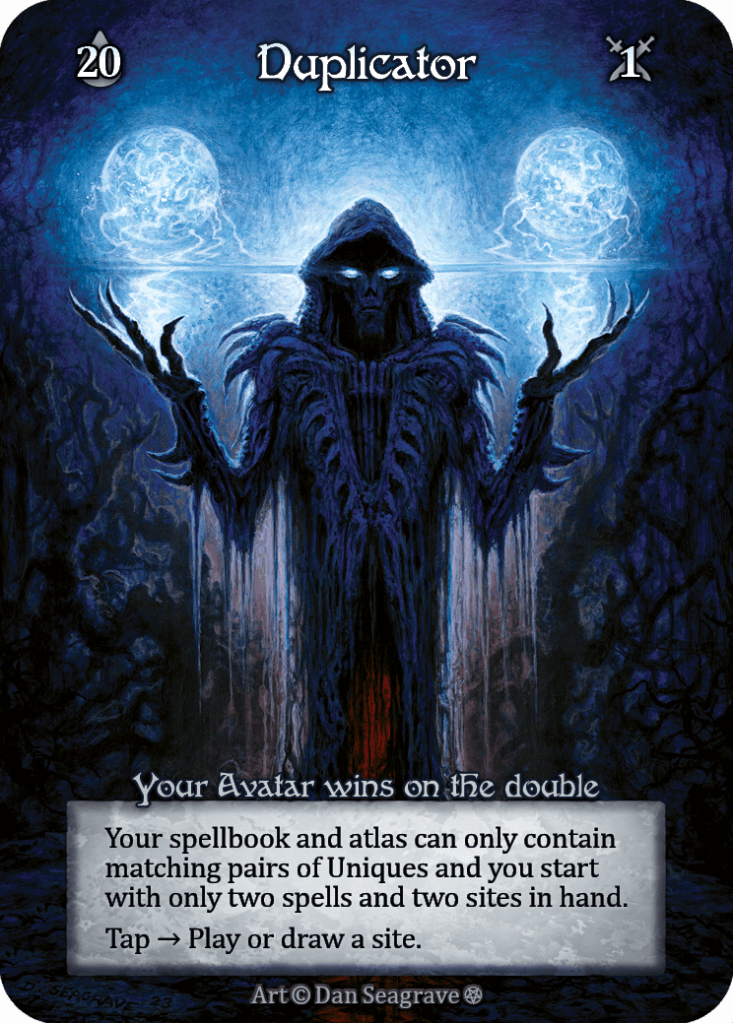
    I am torn on this card. On one hand, this destroys the implied contract of what Unique means to us as players and collectors. One of the selling points of Sorcery was that we only needed a single copy of each Unique card. This affected prices for Uniques as players only needed to get a single copy. Duplicator will affect the entire marketplace.

    On a sour note, this also means that individuals who saw this card leaked before release date had a window of time to gain an unfair advantage by buying cards before the general public was aware of what was happening and could react accordingly. Worst is in the case of Dragonlord. Due to scarcity, many players missed out, and those who got one copy were relieved that it represented all they needed for gameplay. Now that’s no longer the case.

    As for playing with Duplicator, the first hurdle is overcoming the inherent card disadvantage. Tithe and Round Table are the two standout for this. I think there are two obvious routes to building this list. One is the Knights of Arthurian Legends. The other is Immortal Throne. Maybe you could do both of these in the same deck. I have tried Immortal Throne Knights Templar back in the day to middling success, but having two copies of the Round Table is super useful. But it remains to be seen if having a second copy of a critical lynchpin Unique outweighs losing out on the initial card advantage and utility contained in Elites, Exceptionals and Ordinaries.

    Magician
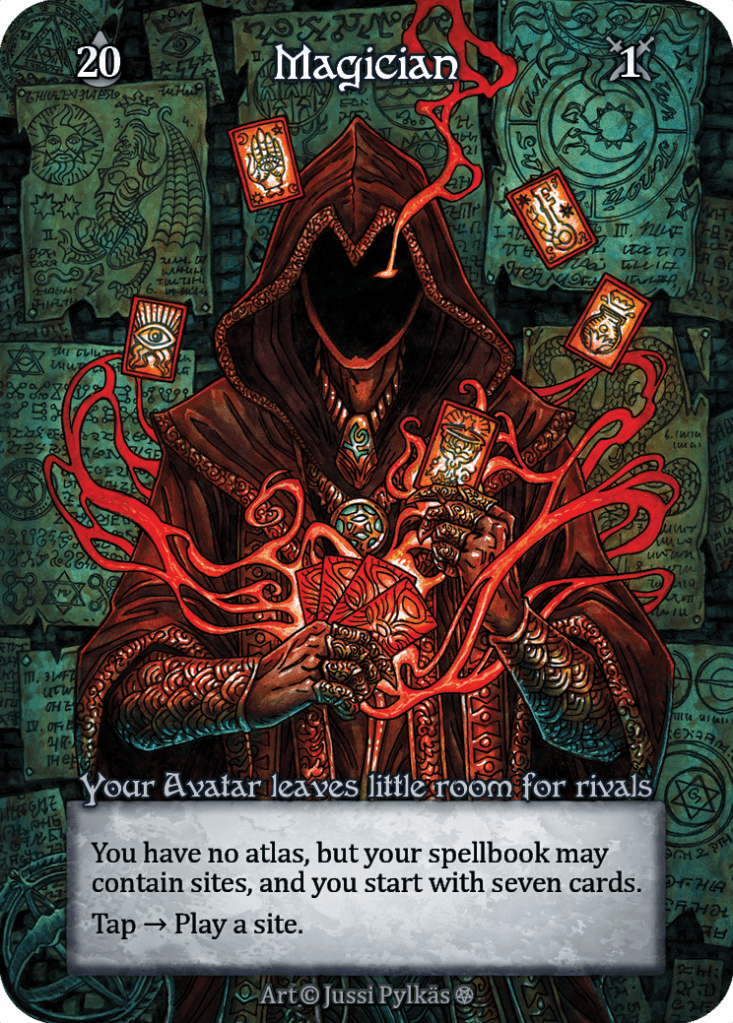
    Now, this is a card that will create positive controversy. I think everyone will have the same reaction of, ‘Oh, no, they didn’t,’ when seeing this for the first time. It’s just a perfect joke and emblematic of the flair and fun out of Erik’s Curiosa.

    On first pass, this just feels like a worse Spellslinger. You get one extra card over Spellslinger without the certainty of drawing an optimal mix of sites and spells.

    But then the next pass is the realization that you get to control the ratio of sites to spells with full control at deckbuilding. This means you can build a deck that wants to draw six spells and one site in the opener – or conversely, a six site and one spell hand. With Sorcery’s mulligan system, it’s easy to push this to the limit since you have a lot of control in choosing what to keep and what to put back.

    For fans of the 40-20 format, this kinda allows you to do essentially that. The cost is that generally it’s cheaper and easier to draw sites than spells, so you’re losing out on the most efficient card advantage sources, such as Tithe and Kettletop Leprechauns, with Magician.

    Magician still has access to the 10-card Collection, so make sure you make the most of that advantage.

    So, what does Magician do that other decks can’t? You’re exchanging one form of consistency to adjust the dials elsewhere. Is that sufficiently powerful? We saw Spellslinger achieve Rainbow foil status, so it’s not impossible that Magician will see tournament play if just for the memes. There is something appealing about only having to shuffle a single deck…

    The worst-case scenario is that Magician’s deckbuilding advantage enables negative-play-experience combos that have been dormant since the increases in deck size. Players were glad to see the back of frustrating combos such as Roots of Yggdrassil, and Candlemas Monks with Crave Golem, so I hope they remain dormant. I’m sure there will be a new negative play experience found in Gothic for those desiring the chance to frustrate their opponents. If such strategies do become a thing, just save them for your friends and tournaments. Don’t make new players suffer through Candlemas Monk nonsense, please.

    Bonus Round: Aspiring Avatar Demon Lord Mephistopheles!

    Mephistopheles wants in on the fun as well! This card is my favourite Unique in the set, and I hope to crack a copy (maybe even a foil) early on so I can play with it. This design space of being able to ascend your Avatar is something I enjoy a lot in card games, and I’m super happy to see it here in Sorcery. Hearthstone fans will know Jaraxxus, but there was a similar mechanic in the older World of Warcraft TCG, where you could turn into a master hero such as Jaina or the Lich King. I find this mechanic extraordinarily fun as it feels like a quest and accomplishment within the game and has great storytelling potential. I’m glad that we only got one card in Gothic, though, so it’s special and unique overall, but I hope to see this design space revisited in the future.

    Mephistopheles is great for Avatars that have an early-game benefit and then need a bit of a push to win the game. This is perfect for Seer, who can find Mephistopheles easier and needs some help in the late game. Pathfinder is another perfect choice. Interrogator is a fun one where once you’ve accumulated lots of cards in hand, Mephistopheles lets you spew them out.

    Conclusion

    Wow, that was a big article. My biggest one yet. I hope it wasn’t too wordy and was densely packed with useful information. I don’t expect anyone will read it entirely, but hopefully people can jump around to their favourite couple of Avatars and leave with something useful to start their brewing.

    Overall, I’m super excited. There’s hundreds of possibilities to explore here. Each Gothic Avatar has at least three obvious paths to go down, with multitudes of less obvious ones to discover. As no Avatar is restricted to a single element, like in Alpha and Beta, each element and combination requires examination.

    We also have to go back and see what Gothic does for our existing 21 Avatars. I am looking forward to seeing what the community comes up with. This time of exploration is going to be immensely fun and rewarding.

    In this article, outside of a few spoilers, I haven’t even talked about how the actual card pool impacts all of this. How will the big archetypes influence things? We have Evil and Ward turning the wheel of the meta. What will come out on top?

    The Beta-Arthurian Legend meta was generally quite fast, especially early on. What will be the tempo of this new meta? Will this be a meta where fast decks, such as Interrogator and Harbinger aggro is MVP, or will it be slow enough where Imposter can shift through six different guises and come out on top?

    So, let’s get on Curiosa, sleeve up some decks, fire up TTS, and have fun with Gothic.
  • Dragonlord – First Impressions, Strategies, and Deck Lists.

    Dragonlord – First Impressions, Strategies, and Deck Lists.

    The long-awaited Dragonlord set is here. 13 incredible new cards, featuring the amazing art and lore of Ed Beard Junior, and the designs and mechanics of Sorcery Contested Realm. I want to give a massive congratulations to Ed Beard Junior and the team at Erik’s Curiosa for what they’ve achieved with this project.

    I’ve had a weekend to think about the cards, test some out, and design a couple of decks. Overall, I’m incredibly positive on this set. The cards give new life to existing decks, there are new strategies and archetypes to explore, and I’m reassessing Gothic spoilers through a new lens.

    Two for One

    My favourite part of the design of Dragonlord is that this isn’t a 13-card set; it’s actually 20 cards. The Dragonlord Avatar is actually eight different cards in one. Each Unique dragon minion in this set pulls double duty as a strong minion and as a mode for the Dragonlord. Note that Kairos the Archivist doesn’t work with the Avatar as you cannot pay for its genesis ability during setup.

    1 of 13 Foils Collected

    I am a fan of foils. They are a great thing to collect or to bling out decks with. I think it will be incredibly difficult to complete this set in foil for one major reason. People will open their Dragonlord box, see the foil and have a reaction along the lines of, “Oh, that’s cool… Wait, what’s that? Whoa, that’s amazing!”

    Then they turn it over to the full-art back, “I didn’t see that before! Dragons are awesome. I love this card.”

    Then it gets put in the front page of their binder as a reminder of the time and place where they opened their Dragonlord set.

    So good luck to anyone going for 13/13.

    My First Weekend – Water-Earth Pathfinder

    Before release weekend, I had been playing my Water-Earth Pathfinder deck. I needed a bit of a break from Battlemage after spending a month playing it exclusively and writing over 10,000 words on it. Please read my three articles about Battlemage and the upcoming Cornerstone events. What I’ve typed will be a window into my madness.

    This Pathfinder brew wanted to achieve two things. First it was to be a deck where I could use my awesome new soldier tokens from the Dust Store. Secondly, it was to see if I could break Helpful Hob. Now, these two missions might seem antagonistic: Hob wants big minions, soldier tokens aren’t big minions. But there’s two things that tie the room together. First is that Hob lets Pathfinder ramp, allowing you to cast your bigger minions sooner. Then with more sites in play, Border Militia and Guards! become stronger, so your soldiers scale with the game. Then the soldier tokens can be Shapeshifted and be the big minions.

    I was having so much fun with this deck, that I decided to add some Dragonlord spice to it on release day and keep rolling with it. I added Shrine of the Dragonlord, Talamh Dreig, and Vatn Draconis. Each of these cards were incredibly fun, and made for some incredible moments. My favourite play was Shapeshifting into Talamh Dreig on turn four, equipping Grim Guisarme turn five and hitting for 20.

    Is Helpful Hob broken? Maybe not, but he is very, very useful in Pathfinder. He can be ramp, a power-doubler with a big minion, a movement spell, and then a blocker to boot. He won me games as a top deck, and four copies in this deck didn’t feel egregious. In Water-Earth, you don’t have too many similar effects, so give him a go!

    Here is the decklist as it stands now. It’s a lot of fun. I also wanted to play Sir Yvain as he’s one of my favourite knights from Arthurian Legends, so there is a beast package as well, but that’s on the chopping block if I wanted to make this deck more refined. So here is my Soldiers, Beasts, and Dragon Pathfinder brew:

    https://curiosa.io/decks/cmdwb27jz00rkla04h2bgoie0

    First Impressions of the Cards

    I’ll go through the cards now, giving my impressions and ideas for potential strategies and decks. I think there is a lot to discover, and I expect some creative brews to pop up over the coming weeks.

    Dragonlord Avatar

    There are currently eight modes that the Dragonlord can be. As I go through the eight minions, I will also talk about the Avatar mode at the same time. As I mentioned above, this is fantastic design and allows us to get a lot of mileage from this set.

    Caelestis

    There’s a couple things to keep in mind with Caelestis. You still need to meet the threshold requirements of the dragon you’re casting for zero. Considering the wide variety of threshold requirements across dragons, it might take a bit of work to squeeze them all in to one deck. You also need to meet normal summoning requirements, so you’ll need a Summoning Sphere to cast dragons on your opponent’s sites.

    So Caelestis does require a bit of work as a minion. I think it will be more fun as the Dragonlord.

    Dragonlord-Caelestis allows for an interesting strategy. Spend your first three turns deploying sites, hopefully hitting the demanding threshold requirements. Wedding Hall is interesting as it delays you a turn, but it might be more consistent than other combinations.

    Then from turn four, tap to deploy one big dragon a turn. It will be interesting to see if this is sufficient pressure to win the game. At least with Airborne dragons, you can get around sites that might otherwise completely shutdown other big minions, such as Bottomless Pit and Perilous Bridge.

    Here is a quick deck I threw together:

    https://curiosa.io/decks/cmdwez2hl00t9l5048x5krj46?tab=settings

    Having to pay three and tap is pretty tough as it limits your ability to develop your board. You’ll need to find opportunities to tap to draw and play sites. You don’t want to overextend your board, and have all your dragons wiped out by one Earthquake.

    Excalibur and Gilded Aegis are interesting as they provide protection for a big dragon and can be played the turn before tapping to deploy one. Rescue also feels pretty vital to get a critical mass of dragons. Blink and War Horse on turn two are important to get the Dragonlord in position so your dragons don’t have to waste a turn moving up themselves.

    This feels like a deck that just gets destroyed by a strong fundamentals deck such as Avatar of Air, but I’ll give this a test and see how it goes. Perhaps it needs some cards from Gothic to make it tick.

    Adtonitum

    Zap, zap, zap. Every movement spell comes bundled with a Lightning Bolt. Adtonitum is so much fun, and there is a card spoiled in Gothic that goes nuts with it. Check out the spoilers on SorceryTCG.com and see if you can spot it.

    As the Dragonlord’s ability, this allows you to build a whole deck that exploits movement effects. It does require a bit of ramp as you need three to activate the Dragonlord first each turn and then enough mana to play all your spells. Merlin’s Staff is a great payoff to this strategy.

    My prediction is that Dragonlord-Adtonitum will be a meta contender. Movement is such an important part of the game, so anything that can leverage or get additional value from movement is just inherently strong and versatile.

    Draco Corvus

    This card makes me laugh. I can just imagine this dragon shuffling around like an old crow, suddenly swiping lightning fast and stuffing someone in a hole, cawing all the while. It just has incredible Jim Henson vibes. This is also the foil I opened, so he’s my special shiny crow boy.

    Stealth and Airborne makes for a versatile and flexible attacker, and his ability lets it beat bigger minions. The ‘tapped minion’ clause is a bit of a limitation, but I can see board states where Draco Corvus is sitting menacingly in stealth and the opponent can’t make effective attacks without opening up their minion to be buried the following turn. Throw in a Border Militia, and your opponent might really struggle to find effective lines.

    As the Dragonlord, I think this might be the least commonly used as it’s more reactive than proactive. Most decks are built with a more active game plan in mind. But having removal always available to your Avatar ability is nice. If the meta shifts towards more big resilient minions like Seirawan Hydra, then Dragonlord-Draco Corvus is a nice answer to that. In this way, Draco Corvus is a nice safety valve to the other cards in this set, so that’s a nice design touch.

    Ignis Rex

    The most dragon dragon. As a minion, Ignis is pretty straightforward. He’s a big minion that you can play if your Fire deck can support it. The ability is useful, and Immune to Fire damage is actually quite powerful.

    As the Dragonlord… Well, poor Avatar of Fire, Dragonlord is just so much better than you. This is also one of the more reliable self-discard effects we have currently, so opens up avenues for reanimation effects, like Raise Dead and Boneyard. Going into Gothic, I’m sure we’ll see plenty more options as well, so don’t assume that Ignis Rex is just a boring one-trick pony-dragon.

    Moonsong Talagelum

    If you have a Grey Wolves deck, throw away one wolf, add one Moonsong. If your Wolves deck was Earth-Water for Geyser, then you might need to retool.

    It’s interesting as the Dragonlord ability because I think Talamh Dreig might be the better choice in this deck as it’s a backup plan to board wipes, such as Poison Nova. Sure, the ceiling is higher with Moonsong, but the floor is lower.

    However, to Moonsong’s credit, there might be situations where you don’t have more Grey Wolves in hand, or don’t want to play more, so being able to pump the ones you have on the board with your Dragonlord-Moonsong Talagelum might provide an important breakpoint to overcome the opponent’s forces.

    I’m sure the Grey Wolf aficionados will solve this one, and we’ll hear all about it in Discord. #TeamFrog

    Talamh Dreig

    As a minion, this dragon is a lot of fun. It’s easy to get to 10 power, which is obviously great with Grim Guisarme. It is surprisingly resilient with immunity to forced movement. Bury and Earthquake won’t work. Avatar of Air can’t puff it into a Bottomless Pit.

    Dragonlord-Talamh Dreig has to be compared to Avatar of Earth and Battlemage. Dragonlord has more flexibility with deckbuilding than Avatar of Earth and a more flexible playstyle than Battlemage.

    What I like about Talamh Dreig Dragonlord is that you don’t have to overcommit minions to the board. You can play a big one, like Pudge Butcher, then if the opponent plays around it or removes it, your Dragonlord can just activate and chunk the opponent for five or six. If the opponent plays around shutting down your Avatar, then your minions are strong enough to hold their own.

    Just be careful with your Blinks and Grapple Shots as you can’t activate your Dragonlord and then use these, as these are forced movement effects.

    Vatn Draconis

    Vatn has a lot of play that isn’t immediately obvious. Water has to be the element that has to do things differently. The mono-water dragon of course doesn’t have Airborne and an ability that isn’t about damage. Water makes you work for it.

    The turn you play Vatn, it provides immediate value by drowning your opponent’s belongings. Then being submerged, is resilient and evasive. If you can flood your opponent’s sites, Vatn can slink over and get in some sneaky damage.

    As the Avatar choice, it’s very strong defensively. Similar to Draco Corvus, but this doesn’t require a tap. This is strong with Riptide and Undertow, and water decks that were relying on Mariner’s Curse can retool to Dragonlord-Vatn Draconis. If you can flood the opponent’s side of the board, this also turns your submerge minions into Gneissgnath Gnomes. This is also quite fun with symmetrical effects like Horn of Caerleon that function on ‘nearby’, as you can bring them up on your turn and then drop them back down at the end of turn.

    I’m hoping Gothic gives us a bit more flexibility with flooding sites to boost Water’s power a bit and unlock strategies like this.

    Xeraphine Konrul

    As a minion, this compares to something like Riddle Sphinx – a big flyer that draws you a card. Xeraphine gives you your choice of card, at the cost of requiring a sufficient mass of minions in the cemetery to keep it up. The ongoing value this can generate is pretty incredible, making it a must-remove minion. But with more cemetery hate being played in the meta, this can be risky.

    Of all the Dragonlord modes, this feels the most unique. I have seen a lot of people dismiss this as just a worse Deathspeaker, but this isn’t the case. Deathspeaker needs a critical mass of value Genesis minions, can only recur each minion once, and the recurred minions don’t have a board presence.

    Dragonlord-Xeraphine can recur the same minion multiple times, and make full use of their board presence. This makes minions like The Green Knight or Sir Mordred incredibly useful. This also allows you to use value engines like Mother Nature.

    Deathspeaker also struggles to close out games, so it relies on combo finishers like Nimbus Jinn. Dragonlord-Xeraphine can just replay big finishers like Infernal Legion again and again.

    Kairos the Archivist

    Shahrazad… If you know, you know. Kairos creates a mini game by threatening to turn back time. This is a card that I hope to see occasionally, but I hope there isn’t some crazy strategy found to make it meta dominant. It’s an incredibly flavourful card, but if my opponent plays this in the final game of a tournament, my brain will fall out of my ears.

    As I said at the top of the article, Kairos doesn’t work with the Dragonlord avatar, which is definitely a good thing.

    Dragonlord’s Lair

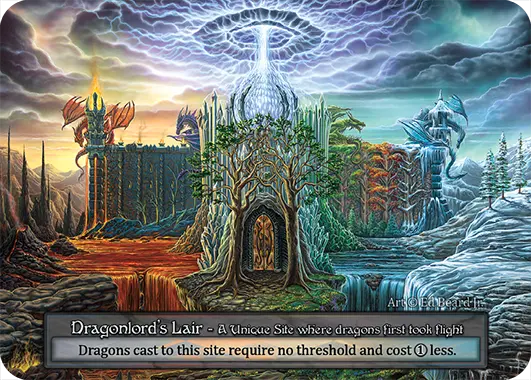
    With release weekend, this seems to be the card that people are most excited about. It’s the one site in the set, and has incredible art displaying the world and creation of Ed Beard Junior. I can understand why its popular, but it will be interesting to see if it holds the top spot.

    My favourite combo with this is Camelot, as you can stack the cost reduction and get your big Unique dragons out a turn sooner. It’s very splashy, and the one game this weekend where I managed to do that, I didn’t draw any Unique dragons to take advantage of it.

    This site suffers from the same problem that Tournament Grounds does. You get incredible consistency in the games you can play the site, but your plan can suffer when you don’t. With 30 cards in the Atlas, this is even more problematic for Unique sites. So when deckbuilding with this site, consider the games you draw this as outliers and build your deck to function without it.

    Cradle of Etherrum

    I think currently it’s a bit of a mistake trying to make a dragon tribal deck work. I don’t think there is a critical mass of dragons to really make the strategy pop off, especially if you don’t include Azuridge Caravan. Combined with the inherent inconsistency of Unique cards, it’s hard to build a strategy around this one. Hopefully, we get a few more Ordinary and Exceptional dragons in Gothic to help this out, but my guess is that we will either get zero or one dragon in Gothic.

    Here is a quick Seer dragon tribal I put together to test dragon tribal:

    https://curiosa.io/decks/cmdwbmu4y011vjp04nhl291h6?tab=view

    I like Seer as it helps you draw appropriate cards for the stage of the game. It also prevents the games where you draw a Mix Ignis and no minions or vice versa.

    Shrine of the Dragonlord

    This is going to be the most discussed card of the set over the next few months. People will argue whether this is so good that it goes in every deck, or if it’s not worthwhile and goes in none.

    Where Four Waters of Paradise is the two-cost version of the Mix cycle, Shrine is the two-cost version of the Core cycle. But where Four Waters doesn’t provide long-term threshold consistency, Shrine of the Dragonlord fixes it permanently. In the Pathfinder deck I listed above, a turn-two Shrine was just so powerful. I’m currently leaning on the side that it goes in every deck, but we will see.

    The biggest thing to note is that the mana isn’t generated on the turn it is played as sites only generate mana when they enter the realm and at the start of your turn. Being a monument, the Shrine is more resilient than Cores that have to be carried as it’s harder for your opponent to purloin it. Just be wary of anyone bearing Land Deeds – or anyone working for the British Museum.

    The Genesis effect is also a nice little addition. There will be one game where you can blow out your opponent playing a bunch of dragons with it. Play this late game, scoop up all the dragons, drop a Cave-In, and bury them all. Make sure you take a picture of your opponent’s face afterwards.

    Conclusion

    Dragonlord is fantastic. It’s improved decks I already have and got my brain churning with new ideas. Over the weekend, I had some incredible games, and the Dragonlord cards were so incredibly steeped in that distinct ‘Sorcery’ flavour.

    One game with my Pathfinder versus Geomancer, my opponent and I completely filled the board. We were both dropping masses of soldier tokens on the board thanks to Magellan Globe, and we were just laughing at all the crazy haymakers from big spells and big dragons. “Now, this is Sorcery,” I said as I threw down a Talamh Dreig.

    I sympathise with people who’ve been unable to get a copy of Dragonlord this weekend. I recommend trying out the cards on Tabletop Simulator or borrowing a dragon or two from a friend to test out a build in the meantime. Hopefully more copies of Dragonlord become available soon. Don’t forget that you can also compete to win a copy at all first-round Cornerstone events.

    Feedback Requested

    With these articles, I’m opting to save time by going barebones with graphic design. One of the goals of this blog is to create a writing portfolio to aid my professional career. So the more time I can spend on writing, the better.

    My personal preference is to have Curiosa open in another window to look up cards as I’m reading articles and watching videos, so I don’t need images within the article. I also mention so many cards that if I included a graphic for each one, the article would be a mile long.

    However, if this isn’t your preference, it would be good to know so I can improve the overall reading experience. Feedback is always appreciated.

    Thank you for all the positive comments I’ve received so far. It really does go a long way to keep up my motivation.

  • The Dust Store is so much more than just a rewards programme.

    The Dust Store is so much more than just a rewards programme.

    With the Arthurian Legends refresh of the Dust Store, I have seen many people asking for advice on what they should spend their dust on. I’m here to make that decision even more complicated. In this blog, I’m going to list my favourite cards available through the Dust Store, both old and new, and explore the six ways that the Dust Store is much more than just a rewards programme.

    • The Dust Store is an opportunity to provide alternate art promos to entice collectors.
    • It rewards players for playing.
    • It allows for design innovation from the designers.
    • Provides practical solutions to enhance gameplay through accessories.
    • Celebrates artists.
    • Preserves the history of Sorcery.

    For each of these points, I have chosen one item from the Dust Store that exemplifies the point. My goal with this blog post is to generate excitement for the Dust Store and get more out of their rewards.

    I think it’s important to state how easily dust can accumulate through consistent participation over time to allay negative feelings. Between participating weekly, opening one or two booster boxes, and winning an event or two, it’s entirely feasible to earn 1500 dust in a year. So far, we haven’t seen the Dust Store go out of stock on anything, so there is time to earn and spend down the road. The marketplace aspect of the Dust Store promos is important but beyond the scope of this blog post. I’m just focusing on fun for now.

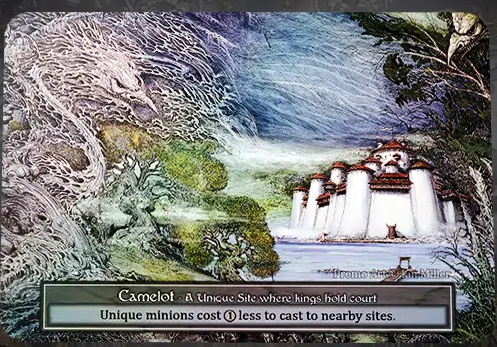
    The Dust Store is an opportunity to provide alternate art promos to entice collectors – Camelot (1500 Dust)

    Camelot is my favourite addition to the Dust Store. It’s the perfect encapsulation of what the store can offer. Collectors are rewarded by being given the opportunity to get these amazing alternate art cards. Whilst I’m certainly looking forward to playing with my Dust Store foils, I know most players are picking these up to add to their collections. The Dust Store does serve to provide that little bit extra value for people who are buying a lot of product.

    I love this alternate-art Camelot for many reasons. Firstly, Camelot, in my opinion, is a strong, fun, and powerful site. Currently, meeting threshold requirements is incredibly important due to having fewer proportionately sites that produce multiple threshold in a 30-card Atlas, powerful cards that attack sites directly, such as Hamlet’s Ablaze and Sinkhole, and the intense requirements of powerful cards such as Morgana le Fay. Due to this, I feel like we haven’t seen Camelot really hit its stride in the current meta, but I expect it to be a strong card into the future.

    The main reason I enjoy this card so much is that I’m a huge fan of Ian Miller’s artwork. This version offers a grim reinterpretation of the original version. 

    In the Jeff A. Menges piece, we see a resplendent Camelot, with triumphant knights returning home, banners waving in the breeze, and the castle gates wide open to welcome the heroes home. For me, this art depicts the height of King Arthur’s reign. However, in the Ian Miller artwork, I see Le Morte d’Arthur, the death of King Arthur.

    In the Ian Miller piece, the bridge from the shore to the castle has been severed, the gates are closed, and the angle looking up to the wall presents an insurmountable cold cliff. The transition of colour from the white castle walls to a lush green forest being drained of its colour, all shadowed by a dark sky and encroaching evil. This pieces says to me that the good times ushered in by the reign of King Arthur are over. This is the end of the Arthurian Legends.

    And we’re going into Gothic. Ian Miller is no doubt going to be featured heavily in the upcoming set of Gothic, so to me, this feels like a deliberate tie-in between two otherwise very disjointed sets. Arthurian Legends feels light, whimsical, and playful; whereas Gothic certainly won’t be. The Ian Miller Camelot is a perfect middle ground from where we are to where we’re going next.

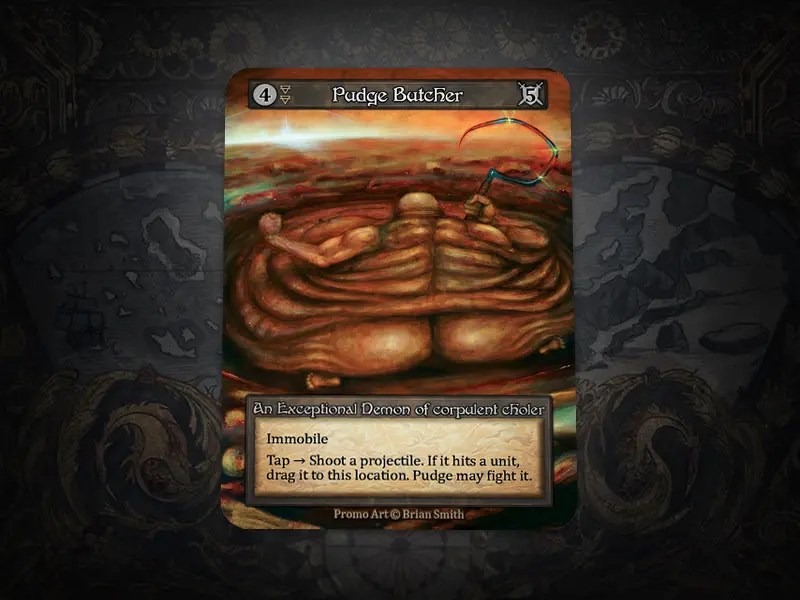
    It rewards players for playing – Pudge Butcher (200 Dust per copy)

    Pudge Butcher might be the card that has hooked more new players into Sorcery than any other, so it’s always fun to see it being celebrated.

    The Pudge Butcher promo also showcases the benefit of the change from one copy per customer per lifetime to three, as players can now get a full playset of three copies of this Exceptional rarity card from the Dust store without having to go to the secondary market.

    Before this change, it was a mission to get a second and third copy, and players who achieved this often then kept them sealed, not quite making the leap to putting them into a deck. Now that everyone can get a playset, I expect this will open the floodgates to the idea of people using their Dust Store promos in decks instead of keeping them sealed in plastic or locked away in a binder.

    Pudge Butcher represents how the Dust Store rewards and celebrates players playing the game. Taking powerful constructed cards and giving them alternate art is a celebration of players. I hope to see other constructed staples get similar treatment in the future through the Dust Store, but I expect such cards are being saved for store promotions, such as the teased Apprentice Wizard and Grandmaster Wizard from Severine Pineaux.

    It allows for design innovation from the designers – Druid four pack (1000 Dust)

    The Druid Dust Store promo highlights how the store is a powerful tool to help the designers break out of the limitations and challenges imposed by the requirements of the printing process.

    The Druid as a double-sided card could have been handled in many different ways. I think the option of putting the foil Druid cards in booster packs as three or four separate cards would have had serious drawbacks.

    Firstly, combining the two Druids into one foil card would mean we’d lose the beautiful full-art back for two cards. And in my opinion, players opening the tokens would have caused more confusion and bad feelings than positive because of the connotation created by other card games that token cards are low value.

    This Dust Store package gives a feasible way to print all four in the way they deserve whilst preserving their perceived value. This shows how experimentation in design can be facilitated by the Dust Store, and I expect to see more of this in the future.

    Provides practical solutions to enhance gameplay through accessories – Soldier Tokens (200 for AL four pack, 400 for Alpha-Beta three pack)

    The tiny Foot Soldier tokens are a tidbit from the Kickstarter when the tokens were accidentally printed quarter size instead of half size. The fanbase loved this, and it was kept this way. 

    There are pros and cons to tokens at this size. An advantage is they help reduce clutter on the board and can be easier to handle in larger quantities. The downside is that they are easier to overlook and be obscured by other cards.

    For ease of game play, using full-sized Foot Soldiers tokens could be beneficial. I find often a Foot Soldier that comes down on turn one through an ordinary Village site can be easily overlooked and forgotten until it causes a critical error. They can easily be covered artifacts held by the avatar and minions played to the back row such as Highland Princess. Larger tokens helps prevent this issue by making the token have the same presence as other minions.

    The tokens help players customise their game experience and have options for how they want their game to look. I think there’s a lot of value in offering these options and provide players with personalisation options in the Dust Store.

    Celebrates artists – playmats, Watchtower, Roots of Yggdrasil, Mirror Realm, Primordial Spring (800 Dust each)

    Did you know that you can win the game before you start playing? If you put down a Roots of Yggdrasil playmat, the opponent will be so tilted by their strong emotional reaction to the power of this card, they’ll be unable to play at their best.

    I think the one thing players, collectors, and everyone involved in Sorcery universally agrees upon is that the artwork in the game is incredible and important. People are generous in giving their support and appreciation to the artists, and the Dust Store is another way in which this can be achieved.

    This is a bit of a cheat category as everything in the store proves this point, but I chose the playmats in particular to represent this. They showcase the passion and consideration that Erik’s Curiosa has for their artists in supporting them and championing their craft. The artwork comes to life at the larger size and small details can be noticed and appreciated at this scale.

    I would like to encourage players to embrace the half-sized mats and use them more often and bring them more often to events. I think it’s fun to sit down, place down your mat next to your opponent’s and share a moment to share and appreciate the art. It’s a great way to ease into a game and get into that positive mindset that makes for an enjoyable experience.

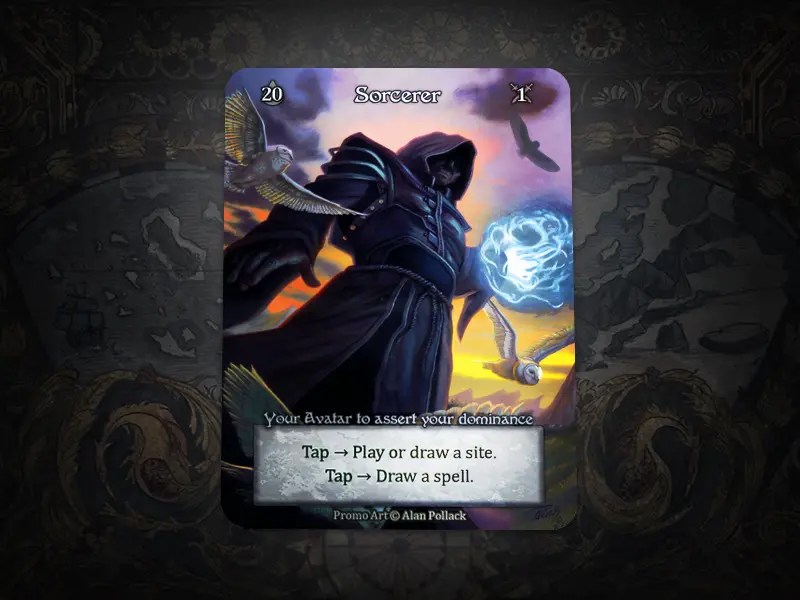
    Preserves the history of Sorcery – Sorcerer (300 Dust)

    The Dust Store can be used to preserve the history of the game. The Sorcerer is an iconic avatar, and this version gives a chance to preserve the Alan Pollack artwork that was previously only available through the Kickstarter and make it more accessible.

    I think perhaps the Sorcerer promo has been unfairly maligned, with players questioning why they would spend dust on yet another copy of the Sorcerer and that it might not be worth the dust, especially considering the availability of the box topper foil Sorcerers. I think this perceived negativity is perhaps the reason we did not see the previously spoiled Common Cottagers in this Dust Store update.

    It is unfortunate for something to be put on to the Dust Store and then rejected by the fanbase. Dust is a precious commodity, and players want to save their currency for when it really matters. I do hope that we see more items like the Sorcerer in the future, but perhaps we will see historical pieces like the Common Cottagers distributed in other ways. The Dust Store can’t quite resolve all issues, but it is still a powerful tool in the arsenal to help.

    I enjoy the Sorcerer promo and am grateful to have it in my collection. I think it gives an insight into the creative process that goes into the game, and that’s something I hold high value for.

    Concluding remarks:

    As I finish up writing this blog, I am eagerly awaiting my promos to arrive in the mail. I am definitely an overthinker and I enjoy musing about these things. As the store refreshed with the AL offerings, I acted a bit too quickly and missed getting Briar Patch because at the time I thought it was only one copy per 500 dust. Due to shipping to my part of the world being so expensive, I save up and do a single big order, so the Briar Patch will have to wait another year. Last year, I couldn’t afford Cloud City, so that was the first thing I put in my cart this time.

    Thinking about that Cloud City promo was a bit of a past-time over the last year, including accidentally bidding on a regular foil Beta version on Ebay thinking it was the promo. Fortunately, I didn’t win that one. Though, at the time I did need a Beta foil for my collection, so it wouldn’t have been a total fail if I had. It was incredibly satisfying a few months later when I opened a foil Cloud City in a booster pack, though. All that to say is that sometimes overthinking can be positive, especially when it’s about cardboard and our hobbies that bring us so much joy. If you’ve read this far, you’ve probably already picked that up about me, and you can expect much more of that in my future posts.

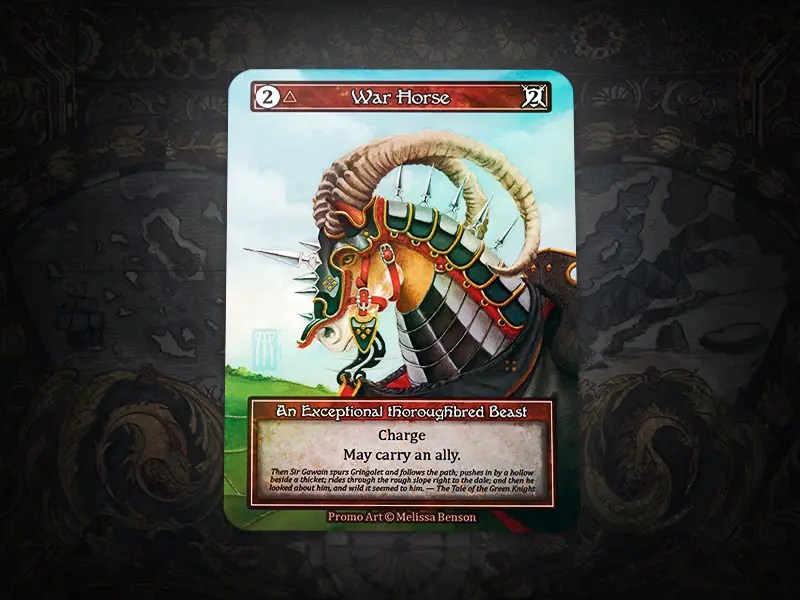
    The Dust Store is a privilege. It’s an example of how Erik’s Curiosa goes above and beyond in many regards. For players and collectors, it’s a chance for us to show our appreciation by using it and taking the time to share our thoughts with the community. If anyone sits down to a game with me and has three copies of Melissa A. Benson’s Warhorse, you will have my immense respect.

  • Five Predictions for Gothic

    Five Predictions for Gothic

    13/6/2025

    Note: this was written and not published before the spoilers on 13/6/2025, so I will resist the urge to update this blog with those in mind.

    Note: Please forgive the current lack of graphic design. This blog is a work in progress, but most importantly for me is the writing, and I need to start getting that out into the world for feedback and to prevent procrastination, so please enjoy this old-school column. To look up cards, please visit: https://curiosa.io/cards

    Greetings. We’re currently in a lull period between sets, and whilst things have slowed down a touch, the whirring in my brain has not. Sorcery has taken over my life in the best way possible, providing me an opportunity to socialise, enjoy an incredible new hobby, and occupy my brain with something somewhat more constructive than its usual overthinking. I am constantly thinking about new decks, new strategies, and with a new set on the horizon possible new cards.

    So, here are five of my personal predictions for the upcoming Sorcery set of Gothic. Some of these are pretty wild and some are probably pretty obvious. It will be interesting to see how far off the mark I am once the set has been released. This is a big of a long-form article, and hopefully my thoughts aren’t too meandering. Number five is a bit of a controversial one, and I have included a prediction on the release date at the bottom.

    These ideas and thoughts came about by thinking (probably too much) of cards and mechanics that would benefit current competitive and casual gameplay, how cards interact with other cards from Alpha-Beta and Arthurian Legends, thematic ideas that would fit into a dark and gritty Gothic set, and parallels to other card games that might have influenced the designers.

    1. New and more minion tokens:

    This is an easy one to start off with. In many games of Sorcery, it feels like the board gets simplified too easily. Minions trade, spell removal is clean and efficient, and the board gets cleared quickly through these interactions. There are plenty of cards that easily clean up small minions, such as the Desert sites and Magic Missiles. We even already have a silver bullet card with Rain of Arrows. Even the design of The Great Famine and the Black Plague feel like precursors to more complex boards and the expectation that number of token-generating cards will increase.

    An advantage of having more small minion and minion tokens is that they can protect your larger and more expensive minions by ‘chump blocking’. One of the disappointments in Arthurian Legends is that the awesome knights get easily taken down by the usual suspects of efficient minions and removal spells. All the minion token generating cards in AL are expensive, such as Guards! and Invasion, so it often felt like the Sirs and Dames didn’t have the necessary backup to stick around on the board long enough to do anything meaningful.

    Lance tokens were a good design choice to help remedy this, but it feels like Lance tokens were cost slightly too high to really achieve this purpose as they function more like removal spells than speed bumps.

    So minion tokens are the perfect compromise to this problem. Already we have seen Gift of the Frog spoiled for Gothic. This is a strong early game roadblock for water decks, but requires a one-drop minion to function on curve, so my prediction for this category is a basic Ordinary site: 

    Lily Pad Pond.

    Water threshold.

    An Ordinary site emits a lonely croak.

    Genesis – create a submerged frog token.

    This helps fill the one-two curve for water decks with Gift of the Frog. Having the token enter submerged makes it play similar to Tadpole Pool, so it functions how players would expect it to. Having the token entered submerged lowers the power of the site by making the chump blocker be more constrained by having to unsubmerge to protect adjacent sites. It’s a choice to make the genesis effect free, compared to the ordinary village sites, but I think the zero power minion and entering submerged is enough of a drawback to justify this.

    1. Tribal archetypes (that use new minion token types)

    Tribal synergies are a fan favourite in many games. Elves and Goblins are fantasy classics, and it’s time that they come to take the throne from the frogs and wolves in Sorcery. Though, I can easily see Erik’s Curiosa deciding to eschew the tropey classics in favour of something else. But we’re definitely getting more Undead tribal in Gothic, and likely more Demons and Spirits based on Sir Galahad.

    My prediction is that in order to support these new tribal synergies, we will see one or two new Minion Tokens. The first is the Skeleton minion token  – a zero power undead Minion that is created by Earth and Air threshold cards. Such as:

    Rank of the Damned.

    3 cost. Air, Air Threshold.

    An Exceptional Magic that demands service.

    Choose a row. Summon a Skeleton token to each site you control in that row.

    This means you can get one to five tokens for the cost of three, putting it at a similar rate as Border Militia, but forces you to play your sites in a very different formation. A design issue is that Skeleton tokens need to be flavourfully and mechanically distinct from Soldier tokens, so limitations such as summoning to a row versus summoning nearby is important and help create different play patterns.

    Earth and Air could both share skeleton tokens but use them very differently. Both elements will benefit from the tokens slowing the game down. The Air element has an existing archetype of expensive and powerful effects such as Lord of the Void and ramp spells to help play them, but this didn’t really take off because aggressive Air strategies are too dominant. 

    Then Earth and Air elements could utilise these tokens in distinct ways. Earth can synergise Skelton tokens with power boosting effects, such as House Arn Bannerman and the spoiled Death Knight. Air could specialise in upgrading these skeleton tokens, such as into Mages and Archers. Even in death, we have to go to school and specialise in a subject that will define our entire lives:

    Scholomance.

    Air threshold.

    An Elite site of profane knowledge.

    Your Skeleton tokens gain Spellcaster.

    Tap four Spellcasters here to draw a card.

    I just really want to see the day where Occult Ritual is a staple and I can use that awesome Frank Frazetta art in my deck.

    Finally, on this point and going into a lot less detail, my second guess for a new minion token is a token for Fire and Water, the Cultist. These will be one-power minions, but there will be a focus on sacrificing them for fun and power. Feed them to the Cauldron Crone for a card draw. Then similar cards can turn them into life, damage, mana, threshold, or sacrifice them to summon the big bad. 

    1. An aggressive Avatar that utilises sites and ramp.

    One thing I feel that Sorcery is missing is an Avatar that wants to be aggressive and also ramp to play larger minions on curve beyond four cost. Avatar of Earth is almost like this, but it needs to stop playing sites so that it can try to actually win the game before it gets stopped by the opponent’s card advantage. Currently, we’re seeing a bit of it out of Flamecaller and Druid playing Fire threshold going up to Infernal Legion on the curve, but I think that’s more due to Fire’s strength in the meta rather than the Avatars actively encouraging this play style. Seer is also able to play like this because its scrying ability can allow it to play a wider curve and actually draw the minions at the appropriate part of the game. But all of these still don’t quite hit the mark, so my suggestion is:

    Titan – 2 power.

    Your Avatar shapes the land through mighty deeds.

    When Titan kills a minion, replace an adjacent Rubble with a site from your hand.

    Titan is a mash up of Battlemage and Geomancer. Note, that it doesn’t require attacking to trigger its ability. Playing Firebolts to kill three minions would create three triggers. The limitation is that it requires adequate Rubble tokens adjacent and Site cards in hand to fuel this ability, so it would likely be slow off the mark and then have explosive turns later in the game. It also would probably require a bunch of new cards. These cards would likely also help Avatar of Fire, which is a good thing. Existing cards that play into this strategy include: Star seeds of Uhr, which can provide plenty of Rubble. Scorched Earth can trigger the ability multiple times and provide rubble. And Tithe is an all-star that with this avatar will be great even later into the game. 

    The biggest clue that had me thinking about this Avatar was how out of place in Arthurian Legends Stone Rain felt. Just something about it made me feel that it had received changes late into the piece. Stone Rain requires you to have three sites in hand to make it a four-cost Minor Explosion, and this feels weak. Maybe it was changed late in development because it was too strong or there were cards that supported it that didn’t make it into the set. Perhaps for Limited play considerations, these cards were broken up into different sets. So my far-out prediction is we’ll see a lot more cards that draw sites in Gothic and support Stone Rain and a possible avatar like Titan.

    And talking of sites…

    1. Something to rival the Ordinary Towers

    Bans and restrictions are always a contentious issue, and I think Erik’s Curiosa has shown that it doesn’t want to go down that route. The three towers from Alpha and Beta (Lone, Gothic, and Dark) are incredibly powerful, and I think there could be sites that rival their power.

    Also, it’s very likely that similar to how we got the fourth ordinary village in Arthurian Legends (and technically the fourth ordinary river in Alpha), Gothic will give us the fourth ordinary tower.

    So here is an incredibly broken site:

    Crumbling Castle. No Threshold.

    An exceptional site that is doomed to disintegrate to dust.

    Genesis – gain Three this turn.

    At the start of your turn, replace Crumbling Castle with Rubble.

    A three-mana burst is probably far too strong, but it needs to be three to clear the towers. The timing of when it becomes Rubble is also another issue. If it generates mana on the turn it becomes rubble, that boosts this card’s power further. This is an example of how complex design is, as there are so many little things that have complex implications and  small flow-on effects – my utmost respect to the team for the great work they do on this game. Mostly, I designed this card as a homage to the band King Gizzard and the Lizard Wizard, so this card is a top-down design that might just need to go right back to the drawing board.

    1. A Jesus Christ Minion Card

    Depicting Jesus on a trading card is a contentious issue. It’s a culturally sensitive issue and one that many would say is inappropriate. We have seen with Crusade and Jihad, where Erik’s Curiosa possibly stand on that debate, so we can go ahead with the thought experiment without getting bogged down in the cultural debate.

    There are already references to the Christian religion in the game. The Spear of Destiny is famously the one that pierced Jesus’ side. We have Sir Balin wielding it to deliver his dolorous stroke. We have references to the cross with the spoiled Day of Judgement. We have Pact with the Devil referencing the devil. It’s impossible to separate Arthurian mythos from Christianity, so the entire set is steeped in it.

    The most convincing reason for me is that in Gothic art, as in the style from the 12th Century, depictions of Christian figures and Jesus were incredibly prominent and important. As art is such a core inspiration to this game, it would be a shame to not delve into that rich source and have the opportunity to take inspiration from that era of art fully.

    So could we get a Jesus Christ minion to move, attack and block for us in a game of Sorcery? It certainly would create a marketing buzz for good or ill. Here we go:

    Jesus Christ.

    A unique Mortal of the divine trinity.

    4 Cost – Earth, Water threshold. 0 power.

    Other minions nearby can’t be destroyed.

    Already in that design there’s plenty of issues, thematically, power level, and theologically. Is this idea a worse White Hart or an overpowered monster?

    I think ultimately there will be a card that is essentially Jesus, but they won’t use the name directly. Instead, it will be a minion called The Messiah or something similar and have a much more interesting twist to it than what I have come up with.

    But the ultimate takeaway point is that there are so many fascinating ways to take Sorcery, and I think the team are willing to go further and take more risks than other current card games through complex and fun designs, concepts that encourage thought and discussion, and incredible art.

    Bonus – release date prediction:

    My final prediction is the release date. I’ve always been optimistic, and my guess is November 2025. It feels like Erik’s Curiosa has been working diligently over the last year and didn’t even pause to rest following the release of Arthurian Legends. They’ve resolved many problems with production, and where other companies might struggle in the face of this year’s political uncertainty, I think they have enough momentum to clear that hurdle.