27 August 2026

In this article, I will go over my card choices for my current build of Water-Air Imposter:
https://curiosa.io/decks/cmsqjys4x00030akymu0siw9l
This deck is something I’ve been working on since the start of Gothic, and after playing it at the Auckland Grand Contest – ultimately placing third – I think it is worth sharing.
In this video from Sorcery with Duo, Henchmen’s generosity of insight and showcase of the deliberation that goes into card selection inspired me to write a primer for my list.
It can be difficult talking about decks in Sorcery as they often feel like a collection of possibilities, a diary of hopes and dreams. Contrasted to other card games, where deck lists are closer to a procedure manual, where each card is a cog towards a prescribed win condition.
My intention with this article is to share my process of card evaluation. This will hopefully be useful for anyone looking for general deckbuilding insight, or struggling on making the last few cuts in their own Imposter list.
Imposter Origins
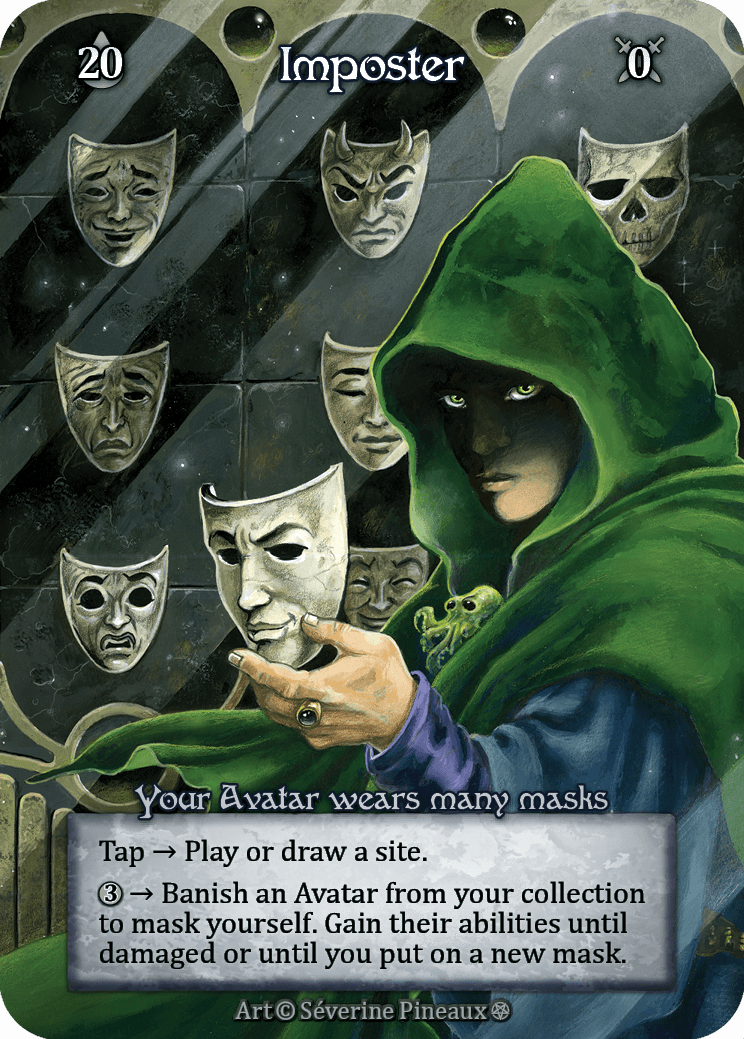
Imposter is an Avatar that I was immediately enamoured with. It has flexibility and power, but is tempered by a meaningful drawback. Playing Imposter asks us to be mindful of our mask. Imposter is flexible, and can easily play any element combination.
There are two main schools of Imposter. The first wants to set the pace of the game and be the aggressor. This way the opponent is too busy dealing with your threats and can’t commit resources to demasking you. This seems to be the more popular version of the deck, particularly with Earth-Fire and Fire-Air builds.
The other school is the more defensive and controlling Imposter that plans to thwart the opponent’s aggression and then find opportune moments to pull ahead. This version needs a plan to overwhelm other controlling lists, such as Archimago, that excel in long games. This is the version of Imposter that I prefer and have tested and played throughout 2026.
But of course, depending on draws and match-ups, games can ebb and flow and you have to identify on the fly whether you’re the aggressor or the defender given the situation. Mist has the flexibility to do well in either situation.
My list began life as Mono-Water. This core of DNA is still evident in the strategy and my card selection. I had success early in the year with Mono-Water, but as the meta matured and players became more familiar with how to play against Imposter, I felt the need to bring in some of my favourite powerful Air cards, particularly Blink, Grapple Shot, and Whirling Blades.
In Mist Imposter, there are multiple different ways to build it. You can lean more into Air, with more aggressive minions. Gyre Hippogriffs in particular are a nasty threat against rival Imposters. You could go heavier into water, and just have Grapple Shot and other one-pip cards. There are also builds that lean on Annual Fair and get to enjoy a bit of everything.
Deck Strategy
This is a deck that looks immediately recognisable when you click into it. There is Thin Ice and Coy Nixie for repeatable minion control. Water has plenty of powerful Uniques that have a strong and immediate impact.
So what makes this deck special? For me, it’s the versatility. This is a list that can use cards both offensively and defensively, making the most of any board state. Scatter and Swap are great examples of this. They can keep you in the game by acting as minion removal, or they can win you the game by rearranging the pieces as you see fit. It is a deck that plays Cores and wants to see them in the opening hand, but will find uses for the mana late into the game.
The deck is exciting to play and has fascinating decision points at every point through the game. As Battlemage, there are plenty of games where the board state feels hopeless. With Imposter, I feel there are always routes to win and chances to salvage a bad situation. This feeling of power and control is intoxicating, and being able to keep the opponent off-balance and second-guessing is a good place to be for competitive play.
My Card Choices – Artifacts
It makes sense to me to start with the artifacts as they demonstrate the unique way in which Imposter plays and the choices that go into building the list.
I always played one or two Cores in my Imposter lists, and enjoyed the occasional busted game where you get it turn one. Then I saw this interview between Zuul and Golden Eagle, and I reevaluated this position.
Zuul identified the power of a turn-one Core and the discrepancy in power that this creates. He went fully into this by playing all four Cores, Key to the City, and Four Waters of Paradise. He played in an event before the Courts were legal, so got to enjoy the last hurrah of this strategy. I was going into a tournament with Courts, so I could be easily punished if I went fully into this strategy.
Four Waters is an easy cut as it doesn’t help with paying for masks. Consulting the hypergeometric calculator, four mana rocks seemed to be the sweet spot, with diminishing returns on the fifth, so I went down to four out of five ‘mana rocks’. I opted for Amethyst and Aquamarine for the threshold fixing. Aquamarine is particularly important in combination with the Ordinary Towers to get explosive turn two plays.
There was a hard decision between Ruby and Onyx Core, as there are corner cases where the threshold fixing is relevant, especially with Mismanaged Mortuary in the mix. Ruby Core allows me the potential to steal the opponent’s Vile Imp with Deathspeaker, so it gets the nod over Onyx.
Key to the City is probably the most important ‘core’. Its versatility as both a defensive and offensive play should not be ignored. Making you immune to damaging sites such as Vesuvius and Mobbed Court is significant in aggressive metas. But it also can be used to get your minions into defensive sites like Gnome Hollows and beat tricky Earth decks.
Amulet of Niniane is my MVP out of this event. You can play it early against Air and Fire decks that want to use Magic Missiles to remove your mask. You can play it on your minions to protect them from Poison Nova and Infiltrate. But most importantly, and this was a meta call, it saves you from being blown up by Major Explosion and Craterize. It also means you are safe on Death’s Door from commonly played kill spells such as Zap, Heat Ray, and Snowball.
Ring of Morrigan is in here, but I am tempted to replace it with a Torshammar Trinket. Ring is nice against Necromancer and other token strategies and the healing can be important. But Torshammar allows your minions to trade more effectively, which is often more significant in winning games versus Ring pings. Overall, I don’t think it’s as powerful as it was in the Beta-AL meta, but its ability to cheese wins means it still earns a spot for now.
Imposter has the card advantage engines to get the most out of all this mana, and Dank Omphalos is a big one. Imposter is one of the big reasons that people are playing Garden of Eden, so you need to be wary of that, but this deck does have more answers than most to sites. Dank Omphalos is a card that single-handedly wins games for me.
Auras
Auras are extra important for Imposter because we have access to Enchantress. I have seen lists that lean heavily into this and plan to go Enchantress every game. For me, this is a potential that can be leveraged, and is powerful when it works, but isn’t something I’m aiming to do.
Atlantean Fate is my pick for the most broken Unique in the game. It can kill multiple minions, deny artifacts, messes with threshold, turns off site abilities, and opens up body of water synergies. The fact that you can then turn it into a five-power minion is cracked.
Acid Rain – I had a difficult time deciding between playing one or two copies. It’s one of those cards that you love seeing the first copy of, but the second copy has massive diminishing returns. I had some bad runs in testing where I drew the second copy too frequently so made the emotional decision to drop to one. Acid Rain lets you win the Water mirror by shutting off the opponent’s powerful sites, such as River Rapids and Thin Ice. It’s critical against Avatar of Air. It shuts off Courts. Also playing it early into the opponent’s void can stifle their ability to place important Genesis sites. This list has flexibility to relocate auras, so you can play Acid Rain aggressively and then reposition it later if required.
The Black Plague is an aura that I’ve seen cut from similar lists. Compared to the Great Famine, hitting the weakest minion often makes it the inferior of the two. But this list has many tools to move the opponent’s minions and the aura itself. One recent game against a Geomancer, I was able to kill six of their minions with it, which is incredible value for a single card. Funnily enough, I lost that game because of Roots of Yggdrassil, but such is the power of the Norse apocalypse.
For other considerations, I have tested Abundance in the past, and it’s a fun combo with Mother, Maiden, Crone to be able to dump huge amounts of mana into the card draw ability. Abundance becomes a five-power minion, but you have to be careful to not give the opponent mana if you attack with it. This is a fun combo that I’ve enjoyed in the past, but doesn’t make the cut for tournament play.
Thunderstorm is a worthy consideration. It can kill multiple minions, facilitates aggressive draws, and is powerful against rival Imposters. But the four-mana slot in Mist is pretty contested.
Honourable shoutout to The Great Drowning of Men. I’ve had so much fun playing this card out of Imposter. It doesn’t work with Enchantress, but when you’ve got big mana, you can do big-mana things.
Minions
Two-Cost Minions:
First up, I want to talk about Winter Nymphs. This is a card that people seem to reluctantly include, but I think in this list absolutely deserves the full playset. If you’re not playing three, you haven’t lost to Saracen Raiders and Redcap Powries often enough.
They are a great defensive play, and it’s easy enough to move them around to allow your minions to not get tapped down. As a Stealth Blocker, they are reliable and hard to remove in early turns, so if you need to throw away a minion to preserve your Pathfinder mask, they do it better than most.
But they also have offensive flexibility. If you can get them to your opponent’s back line, then all their blockers come in tapped, giving you incredible tempo. Stealth can get you Death’s Door kills, especially in conjunction with Swap, and they allow me to remove Aino from my list. I’ve found Aino to be a bit awkward, so haven’t enjoyed playing them.
Next, we have three different two-cost Unique minions. We have Highland Princess to fully utilise our suite of powerful artifacts. Pied Piper is good against Necromancer, which is this deck’s biggest weakness, so he earns his spot. Tom Thumb is one of my favourite cards out of AL. Having two-power is significant and he pulls his weight in the damage race. His one defence power is a liability if Druid is popular, so he’s better this year. You can feed him into the Black Plague. At two-cost, he can often attack and then be replayed as a blocker. He gets hit hard by the courts, but I’d rather run a second copy of Acid Rain before cutting Sir Tom Thumb.
There are some good choices in the two-cost slot. Low-cost minions are important as you need early blockers for your Pathfinder mask. I have played a lot of Adept Illusionists, especially in Mono-Water, but often found them to be too slow. A lot of opponents will often overcommit into getting rid of them because they are such a nuisance, so this can buy you the time you need in a roundabout way.
I have never been a Polar Explorers enjoyer, even in Mist Battlemage. I don’t like that Polar Explorers requires to you to stack your minions up and you can be punished for playing your minions to the wrong site in the early turns before the board has developed. Polar Explorers are good to get around defensive sites, so they’re a meta consideration, but they didn’t get the pick for this tournament.
Highland Falconer is another possibility for this slot, but they conflict with Mock Court, and in a deck that’s already weak to Firebolts and Magic Missiles, I think they’re pretty weak. Whenever I play Highland Falconer, I will always draw their winged friend after my mulligan, so they can be a source of frustration.
Three-Cost Minions:
This section represents the meat and potatoes of the deck, but there is still opportunity for spicy picks and consideration. Lugbog Cat is the heart of this deck, being both an incredible attacker and defender depending on the state of the game. I’m always happy to see this card in my opening hand.
Coy Nixie is the heart of the deck’s power, and really pushes Thin Ice over the edge into broken territory. This combination of two Exceptionals can really just blank big minion strategies. I have seen some people drop to two copies, especially in more aggressive builds, but for me, three is a must. Coy Nixie is a rare example of a card in Sorcery that gets better in multiples.
Order of the Sacred Oak – I wish I could play another three copies of this card. Sinkhole ruins your day and is responsible for the majority of games that I lose. They are of course a great defensive minion, but the Ward allows you can overcommit to an aggressive strategy against decks that rely on Poison Nova. Ward also is powerful against Trinket into Grapple Shot plays so will often be our best defensive three drop.
Fey Changeling is quite popular at the moment. It can be a huge tempo swing, particularly against cards like Gnarled Wendigo. In this Mist list, Fey Changeling overlaps a bit with Coy Nixie, so that’s why I ultimately went to a single copy in this list, but Fey Changeling can surprise with its versatility in solving problems for this deck.
Blue Knight was a late addition to the deck once I was considering the impact that Court of Equity and Mobbed Court would have on this list. One Blue Knight replaces Sir Pelleas. Sir Pelleas was already on the decline in Gothic for me as he gets covered by opposing three-power Ward minions. A Lance token has a lot of versatility, and combos well with the other minions in this list. Lance is also powerful with Whirling Blades. In this list, I couldn’t find room for Torshammar Trinket, so the Blue Knights’ stock rises. You can also use Deathspeaker on a Blue Knight to drop a Lance Token on your side of the board.
Four-Cost Minions:
I’ll begin with Bane of Aventis as he is responsible for how warped our Atlas is. Getting to three Air threshold is a strain on this deck and its consistency. I’ve lost games because of a poorly placed Mountain Peak breaking up my body of water. But Bane of Aventis wins games you have no right to win. Atlantean Fate is my number-one pick for most game-swinging Unique, and BoA is number two. The fact that he’s a four-power as well is just icing on the cake.
Failed Mutation is an absolute champion. The fact that it doesn’t die to Poison Nova is massive, so it combines well with the Order to form an aggressive frontline against Fire decks. Being a Monster is also a huge tick in its favour as it doesn’t get hit by Arjaro Exorcist. There’s a lot going for the Accomplished Mutation.
Sacred Stag – my Gothic hot take is that Sacred Stag should either be an Earth-Water minion or a mono-Earth minion. Water got a plethora of strong Elites in the four and five drop slot, and Stag is easily the best of them. Hyperparasite might slightly beat it out if you have an Airborne-heavy meta or if you want to play Den of Evil.
Abaddon Succubus – she can absolutely run away with some games, combining well with Coy Nixie, but also being able to clean up token minions effectively, undoing early damage from a Necromancer or Geomancer. But four mana is a pinch point in this deck, and I’ve struggled in games where I draw a clump of four drops. She is also one of our only demons, so if the opponent has been sitting on an Arjaro Exorcist, she can be an easy kill. For these reasons, I’m considering dropping her to zero or one copies, particularly if Mock Court successfully pushes out token strategies from the meta.
Ruler of Thul – I said earlier that I wasn’t a fan of Polar Explorer. However, I am a massive fan of Ruler of Thul. He’s another game-warping card in that when you draw him, you can completely change tack. With Mock Court, I removed Plague of Frogs, but with 60-card Spellbooks, this combo almost never came up in a meaningful way. But even without the Plague, Ruler is still a staple. Charge is often way more important than Stealth as a kill spell, so he gets the nod over Aino in this category as well. His interaction with Pathfinder can also be useful and open up some interesting lines to shape the realm.
Five-Mana Minions and Up:
Daperyll Vampire – I am a Vampire enjoyer. They have won me so many games with Battlemage. However, I think in this current Gothic meta, they are often subpar. Five is a lot to spend on a minion without immediate impact and resilience. They will still elicit a groan from the opponent when you play them (instinctive fear of the Daperyll Vampire is embedded in Sorcery players’ DNA), but they often feel fragile and vulnerable for such a big mana investment. Vampires get the spot in Mist as Water sites give them protection from bury effects, meaning they’re more likely to survive the turn.
Hounds of Ondaros – they overperformed for me in this tournament. Their stocks are always in flux depending on what the meta is, but they do well on either side of the Earth-Water debate, so they’re never fully out of the running. Their ability to counter Infiltrate can be critical, especially when there isn’t room for Watchtower in the Atlas.
Archangel Raphael – this guy is Imposter’s best friend. This card is incredible and always overperforms for me. A Ward on your Avatar often wins games by itself. The number-one reason I’m playing Water-based Imposter.
Lord of Lies – the nerf to his ability hit hard. He’s still good, just not insanely broken. With Coy Nixie and Swap, you can set up his ability effectively and get some big swings. With this nerf, it’s safe for Battlemage and Avatar of Earth to go back into the water, so it did need to happen for the viability of whole archetypes in the meta.
The Green Knight – last but not least for minions, the Green Knight is another of the top reasons to play Water. He is incredible against many of the cards Imposter struggles against. One of my favourite interactions is using him to punish decks that rely on Torshammar Trinket, forcing two three-power minions to dive into him. He is a card that can win you the damage race and set up inevitable wins with his Deathrite ability, so his versatility is the capstone to the strength of this deck.
Minion Considerations:
In general after playing this list, the curve is a little wonky. There is too much at three and four, with a bit of a hole in the low end and top end. A lot of the power of the deck comes from being able to play two synergistic cards, but it is lacking in singularly powerful threats. I am missing Mester Stoor Worm in this role.
Minions that you can play before you go into Pathfinder and are resilient blockers are vital for the success of this deck. If you get an uncontested run with Pathfinder, then your chances of winning dramatically increase. When considering the low end of this list, this has to be kept in mind. The strength of going pure Pathfinder over Imposter is that you don’t need to worry about that and can focus on a more impactful midgame. The power of Imposter does come at a deckbuilding price.
I’ve cut a lot of the splashy Water Uniques that Gothic gave us. Aino feels unnecessary for me, as I mentioned when discussing Winter Nymph and Ruler of Thul. Mother, Maiden, Crone is fun but three power is too much of a liability. Lilith is the same. If you need her to hit and you miss, then that’s game over. Evil Twin, and Selfsame, is an interesting choice, but I think get pushed out by the Courts, but Evil Twin does have a lot of versatility and is decent against Gargantula and Charge minions, so could be a meta call.
Sturmgeist is a card I wish I could make room for, but the threes are already too clumped. Lacuna Entity is a staple in mono-water, but becomes slightly redundant in Mist, but I might go back to one copy. Hyperparasite I think is underrated in general and is important if Airborne is popular in the meta.
There are a lot of subtle tweaks that can be made to completely change how the deck feels, such as going slightly more into Air or even dropping the two and three Air threshold cards and going back closer to Mono-Water. If site control becomes too prevalent, then you can reduce the numbers of Coy Nixies and become more aggressive.
Magic
Blink – I love Blink. If my deck has Air, it starts with four Blink, four Grapple Shot and goes from there. Blink has so much versatility and opens up the Grid for you. It works well with Pathfinder. It gets you kills that you otherwise couldn’t. I would love a third copy in this list, but two performs well.
Lightning Bolt / Magic Missiles / Pollimorph – I’m grouping these together as they are a package in my mind. In general, it bugs me to play singletons of non-Unique cards. In many card games it’s easier to look at similar cards and decide that one is the best choice. But Sorcery asks you to cover so many bases, that often it’s better to give yourself the opportunity to draw the exact right card. It’s also important to consider the impact of drawing a second copy of a card and the diminishing returns on it. If you already have one Magic Missiles in hand that isn’t helping, the worst card to draw is a second copy of it. Archimago does make it easier to run a spread as you can double dip later.
Grapple Shot – I love this card. I’ve played so much Battlemage, that I probably overrate this card. What pushes it over the edge for me in this deck is that you can easily get to six-plus mana so you can play a four-power minion and Grapple in the same turn.
Whirling Blades – early in the Gothic meta, I found I won every game where I drew Whirling Blades. I was testing Mono-Air Pathfinder and Earth-Air Battlemage alongside my Mono-Water Imposter. So when Mono-Water Imposter began running out of steam and feeling like it wasn’t quite cutting the mustard in the meta, I knew who to turn to. Minions in Gothic have more resilience in this meta so you’re more likely to start the turn with a minion on the board. There is a case to be made for three copies of Whirling Blades and two Grapple Shot, and a range of other combinations, so this comes down to personal preference.
Swap – Swap is incredible. In Necromancer, Swap is always three copies. Without access to tokens, Swap is slightly less powerful, so I’ve gone down to two copies in this list, particularly since I’m also playing Scatter.
Scatter – credit to Count Tolstoy for bringing this card to my attention earlier this year. Scatter is one of those cards that looks good on paper, but until you play it, it’s hard to evaluate just how good it is. Scatter punishes Avatars holding Artifacts, letting you steal Rings, Cores, and various other toys. It can separate blockers, giving you access to kills your opponent cannot play around. It’s fantastic with Auras, particularly Black Plague. The number-one reason I have two copies of Scatter is that in the Auckland meta, we have a fearsome Ironclad-Imposter enjoyer, who loves turtling on Gnome Hollows with a Golden Harp.
https://youtube.com/shorts/UW2CHNyLUg8?si=MBpCWif6pozkzkuL
Scatter lets you break up the combo and get a win by pushing the Avatar off Gnome Hollows and the Harp in the other direction so they are no longer nearby (as long as the Hollows isn’t on their back row).
Four copies total between Swap and Scatter is a good number, and this could easily be three and one in either direction depending on what threats you need to counter.
Mesmerism – I’ve stopped myself from typing ‘this is the best Unique in the game’ several times now. I already gave it to Atlantean Fate and Bane of Aventis, so I have to stick to that. Mesmerism is busted. Just make sure you have the four Water threshold before windmill-slamming this card. Getting two slices of this cake with Archimago is busted.
Considerations:
I’m already stretching the threshold requirements for Bane, so why no Browse? This is a personal preference. I chose to play Mono-Water Imposter to not get screwed on threshold, so it was a big risk going back to such heavy Air requirements. BoA can turn games around in a way that Browse cannot.
Plague of Frogs got the cut with Mock Court in the list. Mono-Water relies heavily on Snowball, but this isn’t as necessary in Mist with access to Whirling Blades and Grapple Shot.
Into the Abyss and Call of the Sea are good considerations, but one of the way I’ve lost with this list is by getting my body of water split up by unlucky Pathfinder hits. I would like one copy of Call of the Sea, but there’s already several cards fighting for that spot.
You could alter this list to be heavier in favour of Water, in which case you can replace Riptide starts becoming more useful than Blink or running a combination thereof.
Sites
The biggest reason to play Mist Imposter are the powerful sites you get to play. In general, Water sites being resilient to bury effects is meaningful and gives your minions such resilience. Auckland Grand Contest was Earth-dominant, so I benefited greatly from this choice.
3x Troll Bridge / 3x Thin Ice – these are absolute staples. Taxing your opponent for stepping on your sites is one thing, but when your sites become repeatable minion removal, it’s over the top. These six Exceptionals are the number one reason to be playing this archetype.
2x Wuthering Heights / 2x River Rapids – these sites support the Troll Bridge and Thin Ice plan, but also give massive reach to your minions. If you’re worried about Angry Mob and Gargantula, you can use these sites to play your minions to your back row without a movement penalty. This also benefits Imposter as you can play minions defensively and then launch them forward into the attack. You can also play these sites up a row, which then lets you launch minions on top of your opponent’s Avatar, helping with the Interrogator plan.
The Void – this site is a risk. It’s one of the worst sites to see in your opening hand when you need to hit threshold, but late game is the best site in the deck. Just be careful that you don’t give your opponent the chance to sit their Avatar here to turtle. Imposter has zero power, which means you might struggle to finish them on Door. Scatter helps remedy this, at least.
3x Babbling Brook – a versatile role player. I enjoyed this site more when I had Overflow, but it still pulls its weight without it. You can use it to try and high roll an early Pathfinder mask if its in your opening hand. But it stays as it’s one of the best sites to flip off the top when you’re Pathfinder to help smooth out the midgame and when trying to win a damage race. Just make sure to use your minions before you tap Pathfinder in case you flip this over and watch out for popping your own Wards.
1x each of Dark / Lone / Gothic Tower – I’ve seen lists with multiple copies of each. In this list, I like just the one copy of each for a pop of potential power. You could even drop a copy or two in favour of other utility air sites. In this Water-heavy list, they can be awkward and you might not have the threshold to take advantage of them in the early game, but you can high roll big plays by getting one of these in the midgame.
3x Floodplain, 1x Deep Sea, 3x Mountain Peaks, 3x Lighthouse – these are for threshold requirements. I think the days of Root Spiders getting drowned solely by Floodplain are over, but with Waveshaper in the board, you do have some reach to dunk them. Floodplain can help fill in the gaps that disrupt your body of water, which is important if you want to use Avatar of Water or Waveshaper.
Innsmouth Dock – this is a site that I often see cut from Mist lists, and I think that’s a huge mistake. The biggest strength of this card is that it works on your minions. If you play this forward, you can attack your opponent’s site and then pull your minions back on to the safety of a water site. It also provides crazy coverage for your Nixies and Succubus as you can tap to move them up, use their abilities, then pull them back into the safety of your back row.
2x Mock Court – I was struggling against Water-Air Necromancer in the lead-up to the Grand Contest. Mock Court gives me some game against that deck, but more importantly Mock Court just being in the meta scared off some people from playing Necromancer entirely. Geomancer and Archi that play Foot Soldiers can give Imposters problems as well, so I think it’s worth having them in the list. The list plays no Ordinaries and there isn’t even that I would want to, so it’s completely free to run. This is a flex spot in the list, so you can replace them if there’s popular effects that you’re worried about.
Considerations:
Mirror Realm – Mirror Realm is at its best when you have Elites and Uniques that get way better in multiples. My favourite target for it is Island Leviathan, for example. Mirror Realm works well with the forced movement sites in this list, and is good with Thin Ice and Troll Bridge. Generally for me, the more demanding my threshold requirements are, the less relevant Mirror Realm is, as often you need different threshold rather than more of what you have in the realm. If I cut back on Air threshold in this list, then Mirror Realm becomes more of a consideration.
Mismanaged Mortuary – it was a meta call that I didn’t play this site. I anticipated that I wouldn’t play against Archimago. There’s only a couple of Archie enjoyers in the New Zealand meta. Flamecaller is the bigger risk and the Mortuary hoses this deck, but again I used meta knowledge to guess that Flamecaller wouldn’t be an issue. Mortuary doesn’t stop Deathspeaker, but I wasn’t expecting any of them either. If you think Mortuary will be important for your event, then you do need to find room and tweak the deck accordingly as it does do a lot of work against these two Avatars.
Air Utility Sites – to name a few, Watchtower, Perilous Bridge, Observatory, Fields of Phyxis, Ruins (for stealing the opponent’s Vile Imps) – Air has some incredible utility sites. The two Mock Court and three Towers can be replaced with any number of sites.
Playing Against the Courts
The Courts get constantly mentioned throughout this article as they are the newest thing to impact the meta. Overall, I like the influence the Courts have had in shifting the perceived value of a lot of different cards.
For this list, Mock Court and Overflowing Court are a non-issue. Mobbed Court is the biggest threat, and Court of Equity can be a problem.
Overflowing Court can potentially stall us, but I think that’s manageable. This list could itself play Overflowing Court, especially if Mobbed Court becomes an issue. The life loss from Mobbed Court can really stack up, and if they play it in conjunction with Vindictive Nation, then our Acid Rain and Atlantean Fate get hit twice.
Court of Equity is manageable, but there is the potential it can destroy certain opening hands. I have cut a lot of the top end mana-expensive cards to mitigate this. I think in a lot of cases, this deck is fine playing a three-cost Core and can find an opportunity to do so when committing to a defensive game plan. If Court of Equity becomes a meta staple, then you can cut a Core or two. The strength of Water and Air is that it has incredible Exceptional minions, so the core of our strategy is unaffected. If the meta is heavy in both Mobbed Court and Equity, then that might force us to lean more into heavy Air or heavy Water, as we’ll either want to remove Highland Princess and Cores to be heavier Water or take out the top end Water Uniques and become a more aggressive Air build.
Collection
And after all that, we get to perhaps the most important part of playing Imposter, the Collection. Having access to 10 different Avatar abilities is a massive boon.
Whilst 10 different Avatars is the default, it is totally feasible to play other Collection cards accessed via something like Toolbox. It does take a disciplined approach to cut some of the utility and corner case Avatars, but it is justifiable.
It’s also important to consider Avatars with abilities that don’t have a tap cost. This allows us to chain multiple masks in a turn for some interesting plays. This a reason why it’s important to have access to a lot of mana, so we can unlock interesting combinations.
I’ve ranked the 10 Avatars I’ve picked for this deck and ranked them by how important I view them.
Essential:
Pathfinder – this is the reason to play Imposter. In many ways, it’s almost too good. We get the card advantage of not having to draw sites into hand without the singleton Atlas penalty. The biggest learning curve with Imposter is knowing when to go Pathfinder. Generally, the earlier the better, but you want to time it to gain maximum value.
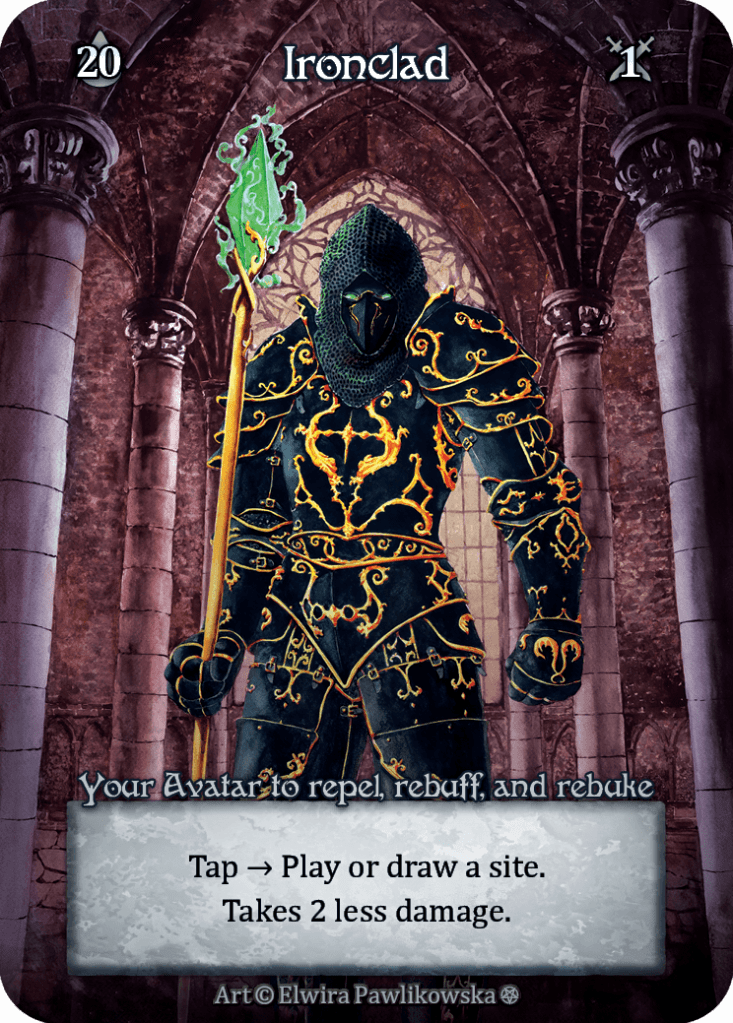
Ironclad – Ironclad can win games you have no right to win. Some Imposters lean heavily into the turtle plan and play cards like Golden Harp. I am a big fan of Amulet of Niniane as it nullifies a huge chunk of cards that players rely on to close out the game.
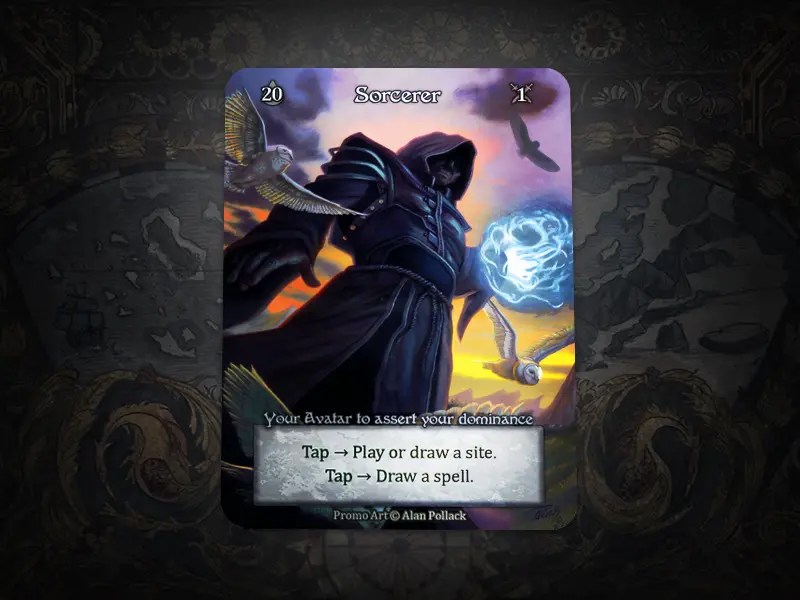
Sorcerer – the games where you get three or more free sites via Pathfinder and then get to draw two cards a turn for the rest of the game are the ones you just win. There are also plenty of games where a single extra card draw is all that it takes, so it’s important to use the masks freely and get the same advantages where you can.
Important:
Archimago – Archie gets relegated to Important and not Essential in this list. With only 15 magic spells, there will be plenty of games where you don’t get the opportunity to use him. Most games, Archie just gives you a guaranteed win via replaying a Grapple Shot.
Witch – I am a big fan of the Witch as she can influence the game like no other Avatar can. In a race, getting an additional two damage a turn can make all the difference. More importantly is the taxation ability. Being able to delay your opponent from dropping a Craterize can be the difference between winning and losing, and is usually telegraphed by how they draw sites and minions. Taxing them on the turn they want to play an Earthquake or Poison Nova is also another vital moment in the game. The Witch also being a counter to Battlemage and Avatar of Earth can also come up and is free with the first two abilities.
Enchantress – the biggest benefit of Enchantress is that it counters opposing Enchantress. It is a headache learning all the rules interactions that it involves, but it’s definitely worthwhile to do so. Being able to use void spaces to banish auras is great. Or being able to drown the opponent’s auras with a Thin Ice is incredible, but it requires correct site placement of two-by-two Water sites underneath the oversized aura-minion. There’s only three Auras in my list, but I have won games solely off the back of combining Enchantress with Atlantean Fate or Black Plague. Plus having Enchantress in the Collection means we don’t have to play a Disenchant in the Spellbook.
Useful:
Avatar of Air – AoA gives you some movement utility and can puff your opponent’s minion on to a Thin Ice. It can be a bit tricky to fully utililse AoA as Pathfinder can make suboptimal site placements and then you also have to be on the correct site. Most often it’s used to reposition myself to either turtle with Ironclad or position a minion for a Grapple Shot. AoA comes up for me maybe once every five games, but when it does it feels significant to justify a Collection slot. If you want to play Mist Imposter and don’t have access to Avatar of Air, you can easily go without AoA.
Deathspeaker – Deathspeaker is an Avatar that is on the bubble of being cut for me. I’m only running a few Genesis minions, so it comes up far less often than Archimago. It does allow you to access the opponent’s cemetary. If Henchmen inspires more Deathspeaker in the meta, then leaning into this mask and having more threshold coverage could be useful. Lance minions can be replayed with Deathspeaker to summon a Lance token, which is a neat trick.
Waveshaper – in Mono-Water, this is such a crucial Avatar (Avatar of Water also did some fun work in that list). It helps you win minion matches and buy time to draw into a better answer. Waveshaper works well with Coy Nixie type effects and Innsmouth Dock to get multiple minions pinned down by the Waveshaper. The downside in this list is that you can easily have your body of water broken up by bad luck or an opponent’s Earthquake.
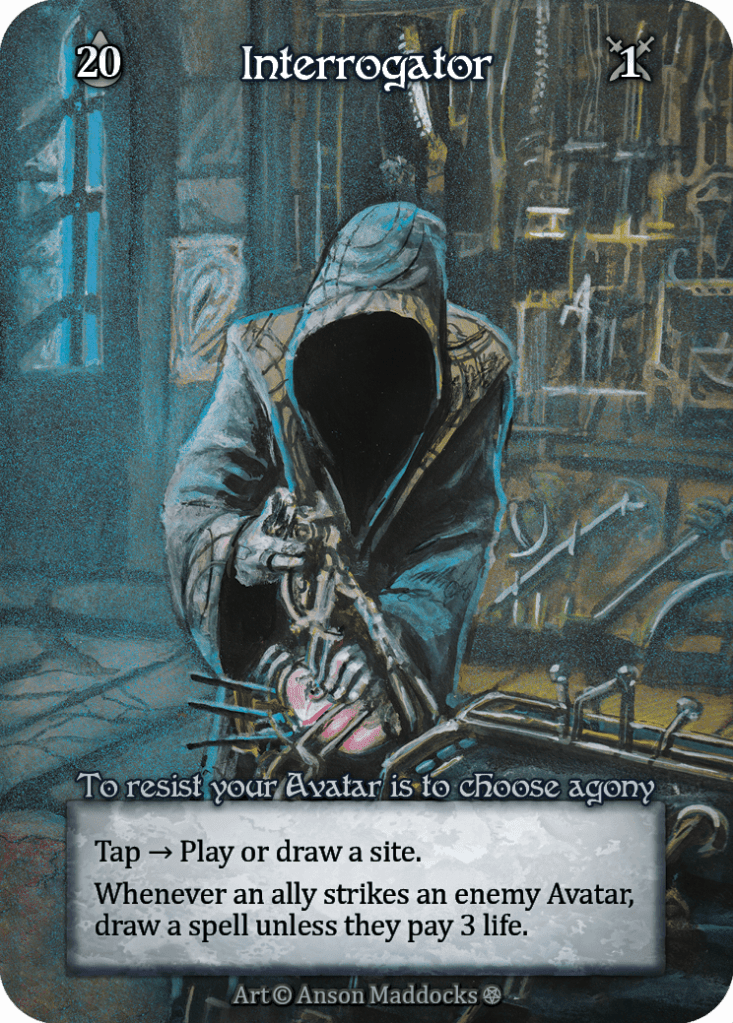
Interrogator – Interrogator makes the Collection as I’m playing a lot of mana and I need all the card draw I can get. It is actually reasonably challenging to get this ability off. In the early game where you can sneak a minion through, often you’re not ready to move off Pathfinder. And in the midgame, a single trigger is often worse than just going either Witch or Sorcerer and getting exactly what you need. Generally, Interrogator comes up when I have a minion that can Door the opponent anyway, but I need card draw to increase my odds of winning the following turn.
Other Choices:
Geomancer – I like Geomancer in Imposter that’s playing Sinkhole. You can go Geomancer, pop Sinkhole, steal their site spot, and then Geomancer again the following turn to replace the Sinkhole rubble. I had considered it as a potential counter to Roots of Yggdrassil, but I don’t think it can actually salvage those games where you’re devastated by Roots. By the time you get back up to three mana to go Geomancer, they will likely have one minion to your zero and demask you anyway. If you fear Roots, Order of the Sacred Oak is your best bet.
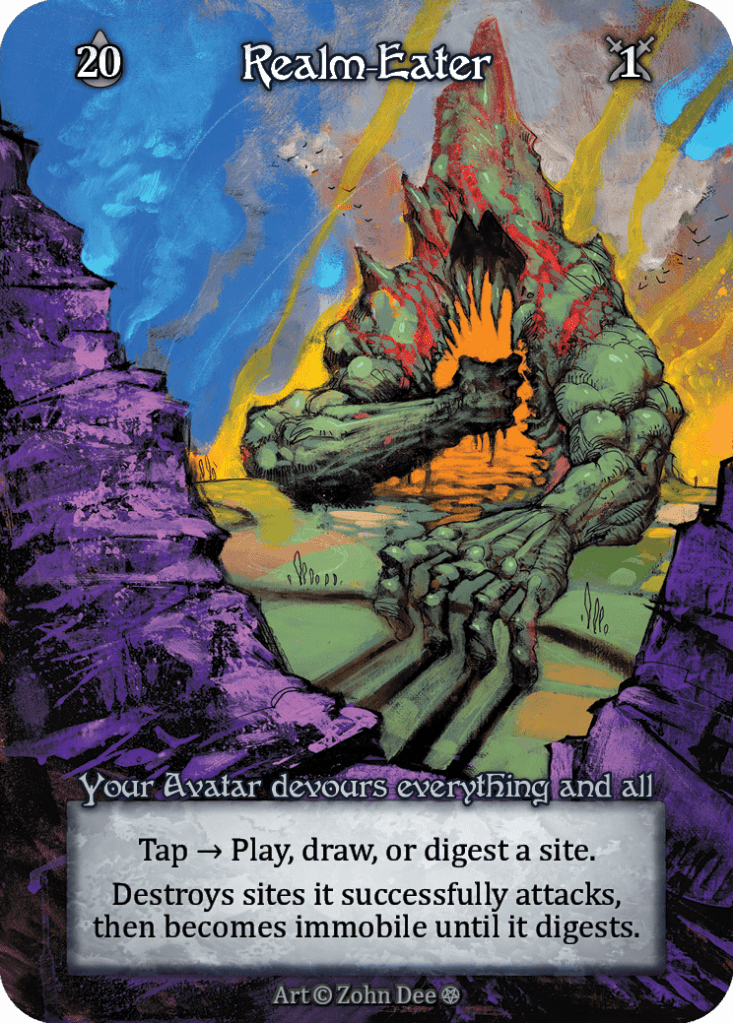
Realm-Eater – I enjoyed Realm-Eater earlier in the year, and it did some nasty stuff. It pairs well with Geomancer. Currently, if you lose your Realm-Eater mask as Imposter and have a site in your belly, you will be permanently Immobile with no way to remedy it. For this reason, Realm-Eater gets the cut, but the fact that Realm-Eater can eat a Gnome Hollows to potentially win the game is worth considering.
Avatar of Water – I mentioned this in the Waveshaper section, but it is a consideration for this list. Being able to tap to cross the entire board can put you in a winning position. Pair this with an Ironclad to then turtle, or a Ring of Morrigan to spike the opponent. But in this current version, there’s too many opportunities for the body of water to be disrupted.
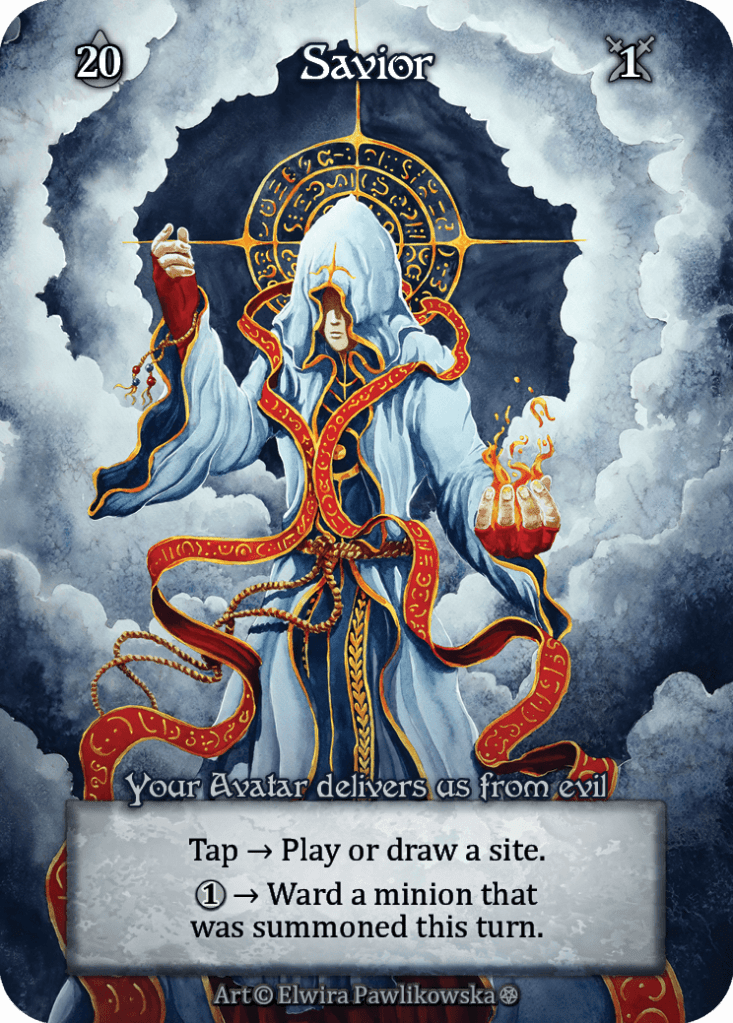
Saviour – I’ve never liked Saviour in Imposter. It easily becomes too expensive, and in Mist there are too many evil minions for it to be reliable. I think for the mana investment and the situations it demands, it doesn’t quite earn a spot for me.
Necromancer – I think there are better B and C plans for this deck than going Necromancer. It does help that the Skeleton can defend your Avatar, so it’s kind of self-sustaining whilst you do other things, but I can’t imagine the games where that’s a better defensive line than going into Waveshaper.
Flamecaller – if you are playing Mismanaged Mortuary, you can play Flamecaller to ruin the day of anyone playing Fire. I think generally if you get a Mortuary against a Flamecaller, you’ve already won, but this is a beating.
Other Builds
This list popped up on Discord just before I went to post, and I think it’s a great example of how similar lists can be quite different. Congrats to Sedge for winning this Cornerstone with Mist Imposter.
https://curiosa.io/decks/cmt6q0xf300wu04l8hqcwxa7r
Sturmgeist is a great choice. I would be interested to hear how Assimilator Snail performed. That’s a card I haven’t tested much. With two Selfsame as well, there’s some good tech to use the opponent’s minions against them. I refuse to play Chaos Twister as I cannot trust my dexterity in a high-stress tournament, but it is a very powerful card. Bottomless Pit is a nice choice in the board, but I value it less because there is a very experienced Avatar of Air player in my meta, so the Pit is a liability for me. Overall, this list looks like a slightly more aggressive version of mine. So, great work, Sedge.
In Conclusion
I hope this primer will be useful for anyone considering Mist Imposter. This deck might look obvious on initial glance, but there are so many small decisions that all accumulate and determine the final list.
My biggest piece of advice for playing Imposter is to practice. Its main strength is being incredibly flexible, but you need to internalise your options so you don’t run out of time in your round or miss a line.
If I was going to Avatar of the Realm or another Grand Contest this year, I would likely play this deck. Imposter has been a massive part of my 2026 Gothic experience, so it joins the immortal ranks of my previous champions Elementalist and Battlemage. I will try new Avatars for the rest of the year now that my tournament season has ended. With Frostmage vs Lavamancer, I am liking the looks of Frostmage. It looks like it can play a tricky and aggressive game, similar to Mist Imposter. Frostbolt gives incredible power to Mist Battlemage, so I definitely want to give that a go. With 69 total new cards in the set, who knows what will stand out?