The long-awaited Dragonlord set is here. 13 incredible new cards, featuring the amazing art and lore of Ed Beard Junior, and the designs and mechanics of Sorcery Contested Realm. I want to give a massive congratulations to Ed Beard Junior and the team at Erik’s Curiosa for what they’ve achieved with this project.
I’ve had a weekend to think about the cards, test some out, and design a couple of decks. Overall, I’m incredibly positive on this set. The cards give new life to existing decks, there are new strategies and archetypes to explore, and I’m reassessing Gothic spoilers through a new lens.
Two for One
My favourite part of the design of Dragonlord is that this isn’t a 13-card set; it’s actually 20 cards. The Dragonlord Avatar is actually eight different cards in one. Each Unique dragon minion in this set pulls double duty as a strong minion and as a mode for the Dragonlord. Note that Kairos the Archivist doesn’t work with the Avatar as you cannot pay for its genesis ability during setup.
1 of 13 Foils Collected
I am a fan of foils. They are a great thing to collect or to bling out decks with. I think it will be incredibly difficult to complete this set in foil for one major reason. People will open their Dragonlord box, see the foil and have a reaction along the lines of, “Oh, that’s cool… Wait, what’s that? Whoa, that’s amazing!”
Then they turn it over to the full-art back, “I didn’t see that before! Dragons are awesome. I love this card.”
Then it gets put in the front page of their binder as a reminder of the time and place where they opened their Dragonlord set.
So good luck to anyone going for 13/13.
My First Weekend – Water-Earth Pathfinder
Before release weekend, I had been playing my Water-Earth Pathfinder deck. I needed a bit of a break from Battlemage after spending a month playing it exclusively and writing over 10,000 words on it. Please read my three articles about Battlemage and the upcoming Cornerstone events. What I’ve typed will be a window into my madness.
This Pathfinder brew wanted to achieve two things. First it was to be a deck where I could use my awesome new soldier tokens from the Dust Store. Secondly, it was to see if I could break Helpful Hob. Now, these two missions might seem antagonistic: Hob wants big minions, soldier tokens aren’t big minions. But there’s two things that tie the room together. First is that Hob lets Pathfinder ramp, allowing you to cast your bigger minions sooner. Then with more sites in play, Border Militia and Guards! become stronger, so your soldiers scale with the game. Then the soldier tokens can be Shapeshifted and be the big minions.
I was having so much fun with this deck, that I decided to add some Dragonlord spice to it on release day and keep rolling with it. I added Shrine of the Dragonlord, Talamh Dreig, and Vatn Draconis. Each of these cards were incredibly fun, and made for some incredible moments. My favourite play was Shapeshifting into Talamh Dreig on turn four, equipping Grim Guisarme turn five and hitting for 20.
Is Helpful Hob broken? Maybe not, but he is very, very useful in Pathfinder. He can be ramp, a power-doubler with a big minion, a movement spell, and then a blocker to boot. He won me games as a top deck, and four copies in this deck didn’t feel egregious. In Water-Earth, you don’t have too many similar effects, so give him a go!
Here is the decklist as it stands now. It’s a lot of fun. I also wanted to play Sir Yvain as he’s one of my favourite knights from Arthurian Legends, so there is a beast package as well, but that’s on the chopping block if I wanted to make this deck more refined. So here is my Soldiers, Beasts, and Dragon Pathfinder brew:
https://curiosa.io/decks/cmdwb27jz00rkla04h2bgoie0
First Impressions of the Cards
I’ll go through the cards now, giving my impressions and ideas for potential strategies and decks. I think there is a lot to discover, and I expect some creative brews to pop up over the coming weeks.
Dragonlord Avatar
There are currently eight modes that the Dragonlord can be. As I go through the eight minions, I will also talk about the Avatar mode at the same time. As I mentioned above, this is fantastic design and allows us to get a lot of mileage from this set.
Caelestis
There’s a couple things to keep in mind with Caelestis. You still need to meet the threshold requirements of the dragon you’re casting for zero. Considering the wide variety of threshold requirements across dragons, it might take a bit of work to squeeze them all in to one deck. You also need to meet normal summoning requirements, so you’ll need a Summoning Sphere to cast dragons on your opponent’s sites.
So Caelestis does require a bit of work as a minion. I think it will be more fun as the Dragonlord.
Dragonlord-Caelestis allows for an interesting strategy. Spend your first three turns deploying sites, hopefully hitting the demanding threshold requirements. Wedding Hall is interesting as it delays you a turn, but it might be more consistent than other combinations.
Then from turn four, tap to deploy one big dragon a turn. It will be interesting to see if this is sufficient pressure to win the game. At least with Airborne dragons, you can get around sites that might otherwise completely shutdown other big minions, such as Bottomless Pit and Perilous Bridge.
Here is a quick deck I threw together:
https://curiosa.io/decks/cmdwez2hl00t9l5048x5krj46?tab=settings
Having to pay three and tap is pretty tough as it limits your ability to develop your board. You’ll need to find opportunities to tap to draw and play sites. You don’t want to overextend your board, and have all your dragons wiped out by one Earthquake.
Excalibur and Gilded Aegis are interesting as they provide protection for a big dragon and can be played the turn before tapping to deploy one. Rescue also feels pretty vital to get a critical mass of dragons. Blink and War Horse on turn two are important to get the Dragonlord in position so your dragons don’t have to waste a turn moving up themselves.
This feels like a deck that just gets destroyed by a strong fundamentals deck such as Avatar of Air, but I’ll give this a test and see how it goes. Perhaps it needs some cards from Gothic to make it tick.
Adtonitum
Zap, zap, zap. Every movement spell comes bundled with a Lightning Bolt. Adtonitum is so much fun, and there is a card spoiled in Gothic that goes nuts with it. Check out the spoilers on SorceryTCG.com and see if you can spot it.
As the Dragonlord’s ability, this allows you to build a whole deck that exploits movement effects. It does require a bit of ramp as you need three to activate the Dragonlord first each turn and then enough mana to play all your spells. Merlin’s Staff is a great payoff to this strategy.
My prediction is that Dragonlord-Adtonitum will be a meta contender. Movement is such an important part of the game, so anything that can leverage or get additional value from movement is just inherently strong and versatile.
Draco Corvus
This card makes me laugh. I can just imagine this dragon shuffling around like an old crow, suddenly swiping lightning fast and stuffing someone in a hole, cawing all the while. It just has incredible Jim Henson vibes. This is also the foil I opened, so he’s my special shiny crow boy.
Stealth and Airborne makes for a versatile and flexible attacker, and his ability lets it beat bigger minions. The ‘tapped minion’ clause is a bit of a limitation, but I can see board states where Draco Corvus is sitting menacingly in stealth and the opponent can’t make effective attacks without opening up their minion to be buried the following turn. Throw in a Border Militia, and your opponent might really struggle to find effective lines.
As the Dragonlord, I think this might be the least commonly used as it’s more reactive than proactive. Most decks are built with a more active game plan in mind. But having removal always available to your Avatar ability is nice. If the meta shifts towards more big resilient minions like Seirawan Hydra, then Dragonlord-Draco Corvus is a nice answer to that. In this way, Draco Corvus is a nice safety valve to the other cards in this set, so that’s a nice design touch.
Ignis Rex
The most dragon dragon. As a minion, Ignis is pretty straightforward. He’s a big minion that you can play if your Fire deck can support it. The ability is useful, and Immune to Fire damage is actually quite powerful.
As the Dragonlord… Well, poor Avatar of Fire, Dragonlord is just so much better than you. This is also one of the more reliable self-discard effects we have currently, so opens up avenues for reanimation effects, like Raise Dead and Boneyard. Going into Gothic, I’m sure we’ll see plenty more options as well, so don’t assume that Ignis Rex is just a boring one-trick pony-dragon.
Moonsong Talagelum
If you have a Grey Wolves deck, throw away one wolf, add one Moonsong. If your Wolves deck was Earth-Water for Geyser, then you might need to retool.
It’s interesting as the Dragonlord ability because I think Talamh Dreig might be the better choice in this deck as it’s a backup plan to board wipes, such as Poison Nova. Sure, the ceiling is higher with Moonsong, but the floor is lower.
However, to Moonsong’s credit, there might be situations where you don’t have more Grey Wolves in hand, or don’t want to play more, so being able to pump the ones you have on the board with your Dragonlord-Moonsong Talagelum might provide an important breakpoint to overcome the opponent’s forces.
I’m sure the Grey Wolf aficionados will solve this one, and we’ll hear all about it in Discord. #TeamFrog
Talamh Dreig
As a minion, this dragon is a lot of fun. It’s easy to get to 10 power, which is obviously great with Grim Guisarme. It is surprisingly resilient with immunity to forced movement. Bury and Earthquake won’t work. Avatar of Air can’t puff it into a Bottomless Pit.
Dragonlord-Talamh Dreig has to be compared to Avatar of Earth and Battlemage. Dragonlord has more flexibility with deckbuilding than Avatar of Earth and a more flexible playstyle than Battlemage.
What I like about Talamh Dreig Dragonlord is that you don’t have to overcommit minions to the board. You can play a big one, like Pudge Butcher, then if the opponent plays around it or removes it, your Dragonlord can just activate and chunk the opponent for five or six. If the opponent plays around shutting down your Avatar, then your minions are strong enough to hold their own.
Just be careful with your Blinks and Grapple Shots as you can’t activate your Dragonlord and then use these, as these are forced movement effects.
Vatn Draconis
Vatn has a lot of play that isn’t immediately obvious. Water has to be the element that has to do things differently. The mono-water dragon of course doesn’t have Airborne and an ability that isn’t about damage. Water makes you work for it.
The turn you play Vatn, it provides immediate value by drowning your opponent’s belongings. Then being submerged, is resilient and evasive. If you can flood your opponent’s sites, Vatn can slink over and get in some sneaky damage.
As the Avatar choice, it’s very strong defensively. Similar to Draco Corvus, but this doesn’t require a tap. This is strong with Riptide and Undertow, and water decks that were relying on Mariner’s Curse can retool to Dragonlord-Vatn Draconis. If you can flood the opponent’s side of the board, this also turns your submerge minions into Gneissgnath Gnomes. This is also quite fun with symmetrical effects like Horn of Caerleon that function on ‘nearby’, as you can bring them up on your turn and then drop them back down at the end of turn.
I’m hoping Gothic gives us a bit more flexibility with flooding sites to boost Water’s power a bit and unlock strategies like this.
Xeraphine Konrul
As a minion, this compares to something like Riddle Sphinx – a big flyer that draws you a card. Xeraphine gives you your choice of card, at the cost of requiring a sufficient mass of minions in the cemetery to keep it up. The ongoing value this can generate is pretty incredible, making it a must-remove minion. But with more cemetery hate being played in the meta, this can be risky.
Of all the Dragonlord modes, this feels the most unique. I have seen a lot of people dismiss this as just a worse Deathspeaker, but this isn’t the case. Deathspeaker needs a critical mass of value Genesis minions, can only recur each minion once, and the recurred minions don’t have a board presence.
Dragonlord-Xeraphine can recur the same minion multiple times, and make full use of their board presence. This makes minions like The Green Knight or Sir Mordred incredibly useful. This also allows you to use value engines like Mother Nature.
Deathspeaker also struggles to close out games, so it relies on combo finishers like Nimbus Jinn. Dragonlord-Xeraphine can just replay big finishers like Infernal Legion again and again.
Kairos the Archivist
Shahrazad… If you know, you know. Kairos creates a mini game by threatening to turn back time. This is a card that I hope to see occasionally, but I hope there isn’t some crazy strategy found to make it meta dominant. It’s an incredibly flavourful card, but if my opponent plays this in the final game of a tournament, my brain will fall out of my ears.
As I said at the top of the article, Kairos doesn’t work with the Dragonlord avatar, which is definitely a good thing.
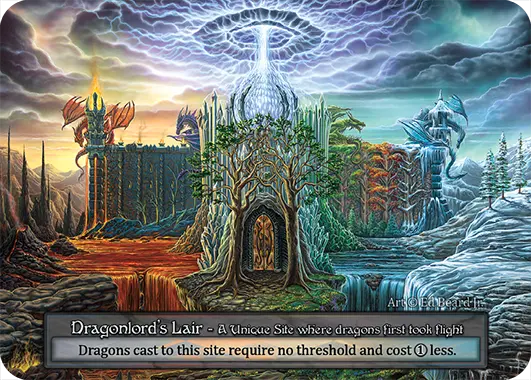
Dragonlord’s Lair
With release weekend, this seems to be the card that people are most excited about. It’s the one site in the set, and has incredible art displaying the world and creation of Ed Beard Junior. I can understand why its popular, but it will be interesting to see if it holds the top spot.
My favourite combo with this is Camelot, as you can stack the cost reduction and get your big Unique dragons out a turn sooner. It’s very splashy, and the one game this weekend where I managed to do that, I didn’t draw any Unique dragons to take advantage of it.
This site suffers from the same problem that Tournament Grounds does. You get incredible consistency in the games you can play the site, but your plan can suffer when you don’t. With 30 cards in the Atlas, this is even more problematic for Unique sites. So when deckbuilding with this site, consider the games you draw this as outliers and build your deck to function without it.
Cradle of Etherrum
I think currently it’s a bit of a mistake trying to make a dragon tribal deck work. I don’t think there is a critical mass of dragons to really make the strategy pop off, especially if you don’t include Azuridge Caravan. Combined with the inherent inconsistency of Unique cards, it’s hard to build a strategy around this one. Hopefully, we get a few more Ordinary and Exceptional dragons in Gothic to help this out, but my guess is that we will either get zero or one dragon in Gothic.
Here is a quick Seer dragon tribal I put together to test dragon tribal:
https://curiosa.io/decks/cmdwbmu4y011vjp04nhl291h6?tab=view
I like Seer as it helps you draw appropriate cards for the stage of the game. It also prevents the games where you draw a Mix Ignis and no minions or vice versa.
Shrine of the Dragonlord
This is going to be the most discussed card of the set over the next few months. People will argue whether this is so good that it goes in every deck, or if it’s not worthwhile and goes in none.
Where Four Waters of Paradise is the two-cost version of the Mix cycle, Shrine is the two-cost version of the Core cycle. But where Four Waters doesn’t provide long-term threshold consistency, Shrine of the Dragonlord fixes it permanently. In the Pathfinder deck I listed above, a turn-two Shrine was just so powerful. I’m currently leaning on the side that it goes in every deck, but we will see.
The biggest thing to note is that the mana isn’t generated on the turn it is played as sites only generate mana when they enter the realm and at the start of your turn. Being a monument, the Shrine is more resilient than Cores that have to be carried as it’s harder for your opponent to purloin it. Just be wary of anyone bearing Land Deeds – or anyone working for the British Museum.
The Genesis effect is also a nice little addition. There will be one game where you can blow out your opponent playing a bunch of dragons with it. Play this late game, scoop up all the dragons, drop a Cave-In, and bury them all. Make sure you take a picture of your opponent’s face afterwards.
Conclusion
Dragonlord is fantastic. It’s improved decks I already have and got my brain churning with new ideas. Over the weekend, I had some incredible games, and the Dragonlord cards were so incredibly steeped in that distinct ‘Sorcery’ flavour.
One game with my Pathfinder versus Geomancer, my opponent and I completely filled the board. We were both dropping masses of soldier tokens on the board thanks to Magellan Globe, and we were just laughing at all the crazy haymakers from big spells and big dragons. “Now, this is Sorcery,” I said as I threw down a Talamh Dreig.
I sympathise with people who’ve been unable to get a copy of Dragonlord this weekend. I recommend trying out the cards on Tabletop Simulator or borrowing a dragon or two from a friend to test out a build in the meantime. Hopefully more copies of Dragonlord become available soon. Don’t forget that you can also compete to win a copy at all first-round Cornerstone events.
Feedback Requested
With these articles, I’m opting to save time by going barebones with graphic design. One of the goals of this blog is to create a writing portfolio to aid my professional career. So the more time I can spend on writing, the better.
My personal preference is to have Curiosa open in another window to look up cards as I’m reading articles and watching videos, so I don’t need images within the article. I also mention so many cards that if I included a graphic for each one, the article would be a mile long.
However, if this isn’t your preference, it would be good to know so I can improve the overall reading experience. Feedback is always appreciated.
Thank you for all the positive comments I’ve received so far. It really does go a long way to keep up my motivation.
 Bardsword Sorcery Blog
Leave a comment